
 Aksh
Aksh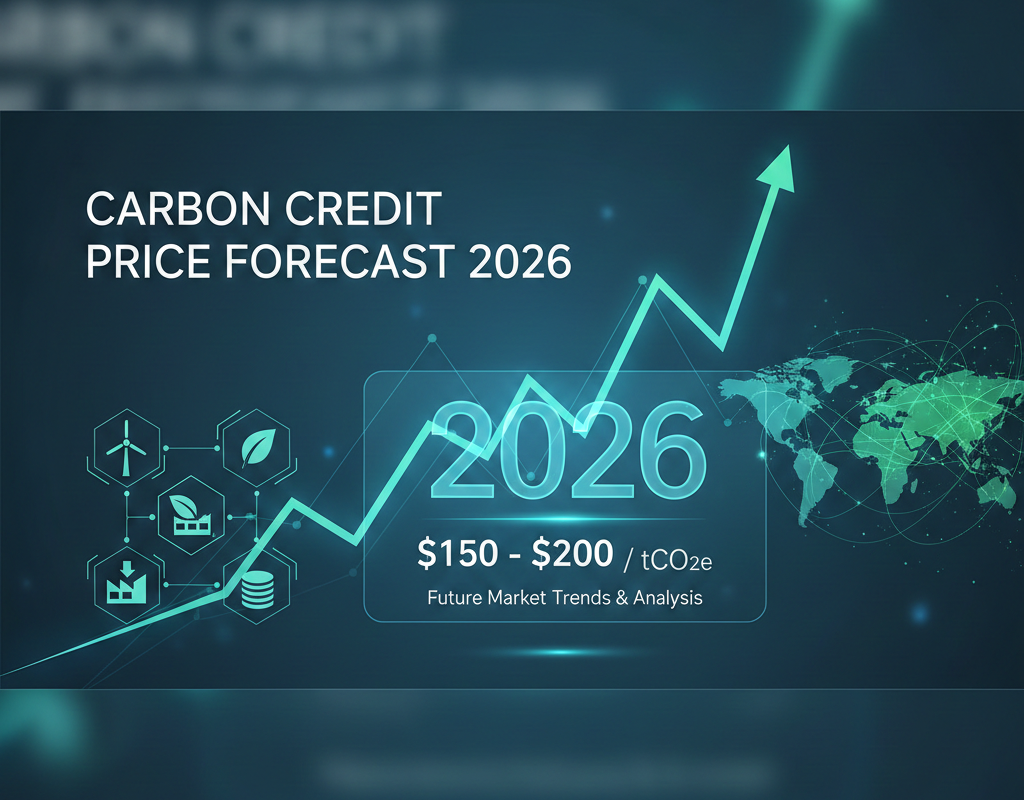
Carbon Credit Price Forecast 2026
Carbon Credit Price Forecast 2026
Overview
As governments, businesses, and investors react to growing climate obligations and new regulatory frameworks, the global carbon credit market is rapidly changing. Prices for carbon credits are anticipated to change in 2026 in response to changing demand dynamics, deeper market structures, and changing policy environments. In order to provide a thorough forecast that influences strategic choices, this Carbon Credit pricing Forecast 2026 article looks at market analyst projections, major pricing drivers, geographical variances, and implications for buyers and sellers in both voluntary and compliance markets.

Forecast for Global Carbon Credit Prices in 2026
- Forecasts for Compliance Market Prices
Carbon pricing in compliance markets takes into account strict emissions limits, secondary trade liquidity, and sanctions. Considering present trajectories:
- Tighter cap reductions and higher auction volumes are expected to raise the EU ETS price to between €85 and €110 per ton of CO₂e by the end of 2026.
- According to forecasts, North American compliance schemes will stabilize between $35 and $60 per ton, with the Regional Greenhouse Gas Initiative (RGGI) and California’s Cap-and-Trade having an impact on broader pricing floors.
- With improved data transparency and market involvement, emerging Asian markets—such as China’s national ETS and pilot regional systems—are expected to see gradual price hikes, possibly reaching $30 to $50 per ton.
These projections are predicated on ongoing regulatory enforcement and the incorporation of new industries, such as industrial emissions and aviation.
- Forecasts of Voluntary Market Prices
Because certification requirements, project history, and credit quality vary, the voluntary carbon market offers a wider range of prices:
- If demand from corporate buyers favoring premium credits increases, high-quality nature-based solutions (NBS) including reforestation and ecosystem conservation credits may fetch prices ranging from $12 to $25 per ton.
- As innovation spurs investment and verification mechanisms develop, technology-based removals, such as soil carbon sequestration and direct air capture, may reach $40 to $70 per ton.
- It is anticipated that market reforms and registries such as the Integrity Council for the Voluntary Carbon Market (ICVCM) will improve baseline quality and price floors, while lower-tier or less verified credits may cluster around $5 to $10 per ton.
By 2026, the average voluntary carbon price worldwide is expected to be between $10 and $20 per ton, driven primarily by increased demand and better uniformity.
Important Factors Affecting 2026 Carbon Credit Prices
As 2026 draws near, a number of factors are affecting the cost of carbon credits:
- Climate policies and regulatory momentum
Demand for carbon credits is being supported by regional and national climate goals, such as major economies’ pledges to achieve net-zero emissions by 2050. Price increases in compliance markets are directly caused by policies such as cap tightening, obligatory offset requirements, and carbon floor pricing.
- Net-Zero Corporate Strategies
Carbon credits are being more and more integrated into larger decarbonization plans by corporations. Large sums of money are being invested in offset portfolios by manufacturing, retail, and energy companies, which is boosting demand in voluntary markets and bolstering price increases.
- Standards for Integrity and Quality
Credit quality is improved by the establishment of strict guidelines, such as those recommended by the Taskforce on Scaling Voluntary Carbon Markets (TSVCM), ICVCM benchmarks, and Article 6 of the Paris Agreement. Premium cost for verified credits results from increased confidence in project verification.
- Limited Access to Excellent Credits
Compared to the anticipated demand, high-quality carbon credits are hard to come by, especially those that have co-benefits like community development and biodiversity protection. One of the main causes of the anticipated price increases through 2026 is this scarcity.
Regional Perspectives: 2026 Carbon Price Forecast
Regional differences in carbon pricing can be attributed to market maturity, economic activity, and regulatory frameworks.
- Europe
The long-standing ETS in Europe continues to serve as a predictor of global carbon price. EU carbon prices are among the highest in the world as a result of the European Green Deal’s push for more decarbonization. As market participation increases and emission limitations tighten, forecasts indicate continued strength through 2026.
- North America
While federal policy signals, like tax incentives for sustainable energy and carbon capture, boost market confidence, regional carbon markets in the US, like California and RGGI, create design patterns. The push for compliance pricing is increased as new sectors are gradually integrated.
- Asia-Pacific
The national ETS in China is expanding quickly and is anticipated to surpass all other carbon markets in terms of volume. As market processes develop and new industrial sectors are added, prices are expected to rise gradually. The voluntary carbon markets in Japan and Southeast Asia also support the expansion of regional demand.
- India
Frameworks to promote carbon trading and link carbon markets with India’s climate pledges have been started. Policy development, demand for renewable energy, and private sector involvement indicate gradual price discovery and higher trends until 2026, even though carbon pricing mechanisms are still in their infancy when compared to those in Europe and North America.
In conclusion: Carbon Credit Price Forecast 2026
According to the 2026 Carbon Credit Price Forecast, supply dynamics, corporate sustainability demand, regulatory momentum, and quality standardization will all contribute to significant price increases in both the voluntary and compliance markets. The overall trajectory points to higher carbon prices that reflect the increasing significance of carbon trading as a strategy for climate mitigation, even while risks and uncertainties still exist.
To take advantage of opportunities and successfully manage carbon risk, companies, investors, and legislators need to remain up to date on market developments, price patterns, and regulatory changes. Carbon markets are anticipated to develop into more strategic, liquid, and transparent platforms that are vital to international climate action as 2026 approaches.
Carbon Credits Income for MSMEs in India: A Complete Guide to Earning Revenue Through Carbon Markets
Carbon Credits Income for MSMEs in India: A Complete Guide to Earning Revenue Through Carbon Markets