
 Aksh
Aksh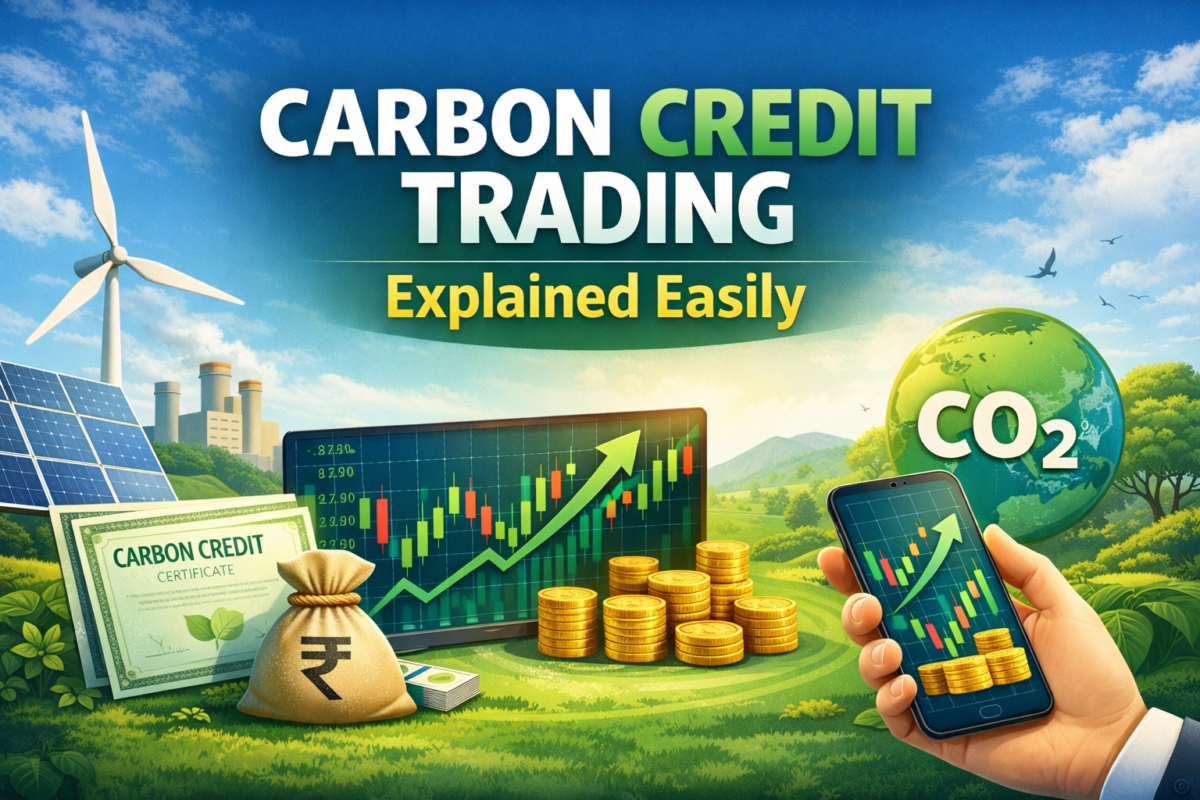
Carbon Credit Trading Explained Easily
Carbon Credit Trading Explained Easily
Globally, trading carbon credits is emerging as one of the most significant ways to combat climate change. Carbon markets are essential to striking a balance between environmental responsibility and economic growth as nations, businesses, and individuals strive to reduce greenhouse gas emissions and reach net zero targets. However, the idea of carbon credit trading may appear unclear or unduly technical to many.
Businesses, investors, and individuals can all readily understand how carbon credit trading operates, why it matters, and how it is influencing sustainable growth in India and around the world thanks to this comprehensive overview.

Carbon Credit Trading: What Is It?
A market-based mechanism called carbon credit trading was created to lower greenhouse gas emissions. One metric ton of carbon dioxide (CO2) or its equivalent in other greenhouse gases is reduced or removed from the atmosphere to create a carbon credit.
To put it simply, a business receives carbon credits for lowering emissions through the use of reforestation programs, energy efficiency techniques, or renewable energy projects. Other businesses who need to offset their emissions can then purchase these credits. Carbon credit trading is the term used to describe this purchasing and selling activity.
The objective is to provide financial incentives for emission reduction initiatives while giving companies latitude in adhering to voluntary sustainability goals or environmental requirements.
The Mechanism of Carbon Credit Trading
It is helpful to divide carbon credit trading into manageable segments in order to make it easier to understand:
A project is created that lowers or eliminates greenhouse gas emissions. This could be a wind farm, solar power plant, energy efficiency project, or forest preservation initiative.
- Independent organizations measure and validate the emission reductions.
- Carbon credits are created from verified reductions.
- These credits can be found on a registry or carbon trading website.
- Carbon credits are purchased by businesses or individuals to make up for their emissions.
For instance, a manufacturing business can purchase 3,000 carbon credits to make up the difference and reach carbon neutrality if it emits 10,000 tons of CO2 a year but only lowers 7,000 tons internally.
A Carbon Offset Project: What Is It?
A project that lowers, prevents, or eliminates greenhouse gas emissions is known as a carbon offset project. Carbon credits produced by these initiatives are exchangeable on carbon markets.
Typical forms of carbon offset initiatives consist of:
- Installations of wind and solar power.
- Initiatives involving biomass energy.
- Increases in energy efficiency.
- Landfill methane capture.
- Programs for reforestation and forestry.
- Sustainable methods of farming.
To guarantee that emission reductions are actual, quantifiable, long-lasting, and extra, every project must go through rigorous verification. Additionality indicates that without the support of carbon money, the project would not have been possible.
Price and Market Dynamics of Carbon Credit
Supply and demand, project type, location, and market circumstances all affect the cost of carbon credits. Government rules and emission limits have an impact on prices in compliance carbon markets. Prices in voluntary carbon markets differ according to the project’s quality and co-benefits.
Carbon credit prices are frequently higher for projects that have significant social and environmental advantages, such as biodiversity preservation or community development.
The value of carbon credit trading is anticipated to rise sharply as the demand for carbon credits rises globally, particularly as net zero commitments rise.
Carbon Credits: Who Can Purchase and Sell Them?
Large enterprises are not the only ones who can trade carbon credits. Carbon markets involve a variety of parties, including:
- Industrial businesses.
- Generators of energy.
- Airlines and transportation companies.
- Developers of real estate.
- Financial organizations.
- Small to medium-sized businesses.
- Private investors.
Carbon credits produced by efficiency, forestry, or renewable energy projects can be sold by project developers. Customers can invest in sustainable assets or buy credits to offset their emissions.
Access to carbon credit trading is becoming more effective and transparent thanks to digital carbon trading systems.
Difficulties with Trading Carbon Credits
Although carbon markets have many potential, they are not without difficulties:
- Ensuring accountability and openness.
- Avoiding credit double counting.
- Upholding precise requirements for verification.
- Volatility of prices in voluntary markets.
- Uncertainty over regulations in developing markets.
For carbon trading systems to remain successful and trustworthy, robust governance frameworks and digital tracking tools are necessary.
The Prospects of Trading Carbon Credits
As companies speed their net zero promises and governments tighten emission laws, the future of carbon credit trading appears bright. Among the major trends influencing the future are:
- Growth of carbon markets for compliance in developing nations.
- Expansion of voluntary involvement in the carbon market.
- Blockchain integration for openness.
- Verification of carbon credits should be standardized.
- Greater demand from multinational companies.
India’s potential for large-scale afforestation and the growth of renewable energy make it a prime provider of high-quality carbon credits.
Carbon credit trading is anticipated to emerge as a key element of global climate finance as carbon pricing mechanisms solidify.
Easily Explained: Carbon Credit Trading Explained Easily
Trading carbon credits is more than simply a way to make money. It is an effective strategy for combating climate change that unites economic opportunity with environmental responsibility. Carbon markets promote responsibility, investment, and innovation by placing a value on emission reductions.
Trading carbon credits offers India a big chance to take the lead in climate solutions and promote sustainable growth. Companies who enter the carbon market early can improve their ESG performance, obtain a competitive edge, and make a significant contribution to the global climate goals.
Carbon credit trading will keep growing as a key component of climate change mitigation methods as awareness rises and legal frameworks develop.
Carbon Credits Explained: A Powerful Tool for Climate Action and Sustainable Growth
Carbon Credits Explained: A Powerful Tool for Climate Action and Sustainable Growth