
 Aksh
Aksh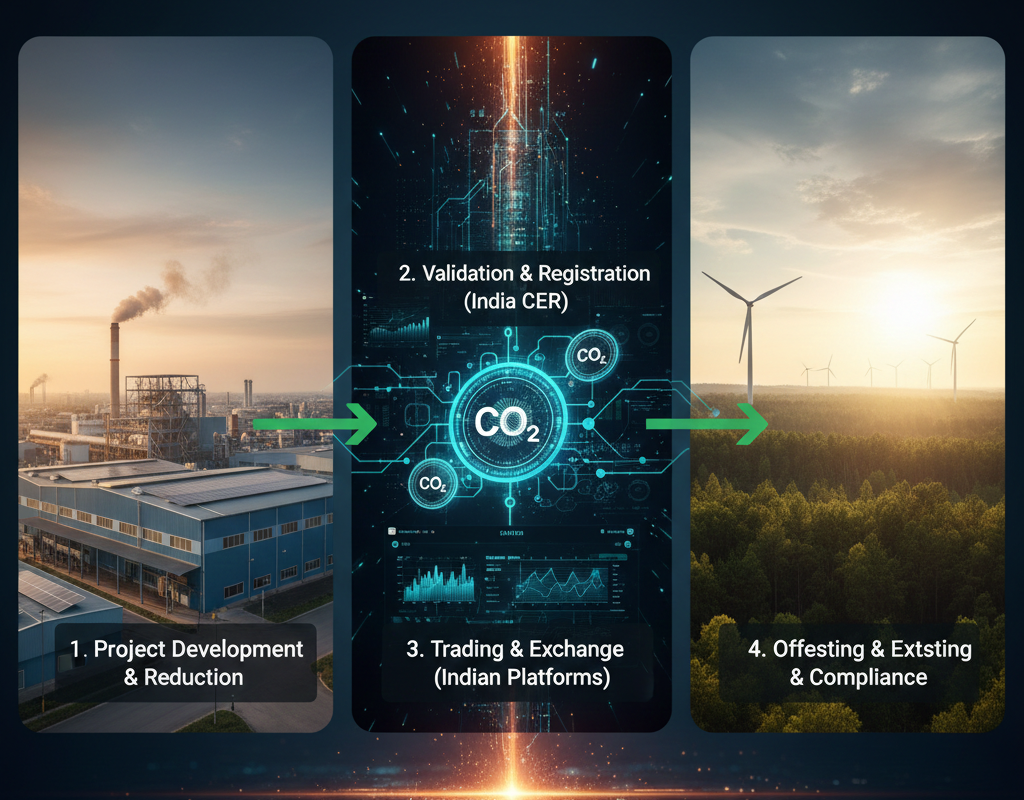
Carbon Credit Trading Process India
Carbon Credit Trading Process India
India’s carbon credit trading system, which combines economic opportunity with environmental action, has become a crucial component of the country’s climate strategy. India is creating one of its most organized domestic carbon markets through the recently operationalized Indian Carbon Credit Trading Scheme (CCTS), which will allow companies to lower their greenhouse gas emissions, generate income, and take part in a regulated carbon market. This in-depth article explains how credits are produced, validated, issued, sold, and retired within the domestic framework, delving deeply into the procedural, legal, and commercial aspects of carbon credit trading in India.

The Significance of Carbon Credits in India
In carbon markets, carbon credits are marketable certificates that signify the reduction, removal, or avoidance of one tonne of carbon dioxide equivalent (tCO₂e) from the atmosphere. Carbon credits are a tool used in India to encourage enterprises to adopt greener practices while allowing organizations that surpass emission standards to profit from their efforts.
India’s carbon credit market combines national economic and environmental goals with international climate pledges made under the Paris Agreement. Carbon credits enhance India’s transition to a net-zero future, enable compliance with changing climate standards, and promote sustainable growth by valuing emissions reductions.
An outline of the Carbon Credit Trading Scheme (CCTS) in India
The Energy Conservation (Amendment) Act, 2022, created India’s carbon market framework, which gives the Central Government the legal authority to design a carbon trading program. This made it possible for the Carbon Credit Trading Scheme (CCTS), which serves as the foundation of the Indian Carbon Market (ICM), to be announced.
There are two concurrent mechanisms via which the CCTS functions:
- Compliance Mechanism: Required for large, energy-intensive industries.
- Businesses, local governments, NGOs, MSMEs, and other organizations who want to voluntarily contribute and cut emissions can use the offset (voluntary) mechanism.
In addition to ensuring that regulated emissions are decreased, this dual framework encourages voluntary climate action for increased involvement and creativity.
Voluntary Carbon Credits vs. Compliance
The difference between voluntary and compliance carbon credits is a crucial component of India’s carbon credit trading system:
- Compliance credits are necessary for industries that are subject to regulations and have to achieve emission-intensity targets, such as petrochemicals, steel, cement, and fertilizers. To stay in compliance, entities that surpass targets must purchase CCCs.
- The majority of voluntary credits are acquired by CSR-focused enterprises, environmentally concerned consumers, and foreign investors. They are produced by activities that are not subject to a compliance mandate, such as the usage of renewable energy, forestry, and energy-efficiency projects.
To prevent market distortion, these two tracks run concurrently with distinct accounting and trading streams.
Market infrastructure and trading platforms
In India, carbon credit trading takes place on authorized online markets that serve as safe, open, and effective channels for transactions. These platforms facilitate:
- Matching and settling orders
- Price discovery in real time
- Trails of audits
- Adherence to CERC guidelines
Every credit is authoritatively recorded in the registry under GCI’s authority, allowing for traceability from issuance to retirement.
Market Trends and Pricing Dynamics
The following factors affect the cost of carbon credits in India:
- Basics of supply and demand
- Costs of sector-specific emission reduction
- Trading volumes and regulatory targets
- Both domestic and foreign involvement
- The credits’ durability and quality
Depending on buyer demand and certification, reported trading ranges for domestic credits can vary significantly.
The advantages of trading carbon credits in India
Engaging in the carbon credit trading process has several advantages:
- Impact on the environment: Directly supports India’s national climate pledges and the reduction of greenhouse gas emissions.
- Revenue Generation: Organizations that go above and beyond compliance goals might profit from surplus reductions.
- Enhancing sustainable credentials and luring climate-focused investment are two benefits of ESG performance.
- Global Integration: Under agreements like Article 6 of the Paris Agreement, credits are becoming more and more able to interact with global markets.
Opportunities and Difficulties
India’s carbon credit industry has obstacles despite its great momentum:
- Mechanisms for price stability are necessary.
- MSMEs’ lack of awareness
- Making sure MRV systems are reliable
- Avoiding false claims and double counting
- Matching local credit to the demands of the international market
Opportunities are also abundant as domestic and foreign investors are drawn to projects in carbon removal, forestry, renewable energy, and agriculture.
Prospects for the Future: The Development of India’s Carbon Market
By 2030, it is anticipated that India’s carbon credit trading system will have grown significantly, with millions of credits being traded domestically and stronger ties to international carbon markets. The carbon economy will evolve over the next ten years as a result of ongoing regulatory improvements, enhanced market infrastructure, and increased involvement.
In conclusion: Carbon Credit Trading Process India
The Indian carbon credit trading mechanism is a path from economic opportunity to environmental responsibility. India’s carbon market is a prime example of how climate action and sustainable business models may coexist with a well-organized framework, reliable verification methods, and regulated trading mechanisms. Both voluntary and compliance markets will be essential in promoting carbon reductions and advancing India’s climate goals as the ecosystem develops.
Carbon Credits Explained: A Powerful Tool for Climate Action and Sustainable Growth
Carbon Credits Explained: A Powerful Tool for Climate Action and Sustainable Growth