
 Aksh
Aksh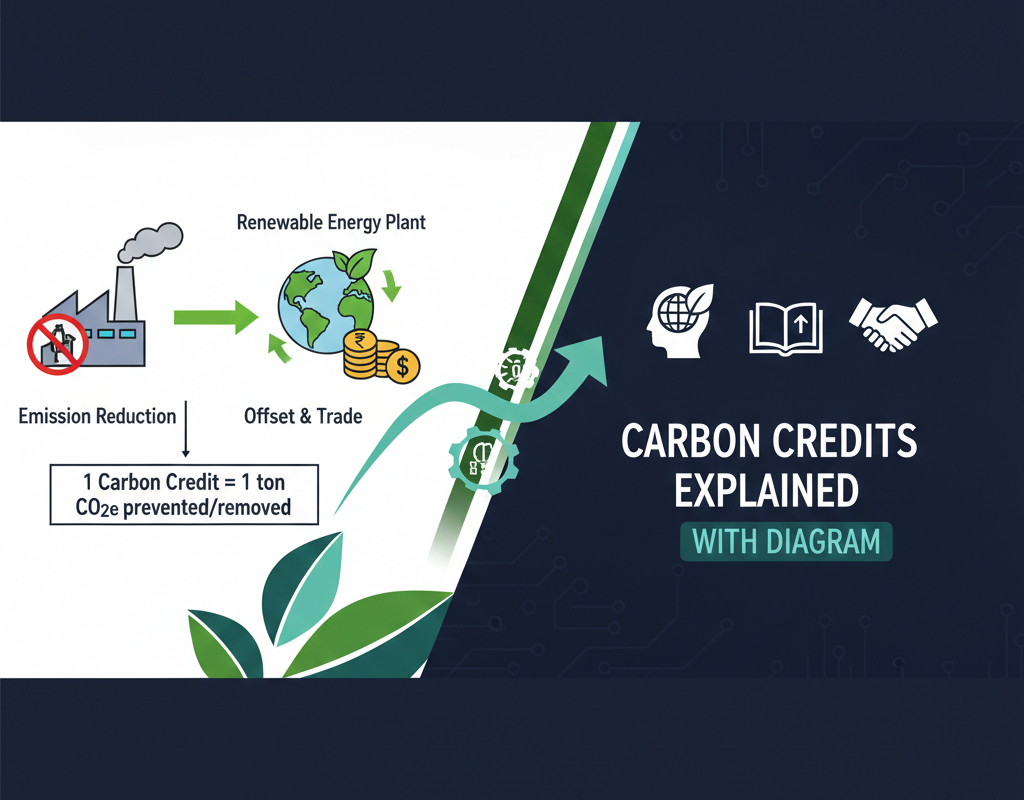
Carbon Credits Explained: Meaning, Types, Benefits
Carbon Credits Explained: Meaning, Types, Benefits
Introduction: The Growing Significance of Carbon Credits
Climate change is now a reality rather than a worry for the future. Extreme weather, melting glaciers, rising global temperatures, and rising carbon dioxide levels have made people, businesses, and governments reevaluate how environmental responsibility and economic prosperity may coexist. Carbon credits are among the most popular market-based instruments for reducing greenhouse gas emissions.
In order to strike a balance between environmental sustainability and economic development, carbon credits are essential. They encourage investments in clean energy, conservation, and climate-positive projects while offering an organized method of measuring, lowering, and making up for carbon emissions. Carbon credits have become a key component of business sustainability plans and global climate policy as countries scramble to meet net-zero obligations.

Carbon Credits: What Are They?
The reduction, elimination, or avoidance of one metric tonne of carbon dioxide (CO₂) or its equivalent in other greenhouse gases is represented by a tradable certificate or permit known as a carbon credit.
To put it simply:
- One carbon credit is equivalent to one tonne of CO2 emissions that are eliminated or reduced.
Projects that successfully lower greenhouse gas emissions through methane capture, afforestation, energy efficiency upgrades, renewable energy production, and industrial process optimization are granted carbon credits.
In order to satisfy legal obligations or voluntary sustainability objectives, these credits might then be offered for sale to businesses or other entities that wish to make up for their emissions.
The Idea of Carbon Credits
The foundation of carbon credits is the idea that:
- Reductions in emissions might occur where they are most economical.
- Regardless of the location of emissions, climate change is a worldwide concern.
Carbon credits enable emission reductions to occur in areas or industries where they are technically and economically possible while still providing a worldwide environmental benefit, as opposed to requiring all businesses to decrease emissions at the same rate.
The Operation of Carbon Credits
Carbon credits operate in a number of structured processes, including:
- Development of Projects
The goal of a project is to cut or eliminate greenhouse gas emissions above and above what would have occurred in a typical scenario.
- Verification and Enrollment
An impartial body evaluates the project to make sure it satisfies predetermined criteria.
- Observation and Confirmation
Third-party auditors keep an eye on and confirm emission reductions.
- Carbon Credit Issuance
Carbon credits are created from verified emission reductions.
- Exchange or Utilization
Buyers can purchase or use credits to offset their emissions.
India’s Carbon Credit System
India’s stance on carbon credits is changing quickly, with more attention being paid to:
- Standardized procedures
- Open and honest verification procedures
- Including national climate targets
- Conformity to global best practices
Carbon credits give India the chance to draw in international climate money while striking a balance between environmental duty and economic prosperity.
Carbon Credits’ Future
Global climate goals are strongly linked to the future of carbon credits.
Important trends consist of:
- National carbon markets’ expansion
- Including digital monitoring technologies
- Corporate net-zero commitments have increased.
- Increased demand for superior credit
- Increased emphasis on co-benefits such as social effect and biodiversity
In order to mobilize private financing for climate action and meet global emission reduction objectives, carbon credits are anticipated to be crucial.
Corporate Sustainability and Carbon Credits
Carbon credits are evolving from a compliance requirement to a strategic tool for companies.
Carbon credits are used by businesses to:
- Complement methods for reducing emissions
- Reach carbon neutrality
- Boost the reputation of your brand
- Fulfill the expectations of stakeholders and investors
Reduction comes first, followed by offsetting, when using carbon credits responsibly.
Conclusion: Carbon Credits Explained
An effective way to combine economic opportunity with environmental responsibility is through carbon credits. They foster innovation and sustainable development while offering a workable, scalable method of lowering global emissions.
India is at the forefront of global climate solutions as it expands its position in the carbon credit ecosystem. Carbon credits can hasten the shift to a low-carbon economy while providing long-term environmental and social advantages with the correct regulations, openness, and funding.
Governments, corporations, and individuals dedicated to a sustainable future must now understand carbon credits; it is no longer a choice.
Carbon Credits vs Carbon Offsets Explained: Key Differences, Uses, and Importance for India
Carbon Credits vs Carbon Offsets Explained: Key Differences, Uses, and Importance for India