
 Aksh
Aksh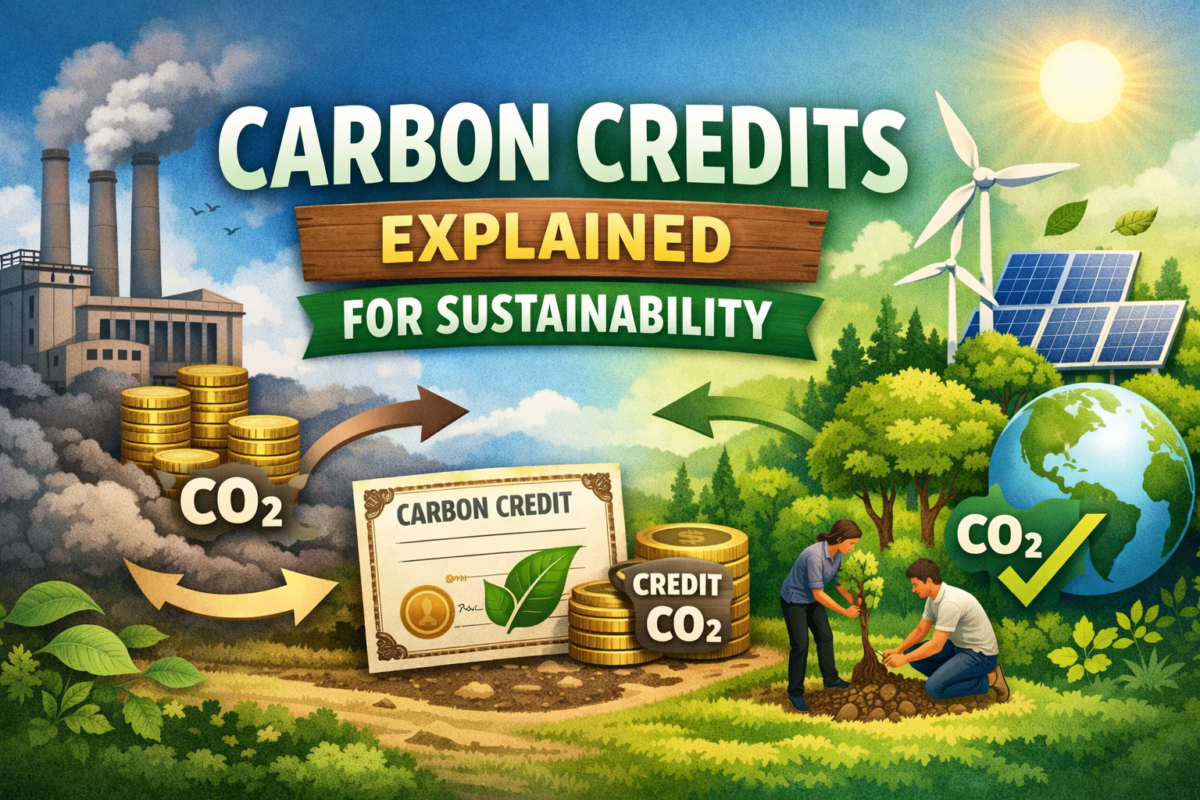
Carbon Credits for a Sustainable Future
Carbon Credits for a Sustainable Future
One of the most important issues of the twenty-first century is climate change. Governments, businesses, and communities have been compelled to reconsider how development and sustainability can coexist as a result of rising global temperatures, erratic weather patterns, melting glaciers, and rising carbon emissions. Carbon credits have emerged as one of the most significant and useful instruments for climate action in this worldwide endeavor to lower greenhouse gas emissions.
This page provides a thorough explanation of carbon credits, their significance for sustainability, their operation, and the reasons they are essential to India’s shift to a low-carbon economy. Understanding carbon credits is becoming crucial for companies, legislators, and environmentally conscientious people as environmental responsibility becomes more widely recognized.

Comprehending Climate Change and Carbon Emissions
Understanding the issue that carbon credits are intended to address is crucial before investigating them. The Earth’s atmosphere retains heat due to the presence of greenhouse gases like carbon dioxide. Fossil fuel combustion, industrial production, transportation, deforestation, and agriculture are the main sources of these gases.
Emissions rise with economic activity unless mitigation measures are taken. Climate scientists concur that significant emission reductions in all sectors are necessary to limit global warming. For many businesses, however, it is not feasible to achieve zero emissions immediately. Carbon credits offer a versatile way to strike a balance between environmental responsibility and economic prosperity.
Carbon Credits: What Are They?
The decrease or removal of one metric ton of carbon dioxide or its equivalent in other greenhouse gases from the atmosphere is represented by a tradable certificate known as a carbon credit. To put it simply, one carbon credit is equivalent to one ton of emissions that were prevented or eliminated.
Projects that lower emissions or improve carbon absorption produce carbon credits. These initiatives could involve methane capture, reforestation, energy efficiency enhancements, forest conservation, sustainable agricultural methods, and the production of renewable energy.
Organizations can successfully assist climate-positive activities elsewhere by acquiring carbon credits to offset emissions they are unable to completely remove.
The Carbon Offset Concept
Carbon offsets and carbon credits are frequently addressed together. Offsetting is a behavioral and strategic concept, notwithstanding their tight relationship. By funding initiatives that lower emissions elsewhere, carbon offsetting enables people or organizations to offset inevitable emissions.
For instance, a manufacturing business that produces carbon emissions might fund a renewable energy project that replaces the usage of fossil fuels. The project’s emission reductions are turned into carbon credits, which the business may utilize to make up for its environmental impact.
During the shift to cleaner operations, this mechanism supports emission reduction efforts rather than taking their place.
The Creation of Carbon Credits
A strict procedure is followed in the generation of carbon credits to guarantee transparency and environmental integrity. Projects must show that emission reductions are extra, permanent, quantifiable, and real.
Project design, baseline evaluation, monitoring, verification, and certification are the standard procedures. Before credits are given out, independent auditors confirm that emissions have decreased. This guarantees that every carbon credit reflects a real environmental advantage.
Carbon Credits’ Function in Sustainability
The goal of sustainability is to satisfy current demands without endangering those of future generations. By facilitating emission reductions where they are most practical and significant, carbon credits directly contribute to this objective.
Carbon credits encourage social justice, economic growth, and environmental preservation by directing money into clean energy, conservation, and neighborhood-based initiatives. They promote creativity and quicken the changeover.
Why Carbon Credits Are Important to Companies
Carbon credits are more than just a way for businesses to comply with regulations. They serve as a tactical instrument for sustainability.
Regulators, investors, consumers, and staff are putting more and more pressure on businesses to lessen their environmental effect. While pursuing long-term emission reduction measures, carbon credits enable organizations to take immediate climate action.
Additionally, they assist businesses in aligning with global sustainability frameworks, managing climate-related risks, and improving brand reputation.
Net Zero Objectives and Carbon Credits
In order to achieve net zero emissions, greenhouse gas emissions and atmospheric removals must be balanced. For industries where it is challenging to completely eradicate emissions, carbon credits are an essential part of net zero strategy.
Organizations can accomplish believable net zero goals by combining direct emission reductions with premium carbon credits.
The Function of India in the Carbon Credit System
India’s rapid economic expansion and enormous potential for emission reduction projects give it a unique position in the global carbon market. India contributes significantly to the supply of carbon credits through afforestation, energy efficiency programs, sustainable agriculture, and the spread of renewable energy.
India’s establishment of a structured carbon market encourages investment in green projects while upholding the country’s climate pledges. Carbon credits offer monetary rewards for environmentally friendly growth in both urban and rural areas.
Carbon Credits’ Advantages for India
India’s economy and ecology can profit from carbon credits in a number of ways. They encourage the use of sustainable energy, lessen reliance on fossil fuels, and generate green jobs. Additionally, they give local communities and project developers sources of income.
Carbon credits promote innovation and aid India’s shift to a resilient and sustainable economy by making emission reductions monetizable.
Renewable Energy and Carbon Credits
One of the most popular sources of carbon credits is renewable energy projects. Renewable energy lowers emissions and promotes energy security by taking the place of fossil fuel-based electricity generation.
By increasing the financial sustainability of renewable energy projects, carbon credits increase the affordability and accessibility of clean energy. The transition to sustainable power systems is accelerated as a result.
In conclusion: Carbon Credits for a Sustainable Future
A potent tool for combating climate change and promoting social and economic advancement are carbon credits. They offer adaptability, stimulate creativity, and direct funds toward worthwhile environmental initiatives.
Carbon credits serve as a link between the carbon-intensive world of today and the low-carbon future of tomorrow for both India and the rest of the world. Businesses and individuals can actively contribute to preserving the environment for future generations by comprehending and using carbon credits wisely.
Carbon Credits Explained for Small Companies | Complete Guide for Indian Businesses
Carbon Credits Explained for Small Companies | Complete Guide for Indian Businesses