
 Aksh
Aksh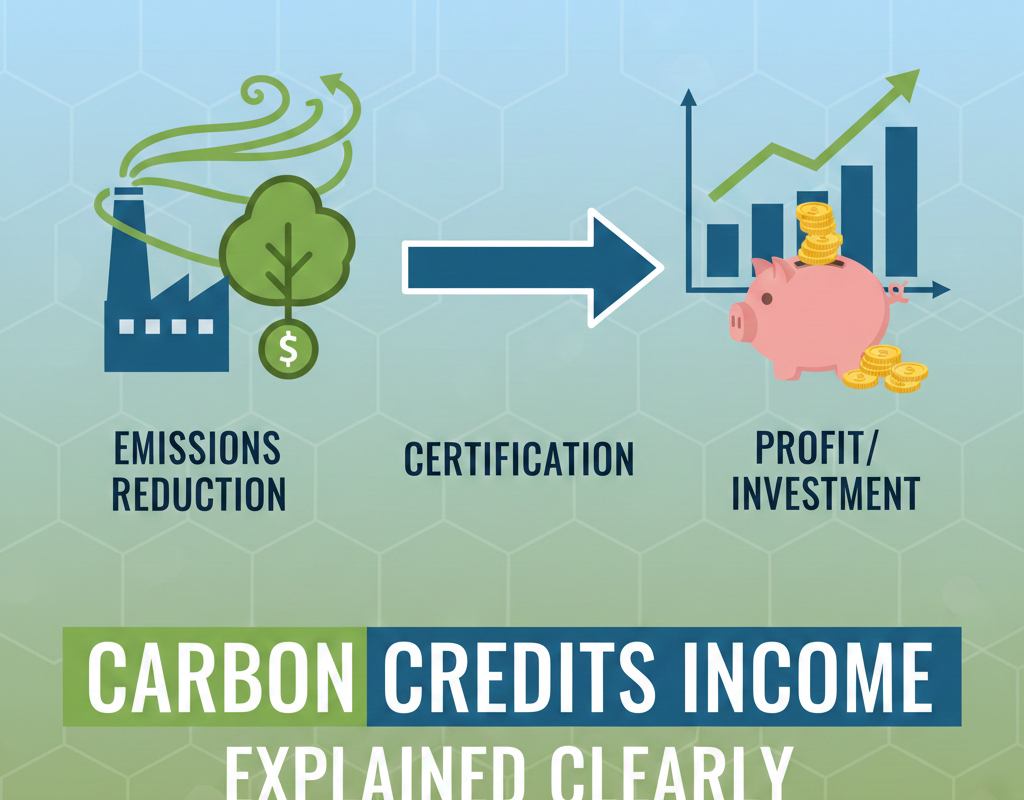
Carbon Credits Income Explained Clearly
Carbon Credits Income Explained Clearly
Governments, businesses, and individuals are actively looking for ways to lower greenhouse gas emissions as climate change emerges as one of the most urgent global issues. The carbon credit system is one of the best financial instruments promoting this shift. Carbon credit income is currently becoming a new source of income for enterprises, landowners, farmers, and providers of renewable energy in India.
This thorough book provides a clear explanation of carbon credit revenue, including how the system operates, who is eligible to earn, and the opportunities in India’s expanding carbon market.

Carbon Credits: What Are They?
The decrease or elimination of one metric ton of carbon dioxide (CO2) or other comparable greenhouse gases from the atmosphere is represented by a carbon credit. These credits are produced by initiatives that lower emissions, including methane collection, afforestation, energy efficiency upgrades, renewable energy installations, and sustainable agriculture.
Carbon-emitting businesses and organizations can buy these credits to make up for their emissions. This procedure makes it possible for climate-positive activities to make money and provides a financial incentive for emission reduction efforts.
To put it simply:
- Cut down on or eliminate carbon emissions
- Verify
- Obtain carbon credits.
- Offer them for sale on the carbon market.
- Make money
How Income from Carbon Credits Operates?
Income from carbon credits is produced through an organized process that includes project development, verification, and trade. Here is a detailed explanation:
- Calculate the Reduction of Emissions
The project must show the amount of carbon emissions that are cut in comparison to a baseline situation. Technical calculations and documentation are needed for this.
- Confirmation and Accreditation
The emission decrease is confirmed by an impartial entity. Credibility and transparency are guaranteed by standards like the Verified Carbon Standard (VCS) and Gold Standard.
- Carbon Credits Are Issued
Credits are given based on the quantity of carbon reduced after verification.
In India, who is eligible to earn income from carbon credits?
Large enterprises are not the only ones who may earn from carbon credits. Several sectors are able to take part:
- Farmers
Carbon credits can be produced by farmers using soil carbon sequestration, organic farming, agroforestry, reduced tillage, and regenerative agriculture. In rural India, carbon farming revenue is becoming more and more popular.
- Owners of land
Long-term income can be generated by forestry carbon credits produced by replanting and reforestation initiatives.
- Developers of Renewable Energy
By substituting fossil fuel-based power, solar and wind energy installations provide carbon credits for renewable energy.
- MSMEs and Sectors
By putting energy efficiency measures into place, small and medium-sized businesses can lower emissions and receive credits.
- Projects for Waste Management
Greenhouse gas reduction credits are available for landfill methane capture systems and biogas plants.
How Much Can You Earn in Carbon Credit?
Market pricing has a significant impact on carbon credit revenue.
The following factors affect prices:
- Type of project
- Standard of certification
- Demand in the market
- Where
- Co-benefits (social impact, biodiversity)
Prices for each ton of CO2 decreased might vary greatly in voluntary markets. Premium pricing is frequently demanded for high-quality credits with significant social and environmental effect.
Trends in carbon credit prices indicate a growing need for verified and high-integrity credits as global climate commitments increase.
India’s Carbon Credit Registration Procedure
Projects must adhere to a proper registration procedure in order to earn revenue from carbon credits:
- Documentation for project design
- Baseline evaluation
- Third-party verification
- Observation and reporting
- Confirmation
- Credit issuance
- Putting your name on a carbon registry
- Sale to purchasers
Navigating technical paperwork and compliance standards is made easy with expert assistance.
Advantages of Earning Carbon Credits
There is more to carbon credits than merely financial gain.
- Diversification of Finances
Businesses and landowners benefit from an extra source of income that is unaffected by the price of commodities.
- Sustainable Growth
Water conservation, air quality, and soil health are frequently enhanced by projects.
- Leadership in Climate
Participants help achieve both national and international emission reduction targets.
- Creation of Long-Term Value
Carbon assets might increase in value over time as global decarbonization picks up speed.
Concluding remarks: Carbon Credits Income Explained Clearly
One of India’s most potential climate finance prospects at the moment is the income from carbon credits. Carbon credits may turn environmental effort into quantifiable cash gains, whether you are an industrial operator upgrading efficiency systems, a farmer improving soil techniques, or a producer of renewable energy building solar power.
Long-term success in India’s growing carbon credit market will depend on factors including quality, transparency, and verification. Carbon credit profits are expected to play a significant role in India’s sustainable economic growth due to rising corporate demand, pro-business regulatory frameworks, and the urgency of the global climate.
People and companies may unleash substantial value and contribute to a more resilient, greener future by fully comprehending the process and making educated decisions.