
 Aksh
Aksh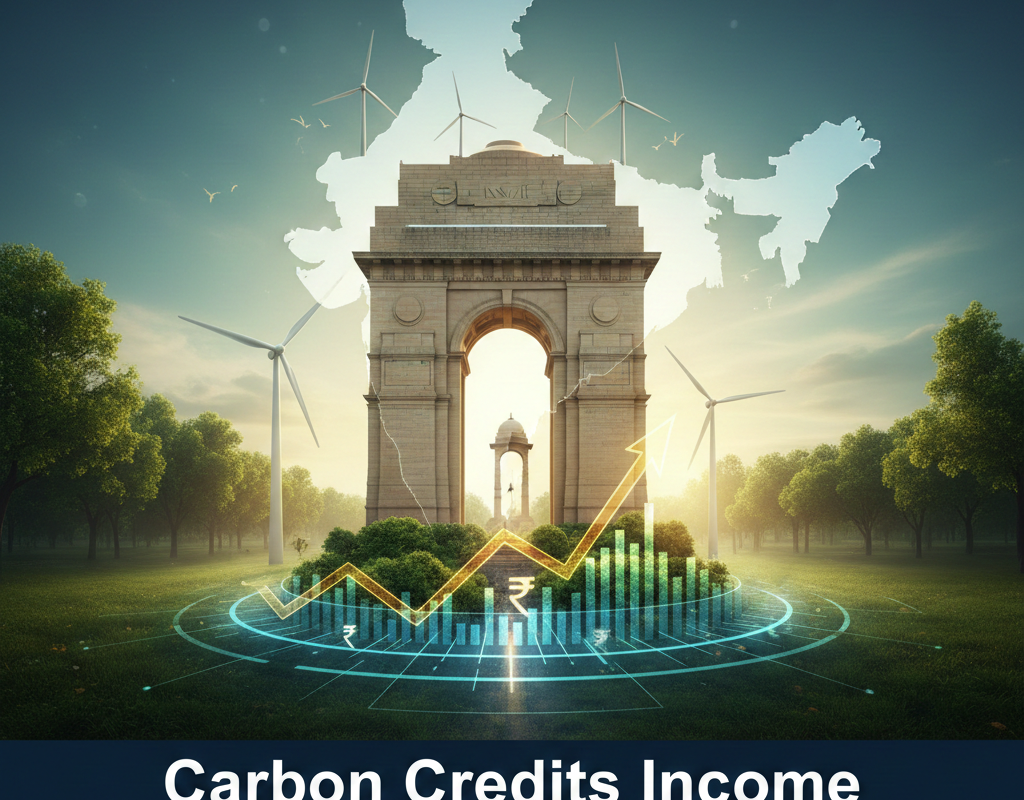
Carbon Credits Income India Explained
Carbon Credits Income India Explained
One of the major participants in the global carbon market is quickly becoming India. Carbon credits are emerging as a new revenue stream for companies, farms, and sustainability-minded entrepreneurs as a result of increased climate pledges, industrial growth, the use of renewable energy, and government-backed climate policies.
Everything from how carbon credits operate to how you can earn, sell, and legally report carbon credit revenue in India is covered in this tutorial if you’re looking for a comprehensive explanation of carbon credit income in India.

Carbon Credits: What Are They?
One metric ton of carbon dioxide (CO₂) or its equivalent greenhouse gas is reduced or removed from the atmosphere to create a carbon credit.
These credits are produced by initiatives that lower emissions, like:
- Solar power facilities
- Projects involving wind energy
- Energy from biomass
- Afforestation and replanting
- Methane capture initiatives
- Improvements in energy efficiency
Following verification, these projects are awarded carbon credits that can be sold to businesses or groups trying to reduce their emissions.
The Significance of Carbon Credits in India
India is one of the fastest-growing markets for renewable energy and is the world’s third-largest emitter of greenhouse gases. India has committed to lowering emissions intensity and increasing the capacity of non-fossil fuel energy sources in accordance with the Paris Agreement and the United Nations Framework Convention on Climate Change.
In order to achieve these objectives, the Indian government announced the Carbon Credit Trading Scheme (CCTS), a regulated carbon market, in 2023.
In India, who is eligible to earn income from carbon credits?
- Farmers
Farmers can make money by:
- Agroforestry
- Carbon sequestration in soil
- Production of biochar
- Agriculture that is sustainable
Regenerative farming and tree planting can generate ongoing carbon credit income for ten to thirty years.
- Developers of Renewable Energy
Developers of wind and solar energy produce a lot of credits.
The expansion of renewable energy in India has made it a significant source of income.
- MSMEs and Sectors
Upgrades to energy-efficient machines produce credits and lower emissions.
- Developers of Real Estate
Green buildings may be eligible for some programs and lower emissions.
- Companies That Handle Waste
High-value credits are produced by methane capture from biodigesters and landfills.
Government Regulations in India That Encourage Carbon Credit Income
India is creating a well-organized carbon market by:
- The CCTS, or Carbon Credit Trading Scheme
Introduced in 2023 as part of the revisions to the Energy Conservation Act.
- Contributions that are determined nationally (NDCs)
By 2030, India wants to cut its GDP’s emissions intensity by 45%.
- Growth of Renewable Energy
By 2030, India wants to have 500 GW of non-fossil power.
- Corporate Sustainability and ESG Requirements
Top firms are required by the Securities and Exchange Board of India to report on their sustainability performance.
India’s Carbon Credit Income Tax
- The taxation of carbon credits has changed throughout time.
- Carbon credits were sometimes regarded as capital receipts.
However, revenue from carbon credits is now taxable under certain circumstances due to changes made to Indian income tax legislation.
Important Points:
- Income from carbon credits is subject to taxes.
- Many times, it is treated as company income.
- Depending on the applicable income tax rate
- Depending on the structure, GST may be applicable.
It is strongly advised to consult a tax expert.
A Comprehensive Guide for Launching a Carbon Credit Company in India
- Determine the project to reduce emissions.
- Perform a feasibility study.
- Engage a carbon credit advisor
- Sign up using the accepted carbon standard.
- Obtain third-party confirmation
- Put in place a monitoring system
- Check for decreases in emissions.
- Obtain credits
- Sell credits via exchange or private buyer
India’s Prospects for Carbon Credit Revenue
India is anticipated to rank among the world’s biggest producers of carbon credits because
- Vast agricultural foundation
- Growth of renewable energy
- Potential for reforestation
- Government-supported market for compliance
It is anticipated that demand for Indian carbon credits will rise sharply as multinational firms strive for net zero.
In conclusion: Carbon Credits Income India Explained
India’s revenue from carbon credits is a potent example of how sustainability and business can coexist. India is about to enter a revolutionary phase in carbon finance, thanks to government-backed compliance markets, voluntary carbon demand, ESG standards, and the growth of renewable energy.
Whether you are an industrialist, farmer, producer of renewable energy, or sustainability business, knowing how carbon credits operate can open up long-term financial prospects.
Carbon credit income is positioned to become a commonplace climate-finance tool as India fortifies its climate pledges under international frameworks and develops its own domestic carbon trading ecosystem.
Carbon Credits Income for MSMEs in India: A Complete Guide to Earning Revenue Through Carbon Markets
Carbon Credits Income for MSMEs in India: A Complete Guide to Earning Revenue Through Carbon Markets