
 Aksh
Aksh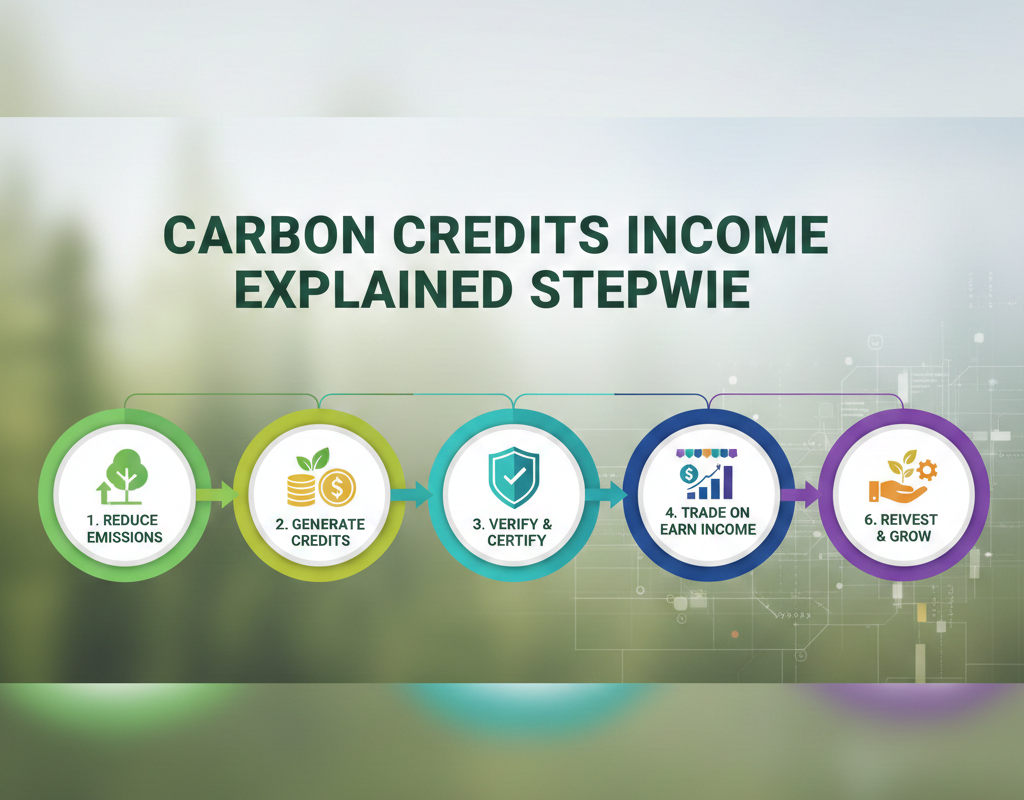
Carbon Credits Income Explained Stepwise
Carbon Credits Income Explained Stepwise
Carbon credit income has become one of India’s fastest-growing environmental revenue schemes as climate change gains international attention. Nowadays, a lot of people are looking at how to profit from carbon credits, including farmers, businesses, renewable energy firms, and corporate entities.
One of the biggest new markets for carbon credit initiatives is India. Strong climate regulations, more ESG compliance, and growing voluntary carbon markets are all contributing to India’s carbon credit income being a substantial long-term revenue prospect.
The income from carbon credits, the operation of the carbon credit system, the beneficiaries, project registration, and carbon credit sales in India are all explained in depth in this comprehensive news guide.

Step 1: Recognizing the Nature of Carbon Credits
Understanding the fundamentals is crucial before learning how to profit from carbon credits.
A marketable certificate that certifies the removal or reduction of one metric ton of carbon dioxide (CO₂) or other comparable greenhouse gases from the atmosphere is called a carbon credit.
- Carbon reduction initiatives like these provide carbon credits.
- Installations of renewable energy
- Afforestation and tree planting
- Projects involving biomass and biochar
- Enhancements in energy efficiency
- Systems that convert waste into energy
- Carbon farming and sustainable agriculture
Every confirmed decrease turns into a carbon credit that can be traded on the compliance or optional carbon markets.
Step 2: How Income from Carbon Credits Operates
Verified emission reductions are turned into marketable credits and sold to businesses looking to offset their carbon emissions, producing revenue from carbon credits.
The streamlined income flow is as follows:
- Put a carbon reduction project into action.
- Measure the amount of emissions that have been cut or eliminated.
- Obtain confirmation from a recognized carbon standard.
- Add credits to a registry for carbon.
- Provide buyers with carbon credits.
- Get paid according to the credit.
Businesses purchase these credits in order to fulfill their commitments to carbon neutrality, sustainability, or ESG.
Step 3: Who Can Receive Income from Carbon Credits?
Large enterprises are not the only ones in India that receive cash from carbon credits.
Participants Who Qualify:
- Farmers and MSMEs
- Developers of renewable energy
- Big production facilities
- Developers of real estate
- Waste management firms
- Manufacturers of biofuel
- NGOs and neighborhood initiatives
Projects with aggregated carbon credits allow participation from even tiny landowners.
Step 4: India’s Potential for Carbon Credit Income
Each project’s carbon credit revenue is determined by:
- Project type
- Emissions volume decreased
- The cost of carbon credits on the market
- Used as a certification standard
- Market need for voluntary carbon
The cost of carbon credits varies according to project quality and market demand. Over many years, renewable energy plants usually produce steady revenue from carbon trading.
Beyond crop productivity, carbon farming income can give farmers extra money each year.
Step 5: An explanation of the carbon credit business model
The following is how the carbon credit business model operates:
The project developer creates credits, registers them, sells them to the buyer, and gets paid.
Among the revenue sources are:
- Direct credit sales
- Long-term contracts for carbon credits
- Investment contracts with an ESG component
- Partnerships for corporate sustainability
Carbon credit income is increasingly a common component of green revenue strategies for many firms.
Step 6: Revenue from ESG and Carbon Credits
In India, the demand for carbon credits is being driven by environmental, social, and governance (ESG) compliance.
Big businesses want to accomplish:
- Net-zero goals
- Being carbon neutral
- Reduction of emissions in scopes 1, 2, and 3
The chance to sell carbon credits in India at competitive pricing is increased by this growing demand.
Step 7: Laws Encouraging Carbon Credit Initiatives
India has pledged to increase renewable capacity and lower emission intensity. Support from policy promotes:
- Growth of clean energy
- Programs for energy efficiency
- Initiatives for sustainable agriculture
- Green hydrogen initiatives
These programs boost the ecology for carbon credits and the potential revenue from carbon trading.
Conclusion: Carbon Credits Income Explained Stepwise
Income from carbon credits is a financial opportunity that is in line with climate responsibility, not only an environmental instrument.
If you are:
- A farmer looking to make more money
- An industry that lowers emissions
- A developer of renewable energy
- An organization that prioritizes sustainability
India’s carbon credit initiatives provide a planned strategy to make steady income while advancing international climate goals.
Transparency and quantifiable environmental impact are ensured by the methodical process of creating, validating, and selling carbon credits.
The opportunity to profit from carbon credits in India will keep growing as the demand for ESG carbon credits increases.
Carbon Credits Income for MSMEs in India: A Complete Guide to Earning Revenue Through Carbon Markets
Carbon Credits Income for MSMEs in India: A Complete Guide to Earning Revenue Through Carbon Markets