
 Aksh
Aksh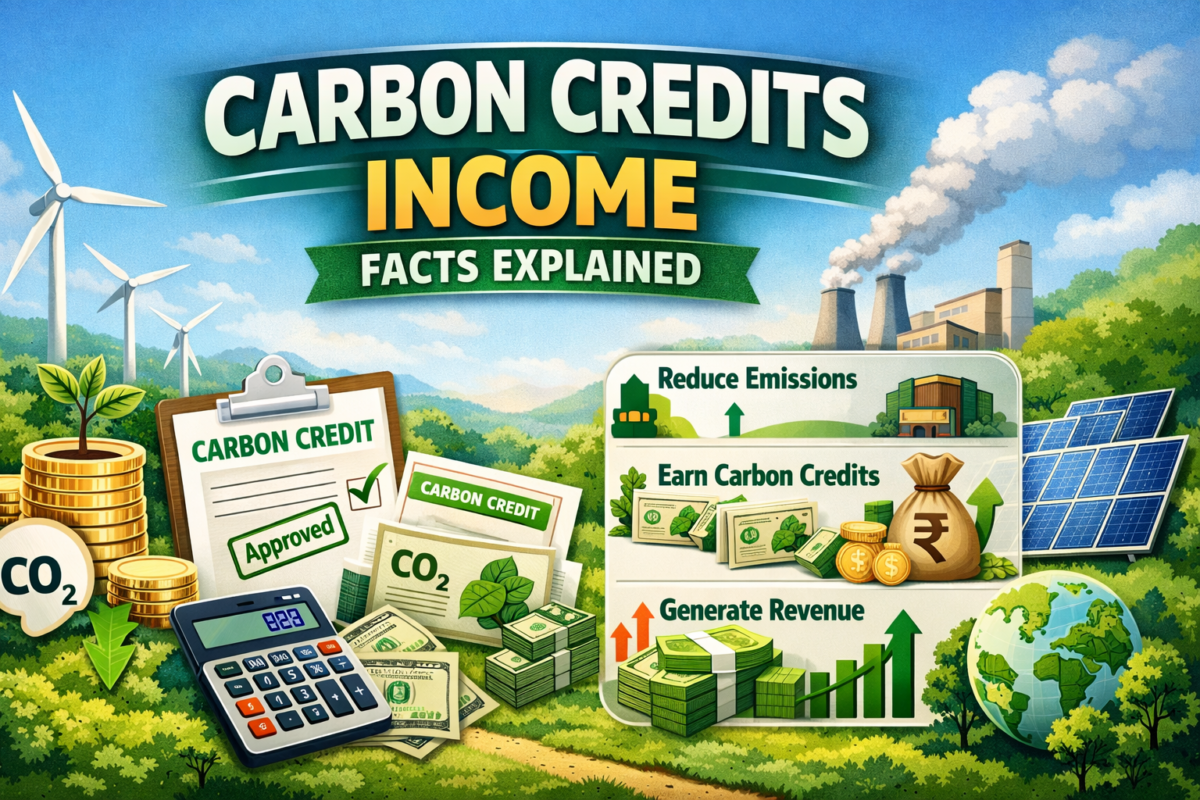
Carbon Credits Income Facts Explained
Carbon Credits Income Facts Explained
The idea of carbon credits has evolved in recent years from a specialized environmental issue to a profitable and sustainable source of income. Governments, businesses, and individuals are searching for methods to offset carbon emissions and support green activities as a result of growing awareness of climate change. Because of this change, carbon trading is now both a commercial opportunity and an environmental need.
We examine what carbon credits are, how the Indian carbon market functions, and the possible revenue streams for farmers, businesses, and investors in this article on carbon credit income facts explained.

Carbon Credits: What Are They?
The reduction of one metric ton of carbon dioxide (CO2) or an equivalent quantity of other greenhouse gases (GHGs) is represented by a tradable certificate or permit known as a carbon credit. A key element of carbon markets are carbon credits, which are intended to offer monetary rewards for cutting emissions.
In essence, one carbon credit is equivalent to one ton of CO2 that is kept out of the atmosphere. Companies or individuals can sell these credits to people who are having difficulty meeting emission requirements if they lower their carbon footprint beyond a certain threshold.
Important Information:
- One metric ton of CO2 is equal to one carbon credit.
- It is possible to trade carbon credits both domestically and abroad.
Reforestation, renewable energy, energy efficiency, and methane collection are among the projects that qualify for carbon credits.
What Is the Process of Carbon Trading?
The process of purchasing and selling carbon credits is referred to as carbon trading or emissions trading. Two main categories of carbon markets exist:
- Compliance Market: In this market, governments mandate that businesses reduce their emissions. Companies are required to buy carbon credits in order to comply if they above their limit.
- Voluntary Market: In this market, people or organizations buy carbon credits to voluntarily offset their carbon footprint. As CSR (Corporate Social Responsibility) programs and sustainability objectives rise, this sector is expanding quickly.
In India, carbon credits
India actively engages in carbon trading through global platforms like the Clean Development Mechanism (CDM). Additionally, domestic carbon markets are developing, providing new opportunities for sustainable revenue.
Carbon Credits Are Earnable by Whom?
The revenue potential of carbon credits for a variety of stakeholders is among their most intriguing features:
- Farmers
Carbon credits can be produced by farmers that use sustainable farming methods like organic farming, agroforestry, or methane capture from livestock. A further source of revenue can be generated by selling these credits to businesses or on the voluntary carbon market.
- Sectors
Carbon credits are available to businesses that lower emissions through waste-to-energy initiatives, energy efficiency improvements, or the installation of renewable energy. This creates possible income in addition to helping to comply with compliance requirements.
- Investors and Entrepreneurs
By contributing to carbon offset initiatives like solar energy or forestry, investors can take part in carbon markets. Sales of confirmed carbon credits to companies looking for offsets generate revenue.
- Urban Projects and Municipalities
Carbon credits, which can lower project costs and encourage sustainable urban growth, are awarded to cities that invest in waste management, solar energy, and green infrastructure.
How to Earn Money from Carbon Credits
Learning how to obtain carbon credits necessitates a methodical approach. Here is a detailed procedure:
- Determine the Project Type: Opt for a project that lowers carbon emissions, such as energy efficiency, renewable energy, or afforestation initiatives.
- Project Registration: Enroll the project in accordance with accepted guidelines, like the Verified Carbon Standard (VCS) or the CDM.
- Monitoring and Verification: Make certain that recognized organizations measure, report, and validate the project’s carbon savings.
- Carbon Credit Issuance: Following verification, carbon credits are granted in accordance with the confirmed decrease in emissions.
- Selling Carbon Credits: In India and abroad, carbon credits can be sold to businesses, industries, or through carbon exchanges.
The advantages of carbon credits
Profiting from carbon credits offers several social and environmental advantages in addition to financial ones.
- Financial Incentive: Offers farmers, companies, and entrepreneurs a steady stream of revenue.
- Environmental Impact: Encourages initiatives to lower greenhouse gas emissions, helping to mitigate the effects of climate change.
- Corporate responsibility: Assists businesses in achieving their environmental, social, and governance (ESG) objectives.
- Green technology innovation promotes investments in sustainable agriculture, energy efficiency, and renewable energy.
Prices and Market Trends for Carbon Credits
Market pricing, which vary according to supply, demand, and project type, determine how much money is made from carbon credits. Currently, carbon credits in India range from $5 to $15 per ton, depending on the location, type, and trustworthiness of the project.
Current patterns show:
- Growing demand from global corporations seeking to achieve net-zero goals.
- Voluntary carbon markets are gaining popularity.
- Improved laws promoting renewable energy initiatives and carbon trading.
India’s Carbon Credit Regulations
The carbon credit system in India is regulated by both national and international regulations. Important rules consist of:
- The Kyoto Protocol’s Clean Development Mechanism (CDM).
- Industries are encouraged to lower their energy use through the Perform, Achieve, Trade (PAT) scheme, which exchanges surplus savings for Energy Saving Certificates (ESCerts).
- Initiatives for the National Carbon Market: New laws to support domestic carbon offset and trading schemes.
Both buyers and sellers are protected when these rules are followed since they guarantee the validity and marketability of carbon credits.
In conclusion: Carbon Credits Income Facts Explained
The idea of carbon credits is turning environmental stewardship into a real source of revenue. Farmers, companies, and investors can access a rising market and promote sustainability by being aware of the revenue figures for carbon credits.
With the help of international standards and government initiatives, India’s carbon market provides chances to make consistent revenue from environmentally beneficial projects. Whether you are an investor, a corporation, or a small-scale farmer, carbon credits offer a viable way to make money while protecting the environment.