
 Aksh
Aksh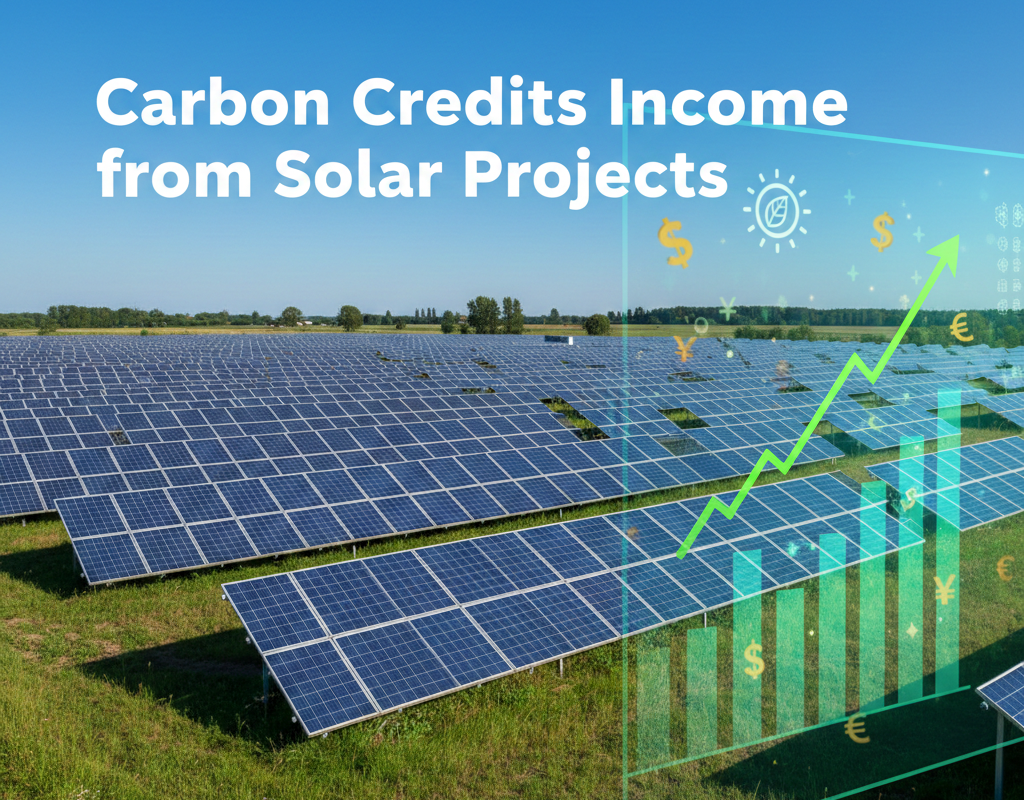
Carbon Credits Income from Solar Projects in India
Carbon Credits Income from Solar Projects in India
India is seeing a significant expansion in the renewable energy sector, with solar power leading the way. In addition to the direct environmental advantages of lowering greenhouse gas emissions, solar systems now generate income from carbon credits. Carbon credit monetization from solar systems has emerged as a strategic possibility as companies, project developers, and investors look for creative financial models to increase returns.
The idea is straightforward yet effective: carbon dioxide emissions are avoided when solar energy projects take the place of fossil fuel-based electrical generation. It is possible to measure, validate, and turn these saved emissions into tradeable carbon credits. One metric ton of carbon dioxide equivalent (CO₂e) avoided or reduced is usually represented by each carbon credit.

Comprehending Carbon Credits and Their Operation
By generating economic value around emission reductions, carbon credits are tools intended to lower global greenhouse gas emissions. In order to offset their carbon impact, governments, businesses, and other organizations who are unable to directly cut their emissions can buy carbon credits.
Carbon credits are produced by solar energy projects through:
- Generating electricity from renewable resources.
- Displacing coal, diesel, and other fossil fuel-based electricity.
- Calculating the emissions avoided using accepted techniques.
- Registering the project in accordance with accepted carbon guidelines.
- Granting certified carbon credits upon independent confirmation.
Depending on buyer requirements and project registration, these credits may be offered for sale in voluntary or compliance markets.
The Benefits of Solar Projects for Earning Carbon Credits
For generating carbon credits, solar plants are especially well-suited for a number of reasons:
- Measurable decreases in emissions
The output of solar arrays is measured and predictable. Metering systems make it possible to precisely trace the generation of electricity, which facilitates accurate estimations of emission reduction.
- Strong Interest in Renewable Offsets
Because renewable energy-based credits are in line with sustainability reporting systems and ESG (Environmental, Social, and Governance) commitments, corporate buyers are favoring them more and more.
- The ability to scale
Depending on the eligibility requirements, projects with different capacities—from utility-scale solar farms to rooftop solar installations—can be eligible for the issuing of carbon credits.
- Long-Term Source of Income
Income from carbon credits can last for years, usually seven to ten years or more, depending on the standard and crediting term selected.
How Solar Projects Produce Revenue from Carbon Credits?
There are various organized procedures involved in producing carbon credit income from solar projects:
- Step 1: Evaluation of Project Feasibility
The solar installation’s eligibility under carbon credit methodology is assessed by the developer. Project size, location, baseline emissions, and additionality requirements are some of the variables.
- Step 2: Registration and Documentation
Technical specifications, anticipated generation, estimates for emission reduction, and monitoring strategies must all be included in the project’s comprehensive documentation. A reputable carbon standard body has received this documentation.
- Step 3: Verification by a Third Party
An impartial auditor confirms that the project satisfies all eligibility standards.
- Step 4: Observation and Confirmation
Accredited auditors keep an eye on and occasionally validate actual electricity generation statistics.
Financial Advantages Apart from Direct Income
Income from carbon credits does more than just produce immediate cash flow.
- Enhanced Bankability of the Project
By increasing the internal rate of return (IRR), carbon revenue makes projects more appealing to investors and lenders.
- Improved ESG Profile
Businesses that use carbon credits to fund solar installations show quantifiable climate action, raising their corporate sustainability scores.
- Prolonged Competitive Advantage
Early adopters of carbon credit monetization enjoy a competitive edge as international carbon restrictions tighten.
Market expansion and policy support in India
India has pledged to achieve net-zero and aggressive renewable energy targets. These pledges are in line with the growth of solar capacity. Clear and transparent policy frameworks are being developed to support carbon markets and renewable energy.
It is anticipated that the growth of an organized carbon market in India will:
- Standardize the issue of credit
- Increase the transparency of prices
- Expand opportunities for domestic trade
- Increase the requirements for compliance
The viability of carbon credit revenue from solar projects is increased, and investor confidence is bolstered by this regulatory progression.
Hazards and Things to Think About
Despite the alluring advantages of carbon credits, project developers need to take into account a few things:
- Volatility of Prices
The price of carbon credits varies according to business sustainability initiatives, governmental changes, and worldwide demand.
- Modifications to Regulations
Eligibility and pricing mechanisms may be affected by changes in national or international climate policy.
- Costs of Verification
Administrative and audit costs are associated with registration, validation, and monitoring.
- Additional Requirements
Projects must show that, especially in voluntary markets, the revenue from carbon credits plays a critical role in project implementation.
Project developers should consider these strategic recommendations.
Developers should do the following to optimize solar projects’ carbon credit revenue:
- Assess the viability of carbon early in the project planning phase.
- Select certification requirements that are in line with your target market.
- Assure precise data monitoring and metering systems.
- Join forces with seasoned carbon consultants.
- To maximize the timing of loan sales, keep an eye on market developments.
- Examine ahead contracts with business purchasers.
- To ensure seamless verification cycles, keep your documentation clear.
Long-term sustainability and profitability can be greatly increased by taking a proactive approach.
In conclusion: Carbon Credits Income from Solar Projects in India
Income from carbon credits generated by solar plants is a potent example of how financial opportunity and environmental responsibility may coexist. Solar power projects are lowering carbon emissions and producing quantifiable economic value as India speeds up its switch to renewable energy.
Project developers can access significant new cash streams by utilizing structured carbon markets, reliable verification mechanisms, and rising corporate demand. Carbon credits are changing the financial landscape of renewable energy, whether through aggregated rooftop installations or large-scale solar farms.
Carbon credit monetization from solar installations is more than just an added benefit for companies, investors, and developers looking to expand sustainably; it is a competitive edge in the developing low-carbon economy.
3 Comments