
 Aksh
Aksh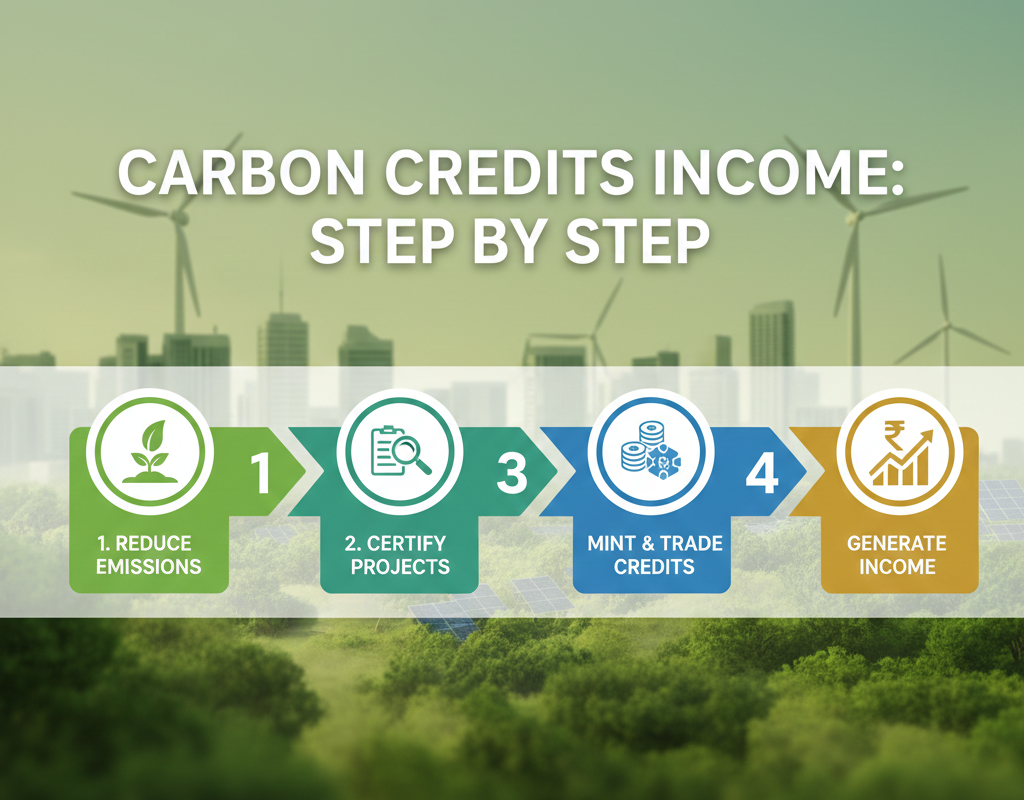
Carbon Credits Income Step by Step Guide
Carbon Credits Income Step by Step Guide
Carbon credits have become one of the most promising financial instruments to lower greenhouse gas emissions while producing sustainable revenue as concerns about climate change grow worldwide. Strong government measures, rising business sustainability commitments, and rising voluntary carbon market participation are all contributing to India’s carbon market’s rapid expansion.
This thorough reference outlines how people, farms, businesses, and project developers can make money by cutting carbon emissions.

Carbon Credits: What Are They?
The decrease or removal of one metric ton of carbon dioxide (CO2) or its equivalent greenhouse gas from the atmosphere is represented by a tradable certificate known as a carbon credit. Businesses and organizations buy these credits to offset their emissions and achieve climate goals.
Carbon credits are produced by initiatives that lower emissions, like:
- Projects involving renewable energy
- Reforestation and replanting
- Enhancements in energy efficiency
- Capture of methane
- Initiatives for waste management
- Agriculture that is sustainable
With the advent of voluntary and compliance markets, the carbon credit ecosystem in India is developing and offering substantial revenue prospects.
Why India’s Carbon Credits Present a Good Income Prospect?
One of the biggest developing carbon markets is India because of:
- Quick industrial expansion
- robust growth in renewable energy
- vast agricultural foundation
- Growing demands for ESG compliance
- Government regulations that facilitate carbon trading
To reach net-zero targets, companies from a variety of industries are actively buying carbon credits. Demand is generated as a result, increasing the possibility of steady revenue from carbon credits.
Process Step-by-Step for Earning Carbon Credits
A detailed explanation of how carbon credit revenue is produced may be found below.
- Step 1: Find a Project That Qualifies for Carbon Reduction
Finding a project that lowers or eliminates greenhouse gas emissions is the first stage in producing income from carbon credits.
- Typical Indian Eligible Projects
- Installations of solar electricity
- Projects involving wind energy
- Biomass power plants
- Biogas facilities
- Better stoves
- Agroforestry and planting trees
- Sustainable agricultural methods
- Waste-to-energy facilities
- Capture of methane from landfills
- Industry-wide energy efficiency retrofits
Depending on the nature of the project, farmers, landowners, businesses, and community organizations can all take part.
- Step 2: Evaluate the feasibility
Prior to moving forward, a technical feasibility study needs to ascertain:
Emissions at baseline (present level of emissions)
- Estimated decreases in emissions
- Duration of the project
- Implementation costs
- Anticipated production of carbon credits
- Forecast of the market price
This phase guarantees that the project will produce enough carbon credits to be profitable.
- Step 3: Preparing the Project Design Document (PDD)
Your carbon credit project’s technical blueprint is called the Project Design Document. It consists of:
- Description of the project
- Techniques employed
- Baseline computation
- Plan for monitoring
- Anticipated decreases in emissions
- Evaluation of the social and environmental effects
Registration with approved carbon standards requires this document.
- Step 4: Carbon Standard Registration
The project needs to be registered under an authorized carbon standard in order to produce trading carbon credits. Common international standards consist of:
- VCS, or Verra
- International Carbon Council Gold Standard
- The Climate Action Reserve
- Additionally, India is creating its own domestic carbon credit trading system.
The project can be verified and given credit when it has been registered.
Income from Carbon Credits for Indian Farmers
One of India’s biggest untapped carbon credit income groups is farmers.
- Agricultural Practices That Qualify
- Decreased tillage
- Organic agriculture
- Use of biochar
- Agroforestry
- Carbon sequestration in soil
- Better methods for irrigation
Farmers may increase crop output and soil health while reducing carbon emissions by implementing climate-smart techniques.
Small farmers can take part jointly through aggregation models, which lower expenses and boost profitability.
Government Assistance for India’s Carbon Markets
India is putting in place structured carbon trading mechanisms and reaffirming its climate pledges. Growth is being aided by carbon market frameworks, ESG compliance requirements, and subsidies for renewable energy.
By formalizing and regulating carbon trading, the Indian Carbon Market mechanism seeks to improve trust and transparency.
Why Earning Carbon Credits Is a Long-Term Prospect?
Carbon credit initiatives often last 10 to 30 years, in contrast to short-term corporate endeavors. This guarantees steady revenue over long stretches of time.
The value of the credit is expected to rise as carbon prices rise internationally, increasing profitability.
India’s potential is further enhanced by its growing renewable energy capacity and agricultural reforms.
Conclusion: Carbon Credits Income Step by Step Guide
One of the most potent connections between sustainability and profitability is represented by carbon credit income. Both individuals and companies can produce quantifiable environmental benefit and gain income by lowering emissions.
Carbon credits have the potential to develop into a dependable, long-term revenue stream with careful planning, competent registration, and effective marketing.
India’s size, agricultural foundation, and growth in renewable energy make it ideally positioned to take the lead in climate finance. This expanding green economy has a lot to offer those that get in early and plan their initiatives well.
Carbon Credit Platforms for Farmers: Unlocking Sustainable Income Through Climate Action
Carbon Credit Platforms for Farmers: Unlocking Sustainable Income Through Climate Action