
 Aksh
Aksh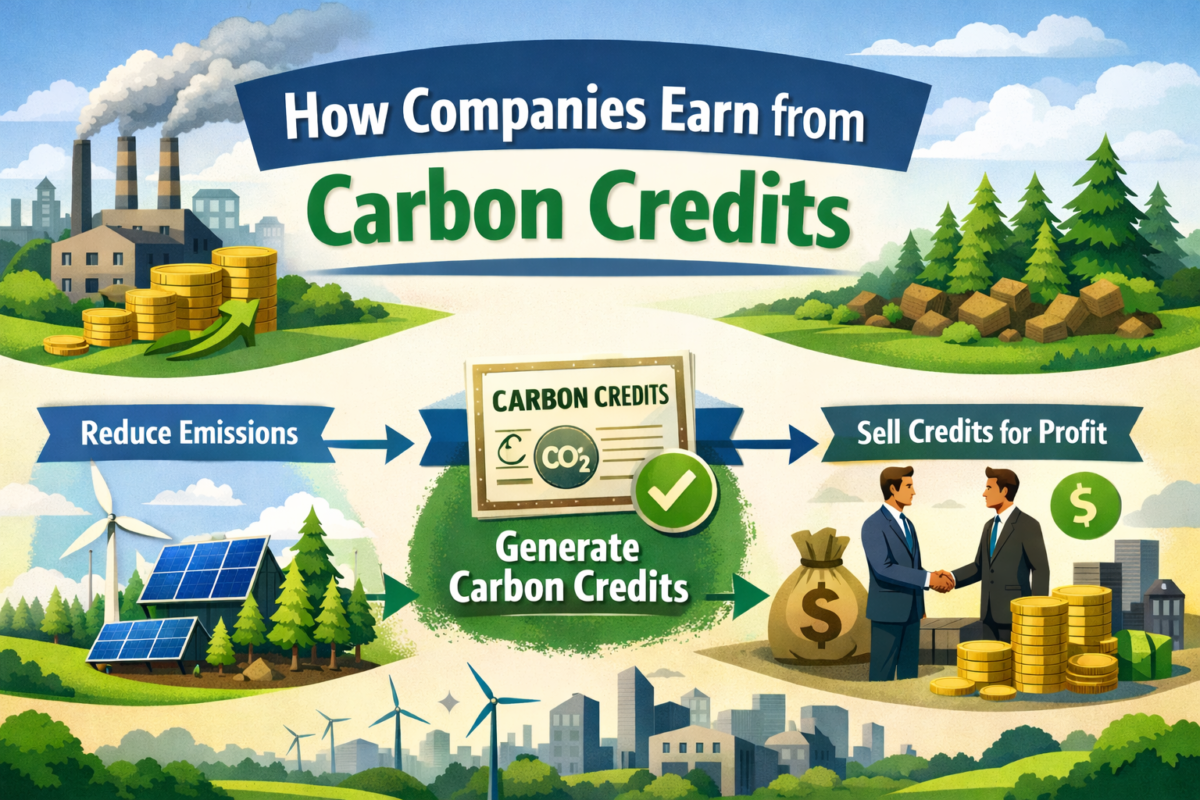
How Companies Earn from Carbon Credits
How Companies Earn from Carbon Credits
Carbon credits have developed into a potent financial tool as international climate restrictions tighten and sustainability becomes a top business focus. What started out as a way to comply with environmental regulations has evolved into a multibillion-dollar worldwide marketplace where businesses may make significant profits while also helping to mitigate climate change.
Carbon credits provide companies in the energy, manufacturing, forestry, infrastructure, technology, and financial sectors both a strategic potential and a compliance requirement. Knowing how carbon markets work, the various kinds of credits that are accessible, and the various business models that propel profitability in this expanding industry are all necessary to comprehend how businesses profit from carbon credits.

Comprehending Carbon Credits
One metric ton of carbon dioxide or its equivalent in other greenhouse gases can be reduced, eliminated, or avoided with a carbon credit, which is a tradable certificate. Verified projects that lower emissions or remove carbon from the atmosphere are used to create these credits.
Generally speaking, there are two main markets for carbon credits:
- The Carbon Market for Compliance
Emissions trading programs and other government-mandated mechanisms manage the compliance market. One well-known example is the EU Emissions Trading System, which mandates that businesses maintain enough allowances to cover their emissions. They can sell extra allowances if they emit less than what has been allotted. They have to purchase credits if they go above limits.
The California Cap-and-Trade Program and comparable regional frameworks around the world are examples of additional compliance measures.
- Market for Voluntary Carbon
As part of their commitments to corporate sustainability or net zero, businesses can voluntarily offset their emissions by purchasing carbon credits through the voluntary carbon market. Usually, projects related to waste management, agriculture, forestry, renewable energy, and industrial efficiency produce these credits.
The Verra and the Gold Standard are two important standards that certify voluntary carbon credits.
The Accounting Framework for Carbon Credit Profits
The lifecycle of a carbon project must be examined in order to comprehend how businesses make money:
- Step 1: Identification of the Project
A business finds a quantifiable possibility to reduce emissions.
- Step 2: Selecting a Methodology
The project adheres to accepted carbon accounting standards.
- Step 3: Verification
Project design is validated by independent auditors.
- Step 4: Execution
Activities to reduce emissions are carried out.
- Step 5: Observation and Confirmation
Reductions in emissions are tracked and confirmed.
- Step 6: Issuance of Credit
Project owners are given verified credits.
- Step 7: Sale of Credit
Direct contracts, brokers, or exchanges are used to sell credits.
Although pre-sales and forward contracts are becoming more and more popular for financing projects, revenue is earned upon credit sale.
Elements That Affect the Profitability of Carbon Credits
Carbon credits are not all created equal. Profits are reliant on:
- Type of Project
Demand for nature-based solutions is frequently higher.
- Standard of Certification
Buyer confidence is increased by premium standards.
- Place
Emerging market projects could have greater margins and cheaper expenses.
- Additionality and Permanence
Premium fees are charged for high-integrity credits.
- The state of the market
The balance between supply and demand has a big influence on pricing.
Corporate Net Zero Commitments’ Function
The market for carbon credits keeps rising as multinational firms pledge to achieve net zero emissions by 2030, 2040, or 2050.
As businesses move toward complete decarbonization, carbon credits act as a stopgap measure. While long-term technologies develop, they allow for rapid climate action.
To meet climate commitments, major multinational firms set aside a sizeable portion of their annual budgets for carbon offsets.
New Developments in Carbon Credit Income
The environment surrounding carbon credits is changing quickly.
- Monitoring, Reporting, Verification (MRV) in digital form
Transparency is enhanced via blockchain, AI, and satellite monitoring.
- Tokenization of Carbon
Digital carbon assets improve accessibility and liquidity.
- The Growth of Blue Carbon
There is new potential for sequestering carbon in marine environments.
- Technologies for Carbon Removal
Future high-value credit segments include improved mineralization and direct air capture.
- ESG Finance Integration
Corporate finance systems are increasingly incorporating carbon credits.
In conclusion: How Companies Earn from Carbon Credits
Carbon credits have evolved from legal requirements to significant financial resources. Carbon credits are earned by businesses through the creation of emission reduction initiatives, the sale of excess allowances, the trading of credits as financial assets, the incorporation of carbon strategies into ESG frameworks, and the use of sustainability to gain a competitive edge.
Opportunities in renewable energy, forestry, agriculture, industrial innovation, and financial services are all part of the growing carbon economy. Carbon markets are positioned to emerge as a key component of business revenue strategy as global climate goals gain momentum.
The best-positioned companies to prosper in the nascent low-carbon economy are those who comprehend market dynamics, guarantee high-integrity project development, and match carbon finance with long-term sustainability objectives.
Carbon Credit Platforms for Farmers: Unlocking Sustainable Income Through Climate Action
Carbon Credit Platforms for Farmers: Unlocking Sustainable Income Through Climate Action
2 Comments