
 Aksh
Aksh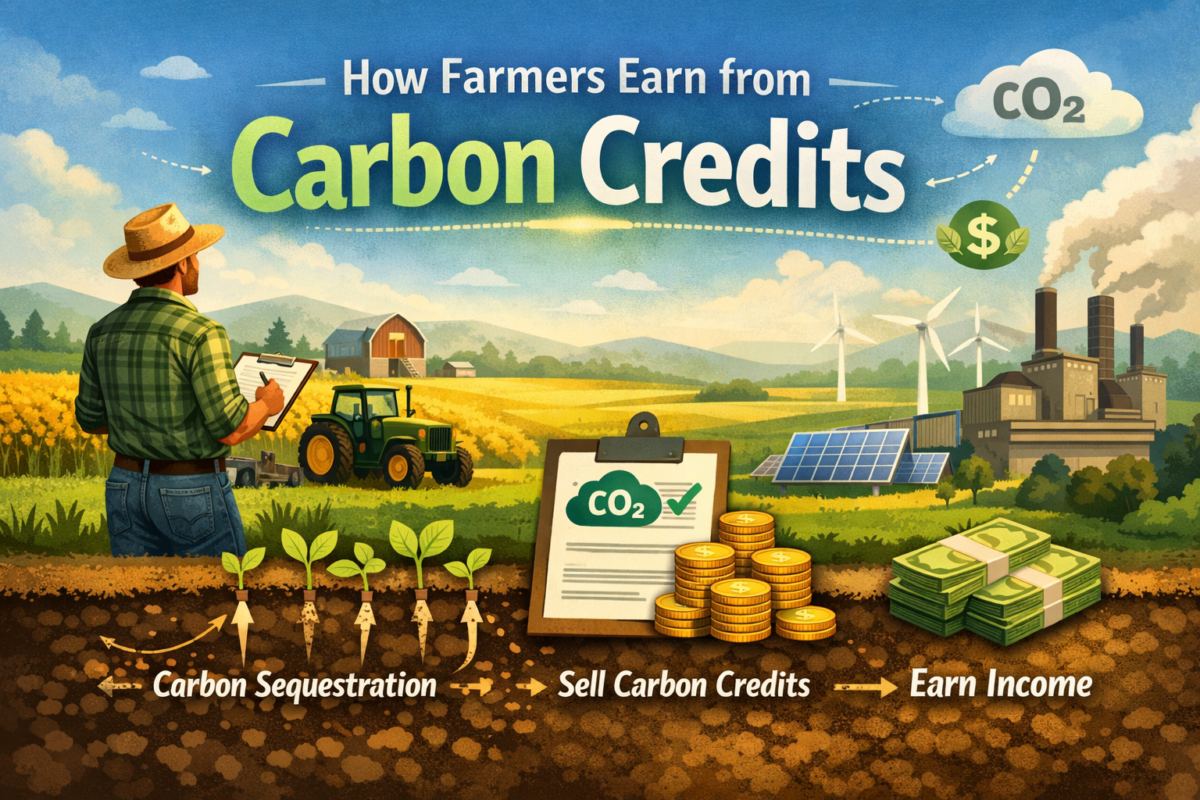
How Farmers Earn from Carbon Credits?
How Farmers Earn from Carbon Credits?
In rural India, a new source of income is opening up as climate change intensifies and businesses look for methods to lessen their environmental impact. By using sustainable farming methods that lower greenhouse gas emissions and boost soil carbon absorption, farmers can now benefit from carbon credits. For farming communities, what was before thought to be simply environmental effort has evolved into a profitable opportunity.
Companies and renewable energy firms are no longer the only entities eligible for carbon credits. Small and marginal farmers can now take part in carbon markets, increase their income, and enhance crop productivity, soil health, and long-term sustainability. In India, the market for agricultural carbon credits is steadily emerging as one of the most promising instruments for climate finance.

Recognizing Carbon Credits in Agriculture
One metric ton of carbon dioxide or comparable greenhouse gasses that have been cut, eliminated, or prevented from entering the atmosphere is represented by a carbon credit. Soil disturbance, fertilizer use, livestock methane, rice cultivation, and crop residue burning are the main sources of emissions in agriculture. But farms also have enormous potential for storing carbon in vegetation and soil.
It is possible to convert the measurable environmental benefit into carbon credits when farmers implement techniques that either improve carbon storage or decrease emissions. These credits are subsequently offered for sale to businesses, associations, or establishments looking to reduce their carbon emissions. As a result, there is a direct financial exchange between environmental stewardship and income.
The Significance of Carbon Credits to Indian Farmers
Declining soil fertility, erratic rainfall, growing input costs, and market volatility are some of the issues facing Indian agriculture. Farmers can receive additional revenue from carbon credits, which are not reliant on commodity prices or crop yield. Rather, income is correlated with environmental impact and sustainable activities.
Even a slight improvement in earnings per acre can make a big difference in small farmers’ financial security. Carbon income can be used to diversify farming systems, invest in improved irrigation systems, or offset fertilizer costs. Carbon payments frequently also promote better soil moisture retention and lower chemical input costs, which boosts profitability even more.
How Carbon Credits Are Generated by Farmers?
By putting certain climate-smart measures into place that either lower greenhouse gas emissions or boost carbon sequestration, farmers can produce carbon credits. Before credits are given, these practices are measured, tracked, and validated scientifically.
Soil carbon sequestration is one of the most popular techniques. Carbon is kept in the soil instead of being released into the atmosphere when farmers use no-till or reduced tillage. As soil organic carbon levels rise over time, fertility and water retention are enhanced.
Another well-known technique is cover crops. Farmers can improve biodiversity, stop soil erosion, and absorb atmospheric carbon by growing cover crops during fallow times. The extra biomass raises the amount of carbon in the soil.
How Carbon Credits Are Obtained?
Enrollment in a carbon project or program is the first step in the process. Farmers commit to putting certain sustainable practices into effect over a predetermined time frame. To ascertain the current emission levels and soil carbon content, baseline data is gathered.
Changes in carbon levels are measured after installation through ongoing observation and recurring soil testing. Results are frequently verified using cutting-edge technologies like digital farm records, remote sensing, and satellite imaging.
Carbon credits are given out once carbon sequestration or emission reductions are verified. Depending on how the program is set up, these credits are then offered for sale in compliance markets or optional carbon markets.
Potential Revenue from Carbon Credits for Agriculture
Location, farming methods, crop type, and market pricing all affect carbon credit revenue. In voluntary markets, the demand from businesses looking to fulfill environmental commitments affects the price of carbon credits.
Depending on how much carbon sequestration is accomplished, farmers can often make more money per acre each year. Carbon credits offer a steady additional cash stream that encourages long-term sustainability, even if they might not be able to completely replace primary agricultural income.
Aggregated carbon credits can provide significant profits for large landowners. Cooperative membership boosts viability and guarantees equitable revenue distribution for small and marginal farmers.
Technology’s Function in Carbon Farming
The way farmers engage in carbon markets is changing as a result of digital platforms. Carbon measurement and reporting are made easier by data analytics, satellite monitoring, and mobile applications.
Technology guarantees openness and lessens the administrative load. To maximize climate-smart methods, farmers can track their carbon performance, keep an eye on indications of soil health, and use advice services.
By guaranteeing traceability and avoiding credit double counting, blockchain technology and digital registries increase trust. Rural communities now have more access to carbon markets because to these technical developments.
Benefits of the Environment Beyond Income
Beyond monetary gains, carbon farming has several additional advantages. Over time, higher crop yields result from increased fertility brought forth by improved soil organic carbon. Crops that retain more water are more resilient to drought.
Reducing the use of chemicals enhances biodiversity and lowers input costs. Additional revenue streams from agroforestry systems include fruits, lumber, and feed. Additionally, sustainable farming lessens agricultural vulnerability to extreme weather events and advances national climate goals.
Carbon credits essentially match financial rewards with environmental sustainability.
India’s Government and Policy Assistance
India is working hard to create a structure for its carbon market. International agreements’ climate commitments have made reducing emissions in all sectors—including agriculture—even more crucial.
Carbon credit options are supplemented by policy initiatives that support organic agriculture, regenerative methods, and sustainable farming. Farmers are encouraged to switch to low-emission agriculture systems through incentive-based initiatives.
In conclusion: How Farmers Earn from Carbon Credits
The value of agriculture has changed significantly as a result of farmers receiving carbon credits. Farmers are acknowledged as climate stewards who can store carbon, lower emissions, and improve ecosystems in addition to producing crops.
Farmers may increase long-term production and open up new revenue streams by implementing sustainable agricultural methods, taking part in carbon markets, and utilizing technology. Agricultural carbon credits are positioned to be crucial to rural economic development and environmental sustainability as India moves closer to its climate goals.
Carbon farming is more than just a green project. It is a route to more sustainable agriculture, better living standards, and a more environmentally friendly future for future generations.
Carbon Credit Platforms Comparison India: Top Platforms, Features & Benefits
Carbon Credit Platforms Comparison India: Top Platforms, Features & Benefits