
 Aksh
Aksh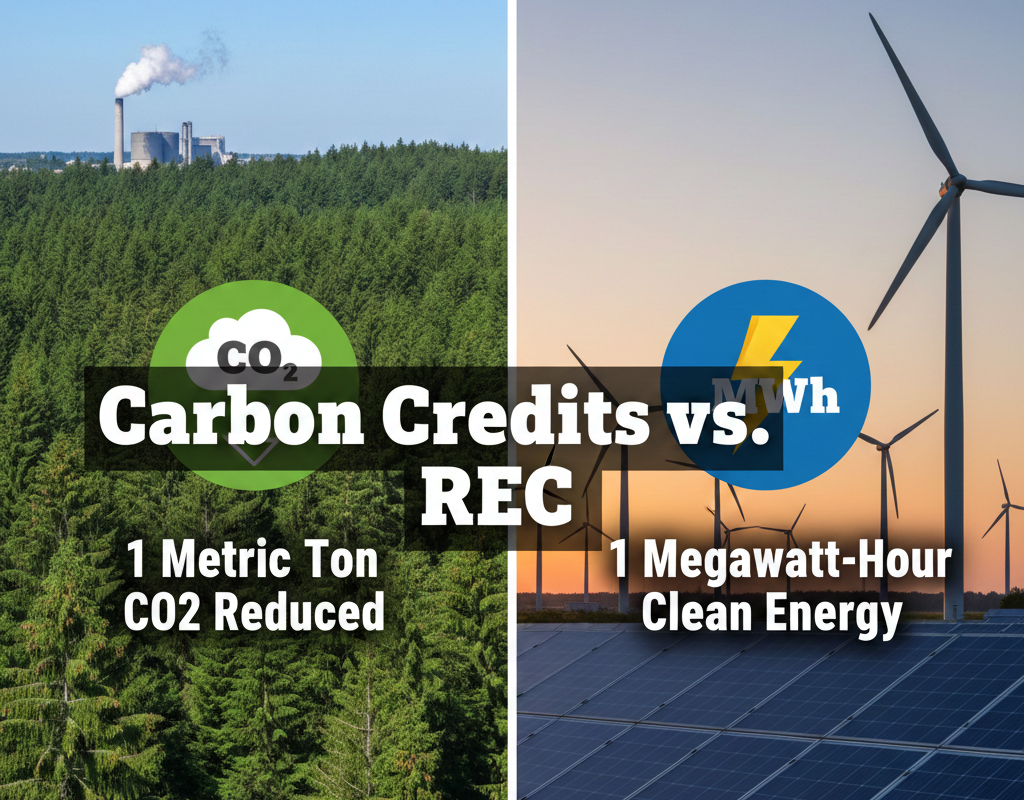
Carbon Credits vs RECs in Renewable Projects
Carbon Credits vs RECs in Renewable Projects
Businesses and governments are actively looking for solutions to lower their carbon footprint in the age of climate change and growing environmental consciousness. Leading this change are renewable energy initiatives, which offer clean energy options that reduce greenhouse gas emissions. Carbon credits and renewable energy certificates (RECs) are two essential instruments for assisting renewable energy projects. Despite frequently being discussed together, these tools have discrete functions and unique workings. Companies, investors, and legislators that want to optimize the financial and environmental advantages of renewable energy projects must comprehend their distinctions.

Carbon Credits: What Are They?
A marketable certificate that certifies the reduction of one metric ton of carbon dioxide (CO2) or an equivalent quantity of other greenhouse gases (GHGs) is called a carbon credit. Projects that actively cut, prevent, or eliminate emissions from the atmosphere produce carbon credits. Reforestation, methane extraction from landfills, and renewable energy projects including wind, solar, and hydroelectric power are a few examples of these.
Carbon credits are primarily intended to facilitate carbon offsetting, which enables businesses to make up for emissions they are unable to completely eradicate. Businesses buy carbon credits to fulfill required carbon market laws or voluntary climate targets. Businesses can show their commitment to the environment and support international efforts to reduce emissions by investing in carbon credit projects.
Understanding Certificates of Renewable Energy (RECs)
Renewable energy certificates (RECs) are linked to the production of renewable electricity, whereas carbon credits concentrate on lowering emissions. A renewable energy certificate (REC) is evidence that one megawatt-hour (MWh) of power was produced using renewable energy sources like hydro, wind, or solar.
RECs have several functions:
- Even if the actual electricity users use comes from the conventional grid, they enable them to claim the environmental benefits of renewable energy.
- They assist enterprises and utilities in fulfilling government requirements for renewable energy.
- By giving producers of renewable energy an extra source of income, they encourage investment in renewable energy infrastructure.
How Carbon Credits Aid with Renewable Energy Initiatives?
When it comes to funding renewable energy projects, carbon credits are essential. Financial and technological obstacles confront many renewable energy projects, especially in developing nations. These initiatives can draw funding from businesses looking to offset their emissions by producing carbon credits through quantifiable emission reductions.
For instance:
- By replacing the production of power from fossil fuels, solar farms lower CO2 emissions and produce carbon credits that may be traded on international markets.
- Wind energy projects are financially feasible for developers since they reduce emissions and produce carbon credits.
In addition to offering a return through trading, investing in carbon credit projects aids in the expansion of the use of renewable energy sources and advances international efforts to mitigate climate change.
RECs’ Function in the Adoption of Renewable Energy
The main purpose of renewable energy certificates is to encourage the production of power from renewable sources. The environmental value of producing renewable energy is represented by RECs, even though they do not directly offset carbon emissions. Businesses that buy RECs encourage more investments in solar, wind, and other clean energy technologies by bolstering the expansion of renewable energy infrastructure.
A company operating in an area with a coal-heavy electrical system, for example, can purchase RECs to demonstrate that the production of renewable energy equals its energy use. Businesses can satisfy corporate social responsibility (CSR) objectives and follow worldwide sustainability trends by implementing this strategy.
Including RECs and Carbon Credits in Renewable Projects
Although RECs and carbon credits serve different purposes, they can work in tandem on renewable energy projects. Take the example of a solar farm that produces 10,000 MWh of electricity each year:
- 10,000 RECs are produced by the project, enabling businesses to claim their use of renewable energy.
- Additionally, the project generates carbon credits that may be sold to offset emissions elsewhere by dislodging CO2 emissions from fossil fuel sources.
Developers of renewable energy can advance sustainability and generate different revenue streams by utilizing both strategies. Companies can align their financial and environmental objectives by supporting the adoption of renewable energy sources and lowering their carbon footprint at the same time.
Standards and the Regulatory Framework
To guarantee legitimacy, both carbon credits and RECs must pass stringent verification:
- International standards including the Clean Development Mechanism (CDM), Gold Standard, and Verified Carbon Standard (VCS) are used to verify carbon credits. Real, quantifiable, and long-lasting emission reductions are guaranteed by these criteria.
- Transparency in renewable energy accounting is ensured by RECs, which are tracked and validated by national or regional registers like the Renewable Energy Certificate India Registry (REC-India).
Both instruments must be properly verified in order to preserve market integrity and provide real environmental impact.
Prospects for India’s Carbon Credits and RECs in the Future
The use of renewable energy is expanding quickly in India because to government programs and business sustainability pledges. RECs and carbon credits are both expected to become more and more important:
- There is a high demand for carbon credit projects as India strives to reach net zero emissions by 2070.
- India’s REC market is still growing, encouraging the development of renewable energy sources and facilitating the switch to green energy.
- Green bonds that are connected to carbon credits, or RECs, are one example of an innovative financing instrument that is starting to draw in international investment.
The combination of RECs and carbon credits will boost the expansion of renewable energy projects in India and around the world as companies, investors, and policymakers adopt both instruments.
In conclusion: Carbon Credits vs RECs in Renewable Projects
Organizations and investors looking to engage in renewable projects must comprehend the distinctions between carbon credits and renewable energy certificates (RECs). While RECs allow companies to claim their use of renewable energy, carbon credits offer a way to mitigate greenhouse gas emissions. When combined, they assist businesses meet their sustainability objectives, promote the growth of renewable energy, and mitigate the effects of climate change.
Leveraging both carbon credits and RECs is a potent way for renewable energy projects in India to draw in investment, create several revenue streams, and have a noticeable effect on mitigating climate change.
Organizations may actively contribute to the worldwide transition to clean energy and secure a sustainable future for future generations by incorporating these tools into their operations.
Forestry Carbon Credits Explained: Complete Glossary for Projects and Investors
Forestry Carbon Credits Explained: Complete Glossary for Projects and Investors