
 Aksh
Aksh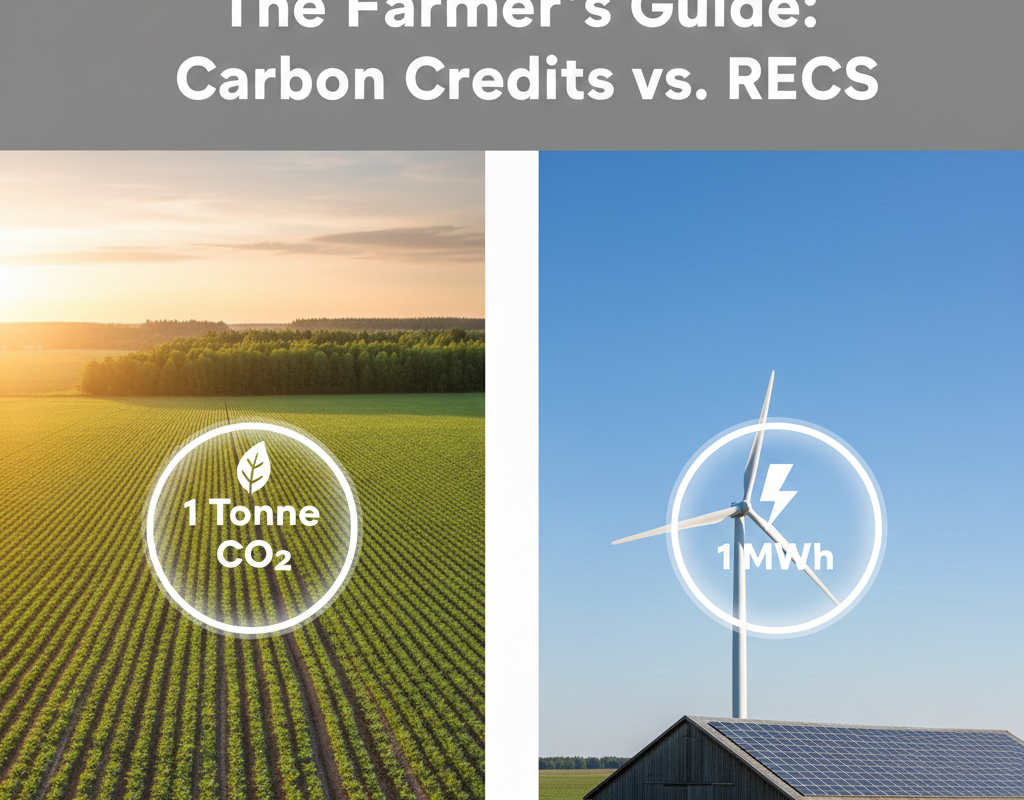
Farmers’ Roadmap to Sustainable Agriculture
Farmers’ Roadmap to Sustainable Agriculture
Sustainability is more than just a catchphrase in today’s agricultural environment; it is essential. More and more farmers in India and throughout the world are searching for methods to improve soil health, lower greenhouse gas emissions, and create new sources of income. Carbon credits and renewable energy certificates (RECs) are two well-liked and rapidly growing paths. Although they operate differently and address various facets of farming, both programs provide financial incentives for ecologically friendly activities. For farmers looking to optimize sustainability and profitability, it is essential to comprehend the differences between carbon credits and RECs.

Carbon Credits: What Are They?
The reduction of one metric ton of carbon dioxide or its equivalent in other greenhouse gases (CO₂e) is represented by a tradable certificate or permit known as a carbon credit. They participate in international carbon trading markets that are intended to combat climate change by providing incentives for reducing emissions. By adopting techniques that maximize energy consumption in agricultural operations, lower methane emissions from livestock, or trap carbon in soil, farmers can receive carbon credits.
For instance, implementing agroforestry, no-till farming, or better rice production techniques can result in quantifiable drops in greenhouse gas emissions. Following verification, these reductions are turned into carbon credits that can be offered for sale to governments or businesses looking to reduce their carbon emissions.
Renewable Energy Certificates (RECs): What Are They?
Conversely, Renewable Energy Certificates (RECs) serve as evidence that one megawatt-hour (MWh) of electricity was produced using renewable energy sources, such as biomass, wind, or solar. RECs are associated with the creation of renewable energy, as opposed to carbon credits, which are mainly associated with the reduction of emissions.
If farmers use renewable energy sources on their farms, such as solar panels, wind turbines, or biogas facilities, they are eligible to take part in the REC market. One unit of renewable energy is represented by each REC, which can be sold to utilities or businesses trying to reach sustainability goals or renewable energy commitments.
The Significance of Carbon Credits for Farmers
- More Revenue from Carbon Farming
Sales of carbon credits can generate additional revenue when carbon-friendly farming practices are used. For example, farmers can increase soil carbon sequestration by implementing conservation agriculture or growing cover crops, which will generate quantifiable credits for the carbon market.
- Management of Sustainable Soil
Carbon farming promotes methods that increase biodiversity, water retention, and soil fertility. Over time, higher agricultural yields from healthier soils will boost farm profits.
- Support for the Climate Goals
Farmers directly contribute to climate change mitigation by lowering emissions. As a signatory to the Paris Agreement, India supports agricultural carbon credit programs in order to meet national goals.
Reasons for Farmers to Take RECs Into Account
- Income from the Production of Renewable Energy
Farmers are able to produce RECs that can be sold for a profit by installing solar panels, wind turbines, or biogas plants. This lessens the financial risk brought on by shifting crop prices and diversifies sources of income.
- Reduced Operating Expenses
Reliance on costly grid electricity and fuel can be decreased by using renewable energy to power processing equipment, cold storage units, and irrigation systems.
- Assistance with Electrification in Rural Areas
Communities become more resilient and sustainable when farm-generated renewable energy lowers greenhouse gas emissions and increases local energy security.
Obstacles and Things to Think About
Although RECs and carbon credits have many advantages, farmers should be mindful of several possible drawbacks:
Challenges with Carbon Credits:
- High verification expenses for small farms.
- Intricate procedures and requirements for monitoring.
- The price of carbon credits is impacted by market volatility.
Challenges for RECs:
- Initial financial outlay for infrastructure related to renewable energy.
- Needs for operations and maintenance.
- Changes to regulations that affect REC eligibility or pricing.
Despite these obstacles, government programs and industry collaborations are helping farmers get over obstacles and take part in the carbon and REC markets.
India’s Government and Market Assistance
To encourage farmers to embrace carbon farming and renewable energy, the Indian government has launched a number of initiatives:
- The Paris Agreement’s Nationally Determined Contributions (NDCs).
- Programs for solar irrigation and financial aid for green energy systems on farms.
- Schemes for agricultural carbon credits run by the Ministry of Climate Change, Forests, and Environment.
Furthermore, farmers can now more effectively monetize carbon sequestration and the production of renewable energy thanks to the emergence of private carbon marketplaces.
Prospects for Farmers in the Future
The value of RECs and carbon credits is expected to increase as a result of the increased focus on climate action worldwide. This provides farmers with long-term chances to:
- Increase revenue by using a variety of revenue sources.
- Adopt sustainable and climate-smart farming methods.
- Participate in international environmental initiatives and India’s net-zero emission targets.
Smallholder farmers can now take part in carbon and REC markets as infrastructure and awareness grow, making sustainable agriculture both economically viable and environmentally beneficial.
In conclusion: Farmers’ Roadmap to Sustainable Agriculture
Both RECs and carbon credits provide farmers special chances to generate revenue, cut emissions, and adopt sustainable practices. Whereas RECs incentivize the production of renewable energy, carbon credits concentrate on emission reductions and carbon sequestration. Farmers may become leaders in sustainable agriculture by selecting the best strategy—or combining both—to help them reap social, environmental, and economic rewards.
Farmers in India can turn their activities into successful, environmentally friendly businesses by comprehending these principles and utilizing the public and private assistance that is offered. Carbon credits and RECs are important instruments in the drive towards sustainability and innovation, which is where agriculture’s future rests.
Carbon Credit Glossary for Carbon Markets | IndianCarbonCredit.com
Carbon Credit Glossary for Carbon Markets | IndianCarbonCredit.com