
 Aksh
Aksh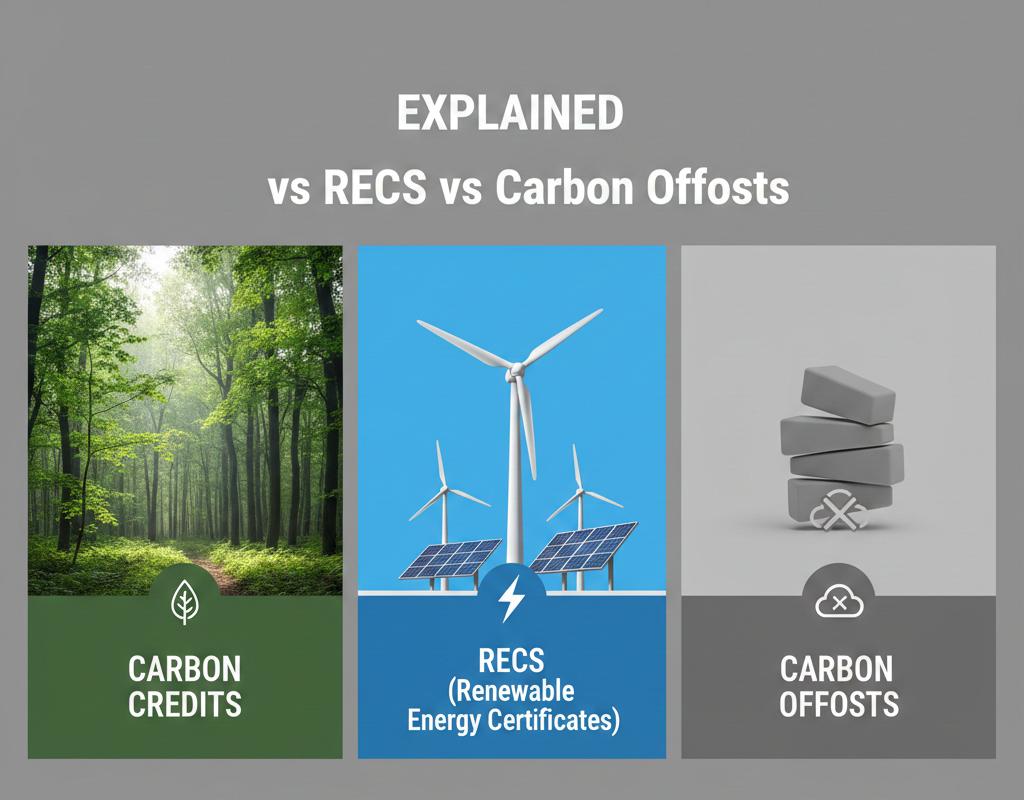
Carbon Credits vs RECs vs Carbon Offsets
Carbon Credits vs RECs vs Carbon Offsets
Environmental markets are growing quickly as climate action around the world picks up speed. To accomplish sustainability goals, adhere to rules, and show climate leadership, businesses, governments, and individuals are increasingly using carbon-related tools. Nonetheless, there is still misunderstanding over three widely used terms: carbon offsets, carbon credits, and renewable energy certificates (RECs).
Despite their frequent interchangeability, these tools have distinct functions, function in various markets, and have various ramifications for emissions reporting and compliance.
This thorough book helps businesses and climate investors make wise decisions in a rapidly changing carbon economy by outlining the distinctions, similarities, regulatory frameworks, market dynamics, and strategic applications of carbon credits, RECs, and carbon offsets.

Knowing the Fundamentals of Climate Markets
In general, climate markets can be divided into two groups:
- Government-regulated markets where companies are compelled by law to restrict emissions are known as compliance markets.
- Platforms where businesses or people buy environmental tools to achieve self-imposed climate targets are known as voluntary markets.
Compliance markets are the main application for carbon credits. The majority of carbon offsets are traded on voluntary marketplaces. RECs are specifically related to clean energy claims and renewable electricity output.
Carbon Credits: What Are They?
One metric ton of carbon dioxide equivalent (CO₂e) is the usual amount of greenhouse gases (GHGs) that can be released by the holder of a carbon credit, which is a marketable permit.
They are mostly utilized in cap-and-trade schemes, in which governments assign credits to regulated organizations by auction or distribution after setting an overall emissions cap.
- The Operation of Carbon Credits
An emissions cap is set by a regulatory body.
- Carbon credits are given to or purchased by businesses.
- A business can sell excess credits if its emissions fall below its permitted level.
- It will be penalized or forced to buy more credits if it emits more.
Technological innovation and carbon reductions are encouraged by this market mechanism.
- Important Features of Carbon Credits
Required involvement (in compliance markets)
- Government-regulated
- Supply and demand dictate price.
- Centered on reducing and capping emissions
Utilized by high-emission sectors such as steel, cement, and electricity
Carbon Offsets: What Are They?
Projects that lessen, prevent, or eliminate greenhouse gas emissions from the atmosphere are known as carbon offsets. Generally, one metric ton of CO2e decreased or eliminated is equivalent to one carbon offset.
Carbon Offsets are mostly traded in voluntary carbon markets (VCM), in contrast to Carbon Credits in compliance markets.
- The Operation of Carbon Offsets
A project developer carries out an emission-reducing project, like:
- Planting new trees
- Installations of renewable energy
- Capturing methane
- Enhancements in energy efficiency
- Direct capture of air
These decreases are quantified, confirmed, and accredited. After that, businesses wishing to make up for their emissions purchase the resulting offsets.
- Important Features of Carbon Offsets
- Participation that is voluntary
- Reductions based on projects
- Utilized in corporate net-zero initiatives
- Pricing determined by the market
- Growing attention to integrity and openness
Renewable Energy Certificates (RECs): What Are They?
One megawatt-hour (MWh) of electricity produced from a renewable energy source and supplied to the grid is demonstrated by Renewable Energy Certificates (RECs).
RECs relate to claims of renewable energy output rather than the direct reduction of carbon emissions.
- How RECs Operate
When energy is generated from renewable sources:
- The grid receives electricity.
- For every MWh produced, a REC is made.
- It is possible to sell the REC and the electricity separately.
Renewable energy use can be claimed by the REC’s buyer.
- Important Features of RECs
- Associated with the production of electricity
- Not in CO₂, but in MWh
- For claims involving renewable energy
- Encourage investments in clean energy
- Avoid directly offsetting emissions
The Expanding Carbon Market in India
India is developing its carbon market ecosystem at a rapid pace.
In order to establish a structured compliance carbon market, the government introduced the Carbon Credit Trading Scheme as part of the Energy Conservation Act modifications.
India currently operates:
- PAT stands for Perform, Achieve, and Trade.
- Mechanism for Renewable Energy Certificates
- New voluntary carbon initiatives
Demand for all three devices is anticipated to rise sharply as India approaches its 2070 net-zero goal.
Honesty and Market Difficulties
- Counting twice
Occurs when many parties assert decreases in emissions.
- Issues with Additionality
Reductions that would not have happened in the absence of the project must be represented by offsets.
- The volatility of prices
Prices for carbon credits in compliance markets vary greatly depending on the state of the economy and policy.
- Openness
The quality and verification of projects are scrutinized in voluntary markets.
Prospects for the Future
Important market-shaping trends:
- Monitoring, Reporting, Verification (MRV) in digital form
- Carbon registries based on blockchain technology
- The Paris Agreement’s Article 6 permits international credit trading
- Corporate pledges to achieve net-zero
- Growth in ESG investments
The difference between Carbon Credits, RECs, and Carbon Offsets will become even more crucial for compliance and credibility as regulatory clarity increases.
Conclusion: Carbon Credits vs RECs vs Carbon Offsets
RECs, carbon offsets, and carbon credits are not the same thing. Each contributes differently to the global climate economy.
- Government limitations on emissions are enforced using carbon credits.
- Carbon offsets use proven reduction programs to make up for emissions.
- Renewable electricity generation is certified by RECs.
Comprehending these distinctions is crucial for compliance, sustainability reporting, and long-term competitiveness for Indian companies getting ready to join the carbon market.
Strategic use of these tools will define responsible business leadership in the low-carbon economy as climate accountability grows on a global scale.
Comprehensive Carbon Credit Terminology: Expert Insights into Offsets, Trading, and Verification
Comprehensive Carbon Credit Terminology: Expert Insights into Offsets, Trading, and Verification