
 Aksh
Aksh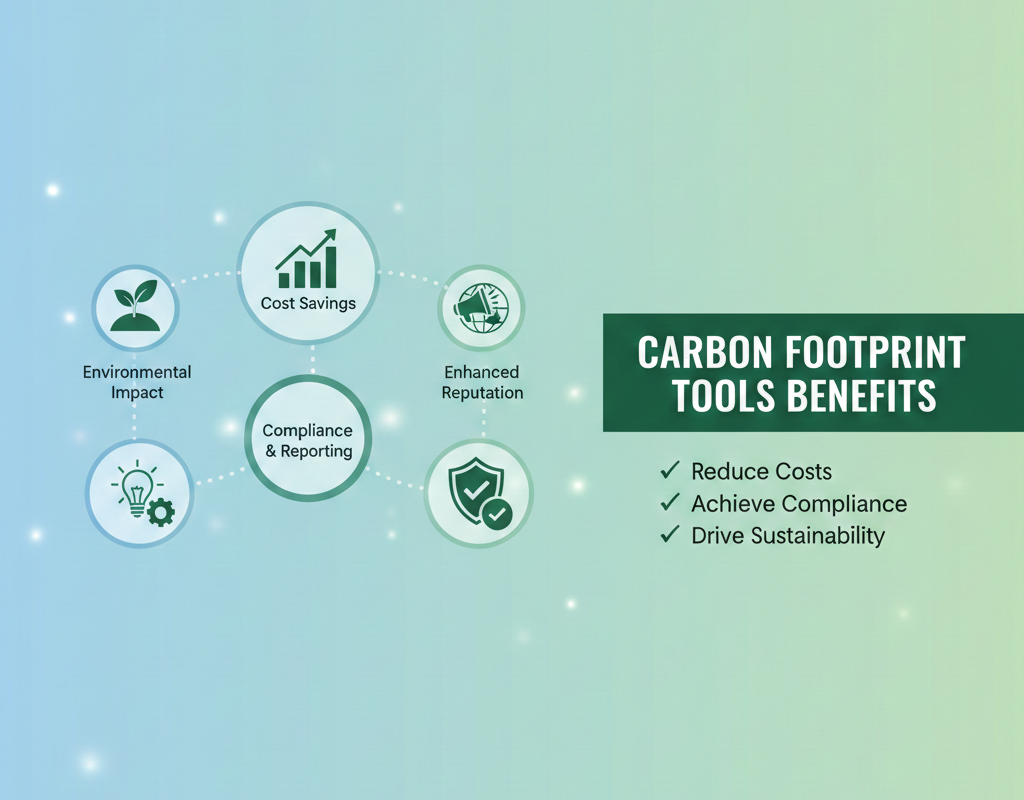
Carbon Footprint Tools Benefits
Carbon Footprint Tools Benefits
Businesses are facing growing pressure to assess and lessen their environmental effect as governments, investors, and corporations around the world make climate change a strategic priority. In India, this shift is accelerating with policy developments, ESG expectations, and growing participation in the carbon market. Carbon footprint technologies are now essential digital solutions that help businesses track emissions, comply with regulations, and take advantage of financial opportunities.
Tools for measuring carbon footprints are now required for sustainability. They are strategic business enablers that boost investor confidence, increase operational effectiveness, and produce quantifiable environmental benefit. Adopting strong carbon management systems is becoming essential for Indian businesses looking to gain a competitive edge and long-term sustainability.

Comprehending Carbon Footprint Instruments
Digital platforms called carbon footprint tools are made to track, measure, evaluate, and report greenhouse gas (GHG) emissions from company operations. Organizations can use these technologies to measure emissions across:
- Emissions falling under scope 1 (direct emissions from owned sources)
- Emissions from scope 2 (indirect emissions from energy purchases)
- Emissions falling under scope 3 (indirect emissions across the value chain)
Carbon footprint technologies offer precise and consistent emission estimations that are in line with international frameworks by incorporating operational data from areas like waste management, transportation, energy consumption, and procurement.
The Importance of Measuring India’s Carbon Footprint
India’s economy is one of the fastest-growing in the world, and it uses a lot of energy. Regulatory and voluntary reporting structures are growing more formal as a result of the Paris Agreement’s climate obligations and aggressive renewable energy targets.
Carbon accounting is crucial due to the growth of sustainability disclosures, ESG reporting requirements, and the developing Indian carbon market. In addition to financial indicators, investors now assess firms’ environmental performance. Companies who don’t measure emissions run the danger of fines from the government, harm to their brand, and missed investment possibilities.
The function of carbon footprinting tools in the carbon market in India
An opportunity for transformation is presented by the growth of India’s carbon trading ecosystem. Establishing a structured market for emission reductions is the goal of the Carbon Credit Trading Scheme, which was introduced by the Ministry of Environment, Forests, and Climate Change.
Tools for carbon footprints encourage market engagement by:
- Keeping an eye on benchmarks for emission intensity
- Getting the paperwork ready for validation
- Assisting with trading tactics
- Monitoring credit performance
Companies equipped with reliable carbon data are better positioned to benefit from market-based mechanisms.
Combining Green Projects and Renewable Energy
Initiatives for renewable energy are also supported by carbon management platforms. Companies switching to biomass, solar, or wind energy can measure the environmental impact and track emissions averted.
This is especially crucial as India scales its renewable energy goals under the Ministry of Power’s direction.
Tools for tracking carbon make sure that investments in renewable energy are appropriately represented in sustainability performance indicators.
Overcoming Obstacles in Implementation
Despite the obvious advantages, some businesses are hesitant to use carbon footprint tools because of:
- Concerns about perceived costs
- Insufficient internal knowledge
- Complexity of data collection
- Uncertainty regarding legal obligations
On the other hand, contemporary carbon accounting systems are becoming more user-friendly and scalable. Numerous systems include automatic integrations, training support, and modular implementation.
Prospects for the Future: Carbon Management as a Fundamental Business Activity
Carbon accounting is quickly becoming a fundamental business discipline rather than just a reporting necessity. In a climate-conscious economy, companies that include sustainability into their strategy will fare better than their rivals.
Future developments include:
- Climate disclosures are required.
- Expansion of the carbon price
- Growth in ESG-related funding
- Enhanced scrutiny by investors
- Cutting-edge digital sustainability platforms
Companies will have a first-mover advantage in the low-carbon transition if they invest in carbon footprint tools early.
The Significance of Carbon Footprint Tools for Indian Businesses
Beyond only measuring emissions, carbon footprint technologies have many other advantages. They promote long-term resilience, market involvement, investor engagement, cost savings, and compliance.
Carbon management tools offer clarity, structure, and quantifiable progress to Indian businesses managing changing rules and environmental requirements.
Businesses that implement cutting-edge carbon accounting systems can:
- Boost ESG performance
- Boost the effectiveness of operations
- Make money from carbon credits
- Enhance stakeholder trust
- Support national climate objectives
Carbon footprint tools are more than just software. They are tactical tools that help businesses balance environmental responsibility with financial success.
In conclusion: Carbon Footprint Tools Benefits
In India and around the world, the shift to a low-carbon economy is quickening. The next generation of business leadership will be characterized by companies that proactively measure, manage, and cut emissions.
Tools for measuring carbon footprints serve as the cornerstone of legitimate climate action. They convert organizational effectiveness and financial opportunity into environmental responsibility. These resources enable Indian businesses to use sustainability as a competitive advantage, from participating in carbon credits to complying with regulations.
Adopting strong carbon footprint tools is now required as the Indian carbon market develops and ESG standards rise. For businesses dedicated to long-term success and sustainable growth, it is a strategic necessity.
In an increasingly carbon-conscious world, companies may unleash creativity, resilience, and climate leadership by incorporating digital carbon management systems into their core operations.
Carbon Credit Price Explained in Easy Language – A Complete Guide for India
Carbon Credit Price Explained in Easy Language – A Complete Guide for India
2 Comments