
 Aksh
Aksh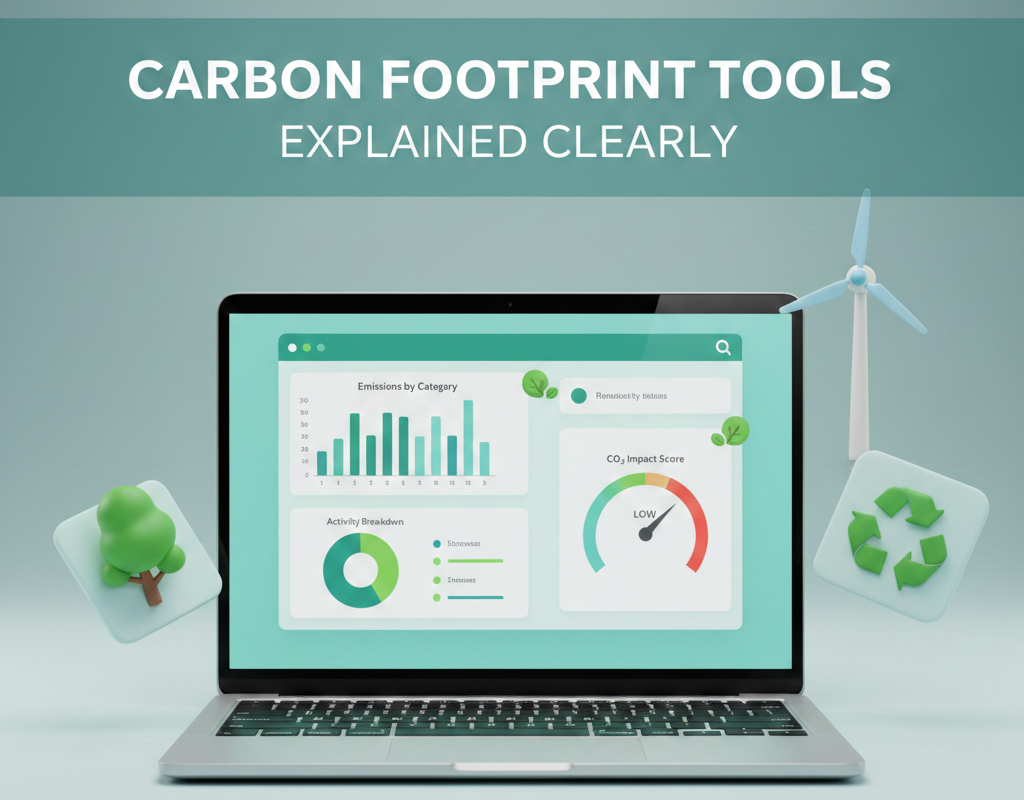
Carbon Footprint Tools Explained Clearly
Carbon Footprint Tools Explained Clearly
It is no longer optional to comprehend and control carbon emissions in the modern, climate-conscious world. There is growing demand on governments, businesses, and individuals to quantify, disclose, and lessen their environmental effect. Tools for managing and calculating carbon footprints have become crucial as climate change picks up speed.
However, what are carbon footprint tools exactly? How do they operate? Who requires them? And how can they open doors like carbon credits while assisting Indian companies in conforming to international climate standards?
This thorough guide helps you comprehend the significance, sorts, features, and advantages of carbon footprint instruments in an easy-to-understand and useful manner.

A Carbon Footprint: What Is It?
A carbon footprint is the total amount of greenhouse gas (GHG) emissions that a person, business, product, or activity produces, either directly or indirectly. Carbon dioxide equivalent (CO₂e), which standardizes the effects of different greenhouse gases like methane and nitrous oxide, is commonly used to measure these emissions.
The Greenhouse Gas Protocol framework divides greenhouse gas emissions into three primary categories:
- Scope 1: Direct emissions from sources that are owned or under control (such as company vehicles or fuel combustion).
- Scope 2: Indirect emissions from steam, heating, cooling, or electricity purchases.
- Scope 3: All additional indirect emissions from the value chain, such as trash disposal, business travel, and supplier activities.
Carbon Footprint Tools: What Are They?
Software programs, calculators, or systems that measure, monitor, evaluate, and report greenhouse gas emissions are known as carbon footprint tools. They support both individuals and businesses:
- Determine emissions precisely.
- Locate hotspots for emissions
- Create strategies for reduction.
- Monitor your progress toward sustainability objectives.
- Create reports for ESG disclosure and compliance.
- Engage with carbon credit markets
Carbon footprint technologies are becoming crucial for businesses looking to maintain environmental compliance and long-term competitiveness in India, where sustainability standards and ESG compliance are gaining traction.
Why Today’s Carbon Footprint Tools Are Important?
- Pressure from Regulations
Globally, governments are enforcing more stringent environmental laws. In accordance with the United Nations Framework Convention on Climate Change, India has instituted sustainability reporting standards. Businesses are now required to openly share environmental performance measures.
- Expectations of Investors
Investment decisions are being influenced by Environmental, Social, and Governance (ESG) criteria. Investors assess businesses according to their strategy for mitigating climate risk and managing carbon emissions.
- An edge over competitors
Customers, partners, and international supply chains are more drawn to companies with quantifiable carbon reduction plans.
- Commitments to Net Zero
The need for trustworthy carbon accounting systems has grown as a result of India’s pledge to attain net-zero emissions by 2070.
Important Qualities of Carbon Footprint Tools
Businesses should consider the following when choosing a carbon footprint tool:
- Observance of the GHG Protocol
- Capability to track emissions in scope 3
- Data integration that is automated
- Compatibility with ESG reporting
- Integration of carbon credits
- Personalized dashboards
- Standards for data security
- Features of audit preparedness
The ideal tool should be in line with industry standards and corporate objectives.
The Advantages of Carbon Footprinting Tools
- Better Decision-Making
Businesses may prioritize reductions and identify high-emission operations with the help of clear data.
- Savings on expenses
Improvements in energy efficiency frequently result in lower operating expenses.
- Compliance with ESG
Carbon solutions make regulatory compliance and sustainability reporting easier.
- Getting into Carbon Markets
In India, producing and trading carbon credits requires precise emissions data.
- Improved Image of the Brand
Leadership in sustainability raises stakeholder trust and brand value.
India’s Carbon Footprint Instruments and Carbon Credits
The first step in getting involved in carbon credit markets is measuring your carbon footprint.
In the global carbon trading market, India is becoming a major player. Carbon credits, which can be exchanged in compliance or voluntary markets, are produced by businesses that lower emissions below baseline levels.
Businesses benefit from carbon footprint tools:
- Determine the baseline emissions
- Keep an eye on reduction initiatives
- Check for decreases in emissions.
- Keep your documentation open and transparent.
It is almost impossible to participate in carbon credit systems without precise measurement.
In conclusion: Carbon Footprint Tools Explained Clearly
Weapons for measuring carbon footprints are crucial weapons in the global battle against climate change. Businesses and individuals can assess, manage, and lessen their environmental impact thanks to their ability to convert complex emission data into actionable information.
These technologies are especially helpful for Indian businesses when it comes to negotiating changing rules, obtaining ESG compliance, and taking part in carbon credit markets. The correct tool enables businesses to create sustainable, future-ready processes, from simple carbon footprint calculators to extensive carbon management systems.
Adopting strong carbon footprint tools is about leadership, accountability, and long-term resilience as climate accountability becomes the norm.
Measuring is the first step in the sustainable path. Additionally, carbon footprint tools make that path transparent, quantifiable, and attainable.
Carbon Credit Price Explained: Complete Guide with Case Study for Indian Businesses
Carbon Credit Price Explained: Complete Guide with Case Study for Indian Businesses