
 Aksh
Aksh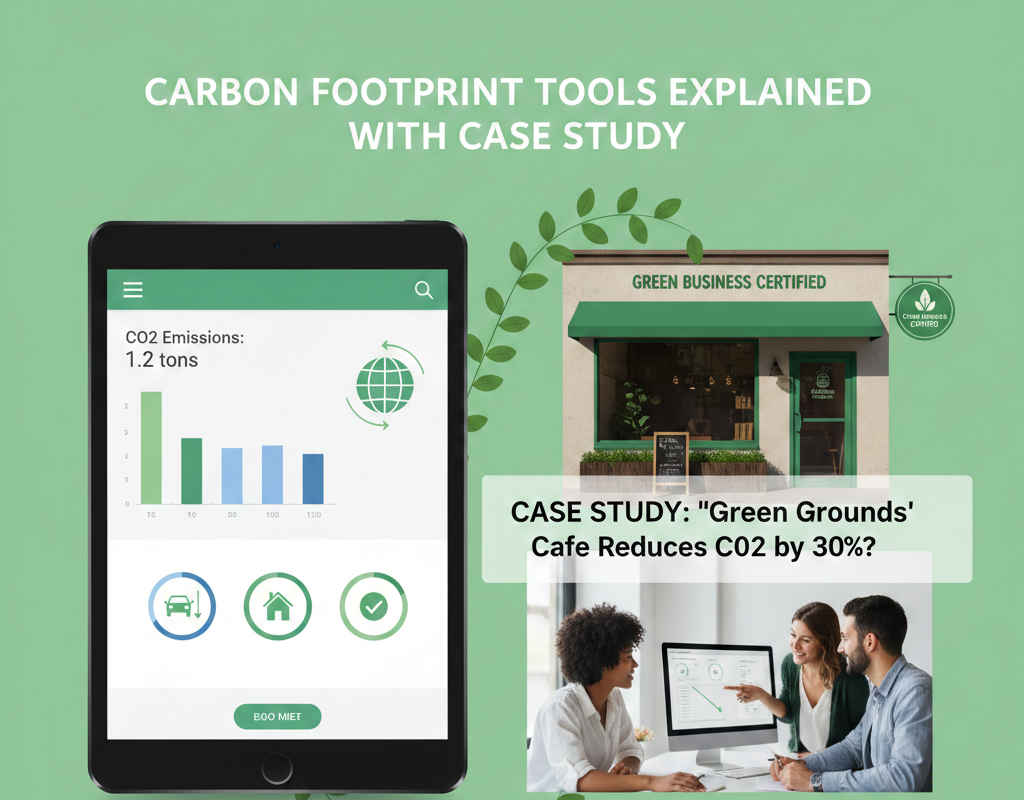
Carbon Footprint Tools Explained with Case Study
Carbon Footprint Tools Explained with Case Study
It is now imperative to measure and manage carbon emissions in today’s climate-conscious economy. Regulators, investors, consumers, and international supply chains are putting increasing pressure on companies in India’s various industries to reveal their GHG emissions and put in place reliable decarbonization plans. Tools for measuring carbon footprints have become essential for this change.
Knowing how carbon footprint tools operate is crucial to remaining competitive in a sustainability landscape that is changing quickly, whether you are a logistics company working across the country, an IT company based in Bengaluru, or a manufacturing company in Gujarat.

A Carbon Footprint: What Is It?
The entire amount of greenhouse gas (GHG) emissions produced both directly and indirectly by a company, good, service, or person is represented by a carbon footprint. Carbon dioxide equivalent (CO2e), which standardizes the effects of gases like methane and nitrous oxide, is commonly used to express these emissions.
The GHG Protocol, created by the World Resources Institute and the World Business Council for Sustainable Development, is the most often used international framework for classifying emissions. Three categories are used to classify emissions:
- Scope 1: Direct emissions.
Emissions from owned or managed sources, including industrial operations, company cars, and fuel combustion.
- Scope 2: Emissions of Indirect Energy
Emissions from heating, cooling, steam, or electricity that has been purchased.
- Scope 3: Emissions from the Value Chain
Every additional indirect emission that takes place across the supply chain, such as trash disposal, business travel, purchased items, and transportation.
Due to international export regulations and ESG reporting requirements, Scope 3 emissions are becoming more and more significant for Indian companies.
Carbon Footprint Tools: What Are They?
Digital platforms, software programs, or organized techniques that compute, track, and report greenhouse gas emissions are known as carbon footprint tools. These solutions produce reports that are ready for compliance, apply standardized emission factors, automate data gathering, and offer insights for emission reduction tactics.
These technologies are increasingly essential in India’s developing climate compliance framework for:
- ESG reporting for corporations
- Compliance with BRSR (Business Responsibility and Sustainability Reporting)
- Participation in carbon credits
- Planning a net-zero roadmap
- Evaluations of supply chain sustainability
Carbon Footprint Tool Types
The complexity of carbon footprint tools varies by sector and company size. The main categories are listed below:
- Simple Carbon Calculators
These are entry-level tools that calculate emissions by taking into account fundamental operating inputs, fuel usage, and energy use. MSMEs and small businesses just starting out in sustainability can use them.
- Tools for Lifecycle Assessment (LCA)
Lifecycle tools evaluate a product’s emissions from the extraction of basic materials to disposal. These systems are widely used in sectors like textiles, FMCG, steel, and cement.
- Carbon Tracking Platforms for the Supply Chain
By collecting emissions data from suppliers and vendors, these methods guarantee Scope 3 reporting is transparent. This capacity is becoming more and more important as Indian exporters provide to international brands.
The Operation of Carbon Footprint Tools
The process of a typical carbon footprint tool is arranged as follows:
- Step 1: Gathering Information
The company enters operational data including waste production, raw material purchases, logistics mileage, diesel use, and power use.
- Step 2: Application of Emission Factors
The tool uses emission parameters that are in line with accepted standards, including national inventory guidelines or the GHG Protocol.
- Step 3: Calculating Emissions
CO2e emissions are computed using conventional formulas.
- Step 4: Classification
The findings are divided into three categories: Scope 1, Scope 2, and Scope 3.
The Significance of Carbon Footprint Tools for Indian Companies
India is quickly incorporating sustainability into its financial and regulatory structures. Adoption is being accelerated by several important factors:
- Adherence to Regulations
Environmental disclosure rules for listed firms are being tightened by Indian regulators. Companies are required to provide standardized, transparent sustainability reports.
- Requirements for International Trade
International consumers, particularly those in North America and Europe, are demanding carbon disclosure from export-oriented businesses.
- Obtaining Carbon Credits
Carbon credits can be produced from verified emission reductions, opening up new sources of income. Validation requires precise carbon accounting.
- Expectations of Investors
Before making a capital allocation, institutional investors are increasingly assessing ESG parameters.
Crucial Elements of Carbon Footprinting Instruments
When choosing a platform for carbon management, Indian companies should consider:
- Adherence to the GHG Protocol’s requirements
- Emission factors unique to India
- The ability to operate in multiple locations
- Integration of ERP
- Audit-ready records
- Modeling scenarios
- Alignment of carbon credits
- Standards for data security
In conclusion: Carbon Footprint Tools Explained with Case Study
In the current commercial and regulatory landscape, carbon footprint tools are no longer optional. They are the cornerstone of long-term sustainability strategy, carbon credit participation, and ESG compliance for Indian companies.
Structured carbon accounting offers quantifiable financial, operational, and reputational advantages to businesses of all sizes. Through carbon credits, the case study illustrates how data-driven carbon management may lower emissions, boost profitability, and open up new revenue sources.
Businesses that invest in strong carbon footprint tools now will spearhead the shift to a low-carbon economy tomorrow as India moves closer to its climate targets.
Carbon Footprint Tools for Startups: Best Solutions to Measure, Track & Reduce Emissions in 2026
Carbon Footprint Tools for Startups: Best Solutions to Measure, Track & Reduce Emissions in 2026