
 Aksh
Aksh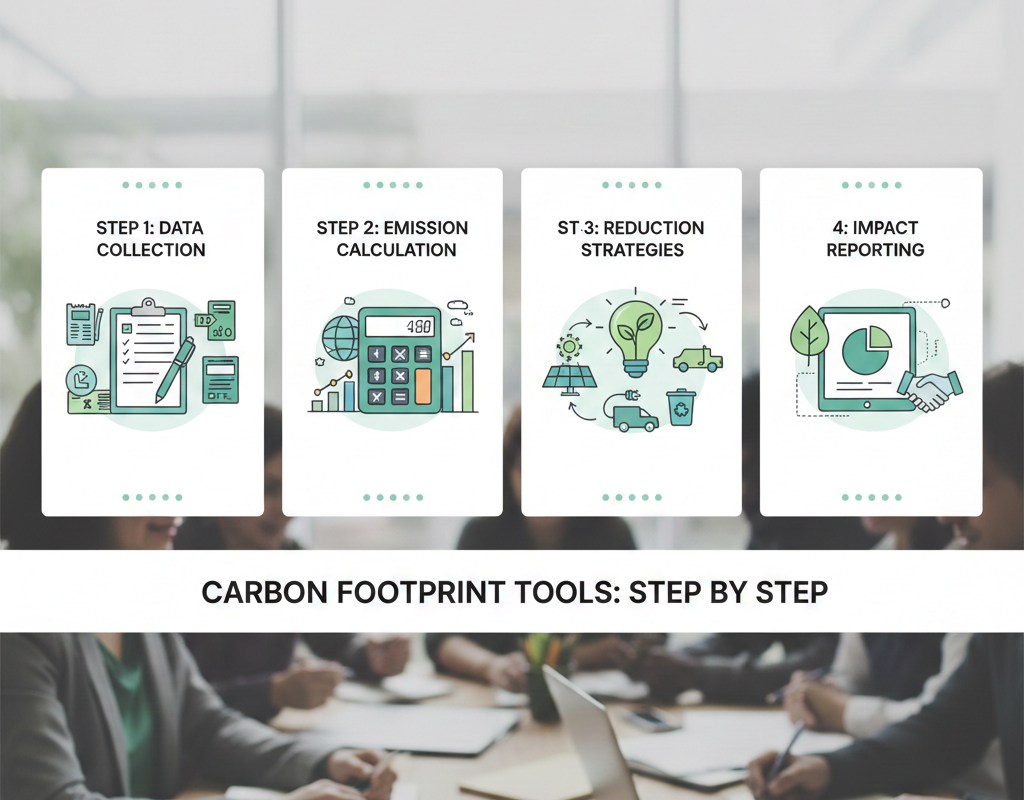
Carbon Footprint Tools Step by Step
Carbon Footprint Tools Step by Step
It is no longer optional to comprehend and control carbon emissions as climate change intensifies and sustainability becomes a commercial need. In order to measure, report, and lower greenhouse gas (GHG) emissions, businesses, organizations, and individuals throughout India are actively searching for trustworthy carbon footprint instruments. Accurate carbon accounting is the cornerstone of climate action, from voluntary carbon markets and carbon credit trading to compliance and ESG reporting.

A Carbon Footprint: What Is It?
An individual, company, product, or activity’s total direct and indirect greenhouse gas emissions are referred to as its “carbon footprint.” In order to standardize the warming impact of various gases, including carbon dioxide (CO2), methane (CH4), and nitrous oxide (N2O), these emissions are commonly stated in tonnes of carbon dioxide equivalent (tCO2e).
In general, carbon footprints fall into one of three categories:
- Scope 1: Direct emissions from owned or managed sources, such as on-site manufacturing, company cars, and fuel combustion.
- Scope 2: Indirect emissions from steam, heating, cooling, or electricity purchases.
- Scope 3: All additional indirect emissions from the value chain, such as those from supplier operations, business travel, waste disposal, and transportation.
Effective use of carbon footprint tools begins with an understanding of these scopes.
The Significance of Carbon Footprint Tools in India
India has bolstered its climate ambitions under international agreements and pledged to achieve net zero emissions by 2070. Accurate carbon measurement is essential in light of growing regulatory scrutiny, ESG reporting requirements, and voluntary carbon market participation.
Organizations benefit from carbon footprint tools:
- Keep an eye on and record emissions
- Determine the sources of high-impact emissions.
- Create plans to reduce emissions.
- Create reports on sustainability.
- Respect the requirements of the regulations
- Create and exchange carbon credits
- Boost investor confidence and brand reputation
Carbon footprint tools are becoming essential for Indian enterprises, particularly MSMEs and large industrial sectors including manufacturing, energy, cement, steel, and agriculture.
Carbon Footprint Tool Types
The following categories can be used to broadly classify carbon footprint tools:
- Carbon Calculators Online
Easy-to-use web-based tools that allow people and small businesses to calculate emissions based on travel, energy use, and waste production.
- Software for Enterprise Carbon Management
Sophisticated platforms made to monitor, report, and confirm emissions across numerous facilities and supply chains for medium-sized and large businesses.
- Tools for Lifecycle Assessment (LCA)
Used to evaluate emissions at the product level during its whole lifecycle, from the extraction of raw materials to disposal.
- Carbon Tools by Sector
Tailored solutions for sectors like energy, transportation, construction, and agriculture.
- Platforms for Carbon Accounting and Reporting
Instruments that are in compliance with global frameworks such as the GHG Protocol, ISO standards, and recommendations for sustainability disclosure.
The Advantages of Carbon Footprinting Tools
- Adherence to Regulations
Aids in fulfilling India’s growing environmental compliance regulations.
- Financial Savings
Finds inefficiencies in energy use and lowers operating expenses.
- Attracting Investors
ESG-conscious investors are drawn to sustainable companies.
- A competitive edge
Increases consumer loyalty and brand repute.
- Revenue from Carbon Credits
Participation in carbon markets is supported by accurate emission data.
Carbon Credits and Carbon Footprint Tools
The first stage in creating carbon credits is measuring one’s carbon footprint.
To produce carbon credits:
- Determine the baseline emissions.
- Put the emission reduction project into action.
- Track the decrease in emissions.
- Verify reductions with recognized organizations.
- Give out carbon credits.
- Trade credits in marketplaces that are voluntary or compliant.
Credible carbon credit creation is impossible without precise carbon accounting methods.
How Indian Companies Can Launch Right Now?
- Make an internal sustainability analysis.
- Determine the sources of emissions.
- Select a trustworthy carbon footprint calculator.
- Teach employees how to collect data.
- Determine the baseline emissions.
- Establish minimization goals.
- Regularly check on progress.
- Examine your options for carbon credits.
- Release reports on sustainability.
- Adhere to a long-term plan for decarbonization.
In conclusion: Carbon Footprint Tools Step by Step
Carbon footprint tools are now necessary for companies looking to be sustainable, comply with regulations, and take part in the carbon market. The first stage in reducing emissions and creating carbon credits, for both MSMEs and major enterprises, is precise carbon monitoring.
Clear, precise, and expandable carbon accounting systems will be essential to India’s path to net zero emissions. Organizations can turn climate responsibility into a strategic business advantage by gradually deploying carbon footprint tools.
Sustainability is about long-term prosperity, resilience, and leadership in a world economy that is changing quickly. It is not simply about protecting the environment.
Carbon Credit Price Explained for MSMEs: Comprehensive Guide to Costs and Benefits
Carbon Credit Price Explained for MSMEs: Comprehensive Guide to Costs and Benefits