
 Aksh
Aksh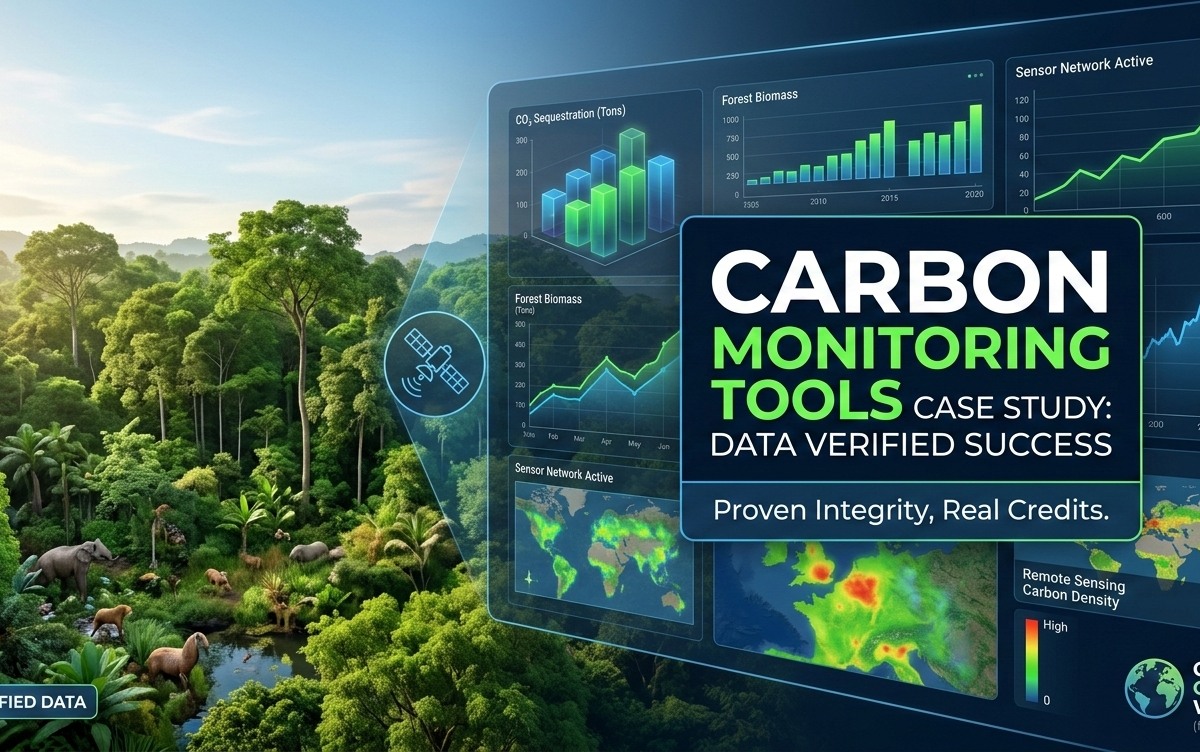
Carbon Monitoring Tools Case Study
Carbon Monitoring Tools Case Study
Overview: The Significance of Carbon Monitoring
Understanding and lowering greenhouse gas emissions has become crucial for governments, businesses, and communities worldwide in a time when climate challenges are getting worse and global temperatures are rising. Carbon monitoring systems have become essential technology that allow precise emissions tracking, data-driven insights, and verifiable results for carbon reduction plans. The expanding carbon credit market, where emissions reductions are measured to produce credits that may be exchanged or utilized to achieve sustainability targets, is one of the most significant uses of these techniques.
This article examines the success story of how businesses were able to measure, verify, and achieve significant carbon reduction through the use of sophisticated carbon monitoring systems, resulting in both environmental outcomes and a comprehensive carbon credit case study.

Comprehending Climate Action and Carbon Credits
One metric ton of carbon dioxide equivalent (CO2e) that has been avoided, decreased, or removed from the atmosphere is the typical amount of carbon credits, which are a quantifiable and tradeable unit of emissions reduction. Verified projects that have a proven effect on reducing greenhouse gas emissions, such as methane capture systems, forestry and reforestation programs, renewable energy installations, and energy efficiency projects, are the source of carbon credits.
Since the world has pledged to keeping global warming well below 2°C and working toward 1.5°C, carbon credits have become a popular and adaptable tool for managing carbon emissions and mitigating climate change. Carbon credits are used by governments and corporations to show progress toward net zero or carbon neutrality objectives and to supplement internal emissions reduction initiatives.
Tools for Monitoring Carbon: The Foundation of Verification
The legitimacy of the emission reductions a carbon credit reflects determines its value. Carbon monitoring technologies, which are specialized systems that measure emissions in real time, analyze data trends, and offer stakeholders with transparent information, are the source of this credibility.
Current carbon monitoring devices are driven by:
- Remote sensing and satellite data
- IoT sensors installed in buildings and manufacturing sites
- Sophisticated program for carbon accounting
- Predictive analytics and artificial intelligence
- Blockchain-powered tracking for transparency and auditability
These technologies guarantee that claims of carbon reduction are substantiated and consistent with accepted norms. They make it possible for buyers, verification organizations, and project developers to confidently and precisely evaluate performance.
Overview of the Case Study: How Monitoring Tools Facilitated Achievement
This case study looks at a carbon credit program put in place at a manufacturing sector business dedicated to lowering its environmental footprint in order to demonstrate the concrete effects of carbon monitoring systems. The company aimed to achieve long-term sustainability and operating efficiency while also being in line with global climate goals.
The following were the project’s main goals:
- Accurately measuring baseline emissions
- Putting strategies for reducing emissions into practice
- Confirming emissions reductions in order to generate carbon credits
- Calculating the financial and ecological advantages
To achieve these objectives, the business implemented a set of carbon monitoring tools and included them into both strategic planning and day-to-day operations.
Strategic Planning and Baseline Measurement
To determine the company’s emissions profile, a thorough baseline assessment was carried out at the beginning of the project. In order to track energy use, fuel consumption, process emissions, and indirect emissions sources across sites, carbon monitoring technologies were essential.
Patterns and hotspots of emissions were discovered by real-time analytics and automated reporting; this information had previously been dispersed or collected by hand. Using cutting-edge carbon emissions tracking software, the business benefited from:
- Precise emissions inventories
- Sources of emissions by industry and procedure
- Using time series data to analyze trends
- Comparisons to industry peers as benchmarks
The data laid the foundation for focused reduction measures by clearly showing where emissions were highest and where actions may be most successful.
Putting Carbon Reduction Strategies into Practice
Equipped with accurate emissions data, the business implemented several tactics to lower its carbon footprint:
- Optimizing energy use with intelligent thermostats and effective motors
- Switch to renewable energy to meet power needs
- Modernization of production equipment to reduce energy intensity
- Systems for recovering heat from waste to collect and repurpose energy
Each strategy’s effectiveness was tracked using carbon monitoring systems, which gave continuous insight into performance enhancements. The ability to view real-time data indicating variations in emissions intensity allowed leadership teams to modify and improve their strategy.
Carbon Credit Creation and Verification
The creation of traceable carbon credits was one of this initiative’s most significant results. The business collaborated with independent verifiers to certify the outcomes in accordance with accepted carbon standards as emissions reductions were recorded and measured.
Tools for carbon monitoring made sure that:
- Reductions in emissions were quantifiable and clear.
- Methods of data collecting satisfied audit standards.
- Verification procedures were aided by real-time emissions reports.
- It would be possible to verify trends and link them to interventions.
The organization was able to participate in carbon markets and show stakeholders that it was taking quantifiable climate action thanks to the certified and recorded carbon credits that resulted.
Impact Scaling Across Sectors
The consequences of this case study go much beyond a single manufacturing company. In an effort to lower emissions and produce carbon credits, companies in a variety of sectors, including forestry, transportation, real estate, and agriculture, are quickly implementing carbon monitoring technologies.
Carbon monitoring capabilities provide a competitive advantage as investors prioritize sustainability performance and climate policies tighten. Strong emissions measurement and verification systems put an organization in a better position to:
- Make progress toward your climate pledges.
- Reduce supply chain climate risks
- Draw in investment capital with a climate focus
- Continue to adhere to regulations in all jurisdictions.
Conclusion: Carbon Monitoring Tools Case Study
This case study on carbon monitoring instruments and the introduction of carbon credits serves as a potent model for addressing climate change. Businesses that adopt data-driven sustainability initiatives can achieve quantifiable outcomes that lower emissions, produce carbon credits, and add value for both the environment and the company.
Businesses with precise emissions data, cutting-edge monitoring equipment, and a dedication to openness are revolutionizing the way sustainability is quantified and attained.
A more resilient, low-carbon future will be shaped by the success of today’s carbon credit programs through sustained innovation and cooperation.