
 Aksh
Aksh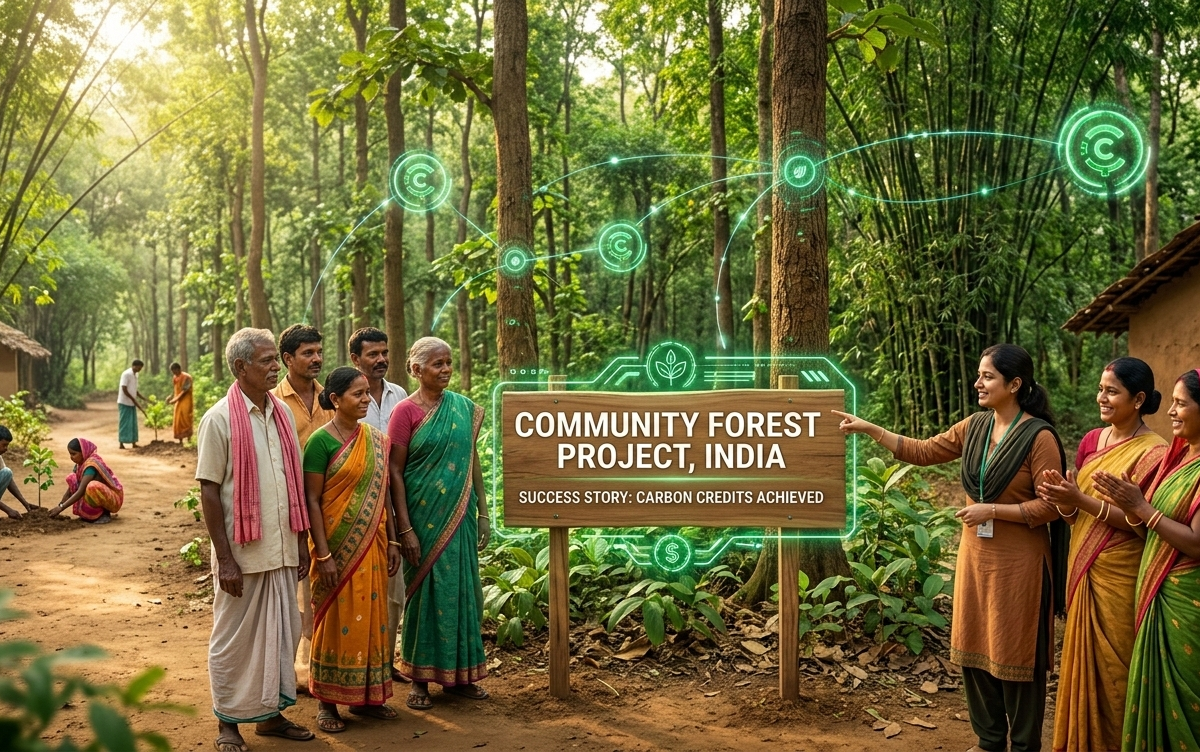
Community Forest Carbon Credits in India
Community Forest Carbon Credits in India
India’s Community Forest Project, which combines climate action with sustainable community development, has become one of the world’s most inspiring carbon credit success stories. India’s strategy of using forest carbon sequestration, supporting local farmers, and combining nature-based solutions with financial incentives offers developing countries a repeatable model in a period when environmental degradation and global warming affect every region.
Communities are no longer passive observers of environmental degradation across a variety of settings, from rural forest belts to wastelands. They actively participate in land reclamation, biodiversity enhancement, and financial gain through carbon credits, a system that compensates individuals who restore and conserve forests in order to remove greenhouse gases from the atmosphere.

India’s Community Forest Carbon Credit Movement’s beginnings
Indian rural populations practiced forest management and protection as a way of life even before carbon trading made headlines. However, India was first to see the possibilities of coordinating social development with climate mitigation when the idea of commodifying carbon sequestration through carbon credits entered the realm of global environmental regulation.
This idea transcended theory and became practical in initiatives like the one created by the Indian Farm Forestry Development Cooperative (IFFDC). In addition to receiving more than 78,000 carbon credits for afforestation and agroforestry operations carried out between 2008 and 2022, the IFFDC registered its forestry project in accordance with globally accepted criteria.
How Community Forest Projects Use Carbon Credits
Fundamentally, a carbon credit is a quantifiable quantity of greenhouse gas that has been prevented or captured. One metric ton of CO2 equivalent that is stored, stopped, or decreased from entering the atmosphere is normally equivalent to one carbon credit.
In terms of forest carbon projects, this entails:
- Through photosynthesis, trees and other flora absorb carbon dioxide, acting as carbon sinks.
- Projects must use reliable techniques established by organizations like Verra’s Verified Carbon Standard (VCS) to measure, report, and validate the amount of carbon sequestered.
- Credits can only be awarded and sold in voluntary or compliant carbon markets following verification, making environmental stewardship profitable for rural stakeholders.
Firsthand Narratives: The Influence on Farmers and Communities
The voices of the farmers, cooperatives, and tribal people who transformed desolate areas into flourishing green belts are the greatest way to comprehend the Community Forest Project India’s transformative influence.
- Using Carbon Revenue and Agroforestry to Empower Farmers
Farmers in areas such as Uttar Pradesh have taken part in carbon farming and tree planting initiatives that incentivize them to sequester carbon. Farmers in a number of regions have already earned more than 42 lakh carbon credits, which provide traditional agriculture with much-needed additional revenue.
In addition to encouraging environmental stewardship, this increases rural incomes, especially in regions where traditional agricultural yields are being strained by market instability or climate hardship.
- Forestry Cooperatives as Local Development Engines
The IFFDC model demonstrates how local organizations, such as forestry cooperatives, can serve as drivers for both economic empowerment and climate action. Cooperatives have opened up an income model that would not be accessible to individual farmers working alone by pooling land, organizing tree planting initiatives, and negotiating carbon certification procedures.
Essentially, this method has produced localized ecosystems for sustainable forestry, in which farmers directly profit financially from preserving and expanding forest cover and are co-owners of natural assets.
Environmental Effects: Biodiversity, Sequestration, and Other Aspects
Beyond carbon, India’s community forest projects have numerous other positive environmental effects.
- Improved Sequestration of Carbon
Agroforestry and afforestation initiatives have greatly increased soil and vegetation’s capacity to absorb carbon, supporting both regional ecological balance and global climate mitigation objectives.
- Repairing Degraded Areas
These initiatives are greening previously unproductive areas by planting native species in wastelands. This increases soil fertility, decreases erosion, and improves water retention, all of which support agriculture and increase ecological resilience.
- Gains in Biodiversity
Because they support pollinators that are essential to agricultural ecosystems and offer habitats for local wildlife, planted tree species are frequently chosen for their ecological significance.
India’s Policy Environment and Carbon Market
India has a big role to play in the global fight against climate change. To support open, trustworthy carbon markets, the government has established frameworks such as the Carbon Credit Trading Scheme (CCTS) and set clear net-zero targets.
In order to satisfy performance targets under CCTS, industries are expected to trade carbon credits and lower their greenhouse gas intensity. At the same time, voluntary carbon markets enable rural stakeholders and social enterprises to participate in global climate finance flows by purchasing and selling verified carbon credits from initiatives like community forestry.
Difficulties and Acquired Knowledge
There are obstacles in every success tale. The development of carbon credit initiatives in India reveals a number of important learning areas:
- Confirmation and Openness
Building trust with buyers and participants requires accurate measurement and reliable verification utilizing standards like Verra VCS.
- Fairness in Benefit Distribution
To guarantee that farmers and community people receive revenue from carbon credits in a fair and consistent manner, transparent systems must be in place.
- Certainty of Policy
Although India has strong climate policies, adoption will be accelerated by better infrastructure and transparency in carbon trading platforms.
- Awareness & Education
For sustained engagement, many rural communities need ongoing assistance in understanding carbon markets, monitoring needs, and long-term ecological advantages.
In conclusion: Community Forest Carbon Credits in India
More than just an environmental project, the Community Forest Project India is a game-changing success story that connects social upliftment and climate action.
The model demonstrates that economic development and climate action are not mutually exclusive—rather, they can be mutually reinforcing—from wastelands transformed into carbon-rich forests to farmers earning money for environmental care.
India’s carbon credit tale demonstrates how nature-based solutions may result in a greener planet, healthy ecosystems, and resilient rural livelihoods through strategic collaboration, transparent verification, and community ownership.