
 Aksh
Aksh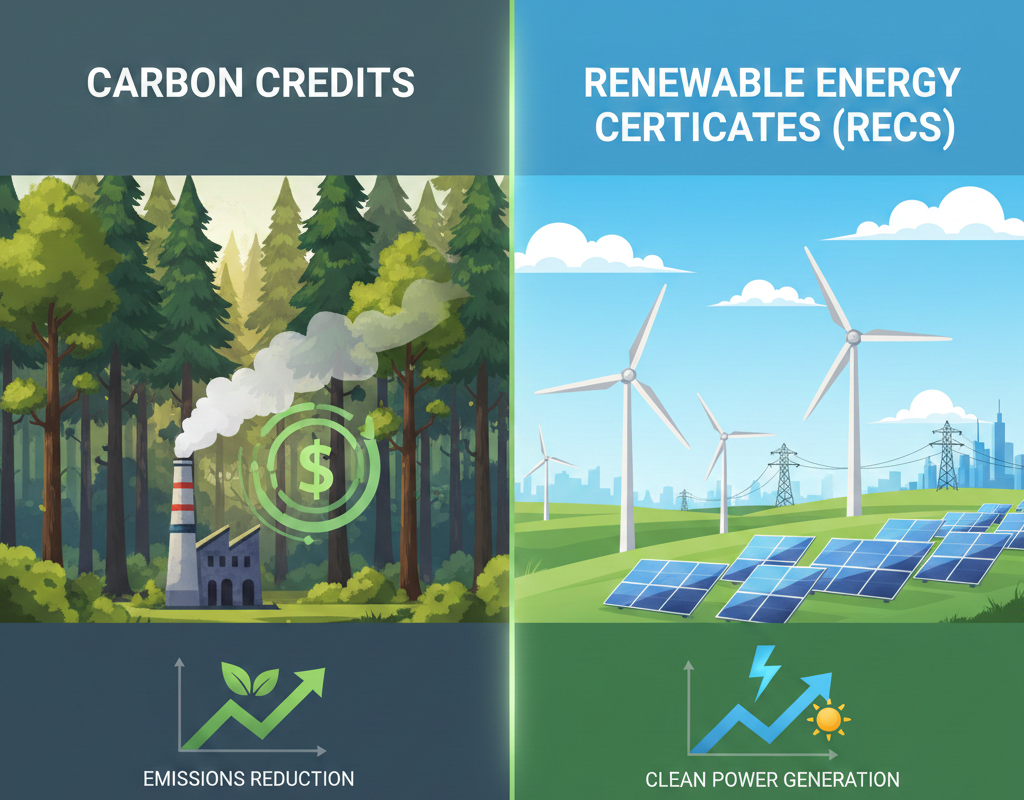
Comprehensive Guide to Reporting on Carbon Credits vs RECs
Comprehensive Guide to Reporting on Carbon Credits vs RECs
The global dialogue on climate action, corporate social responsibility, and net zero commitments has been more heated in 2026. Environmental claims are being examined more closely than ever by governments, regulators, institutional investors, and sustainability teams. Carbon credits and renewable energy certificates (RECs) are two phrases that often cause confusion. Despite the fact that both are essential to global climate policies, their environmental characteristics and reporting implications are essentially different.
Clarifying Carbon Credits vs. RECs for companies, sustainability experts, and policy stakeholders is the goal of this news item. It breaks out the meaning, goal, market dynamics, reporting standards, compliance environment, risks, opportunities, and impact factors that ought to direct open and honest climate reporting.

Comprehending Carbon Credits
The reduction, elimination, or avoidance of one metric tonne of carbon dioxide equivalent (CO2e) emissions is represented by a marketable certificate known as a carbon credit. Projects that produce these credits lower greenhouse gas emissions in a quantifiable way. Reforestation, methane collection, renewable energy installations, and community energy initiatives are a few examples.
Because they allow organizations to offset emissions that they are unable to eradicate internally, carbon credits are essential to global climate policies. A business essentially assumes accountability for the measured reduction in emissions produced by an outside initiative when it acquires and retires carbon credits. This serves as the foundation for carbon offset reporting and is crucial to sustainability reporting, net zero strategies, and climate framework compliance.
Renewable Energy Certificates: What Are They?
One megawatt-hour (MWh) of electricity produced from a qualified renewable energy source, such as wind, solar, hydro, or biomass, is represented by a Renewable Energy Certificate (REC). RECs serve as evidence that clean energy has been generated and added to the electrical grid.
RECs precisely track the generation and use of renewable energy, as opposed to carbon credits, which measure emission reductions or removals. In order to prove that some or all of their electricity use is offset by renewable energy production, organizations buy RECs.
Regulatory Environment and Reporting Needs
- Reporting of Carbon Credits
GHG accounting systems like the Greenhouse Gas Protocol, ISO standards, and sustainability disclosure laws like the EU’s Corporate Sustainability Reporting Directive (CSRD) or India’s new ESG regulations serve as the foundation for carbon credit reporting. Typically, reporting includes:
Credit source
- Vintage year
- Standards and methodology (e.g., Gold Standard, Verified Carbon Standard)
- Serial numbers and retirement status
- Acquired and retired volumes
- Claims for related GHG removal or reduction
Thorough reporting reduces the possibility of greenwashing and increases credibility.
- REC Disclosure
RECs are typically covered in sustainability reports’ energy disclosure sections and renewable energy purchase statements. Typical information consists of:
- Number of RECs obtained
- Technology for generation (wind, solar, etc.)
- The area or grid from which RECs were obtained
- Retirement and monitoring using REC databases
REC reporting does not directly eliminate greenhouse gas emissions, but it does indicate progress toward renewable energy commitments.
The Best Ways to Report Carbon Credits
Reporting carbon credits accurately necessitates openness, thorough documentation, and conformity to accepted norms. Among the leading practices are:
- The ability to trace
Make sure that each carbon credit that is bought and retired can be linked to its original project, methodology, and registry retirement records.
- Normal Alignment
Always submit credits in compliance with national rules or recognized reporting standards, such as the GHG Protocol.
- Do not count twice.
Verify that no more than one entity is claiming carbon credits. Reuse is eliminated by retirement from a recognized register.
- Unambiguous Disclosure
In sustainability reports, include explicit explanations of the credits used, including project type, vintage, and environmental integrity.
The Best Ways to Report RECs
Clean energy consumption and disclosure integrity should be the main topics of reporting because RECs represent electrical qualities rather than carbon reductions:
- REC registration and retirement
Similar to carbon credits, RECs must be retired in an approved system upon claim in order to avoid duplication.
- Disclosure of Grid Regions
Since the impact is dependent on the availability of renewable energy sources and the local energy mix, report the grid regions where RECs were sourced.
- Make Environmental Claims Clear
Be clear that RECs stand for the use of renewable electricity; do not imply direct reductions in emissions unless supported by proper carbon accounting.
Difficulties with Verification and Reporting
Although RECs and carbon credits are essential instruments for sustainability, there are issues with reporting:
- Gaps in Standardization
Different disclosures are needed for different frameworks. The process of harmonizing carbon credit reporting standards globally is still ongoing.
- Quality of Verification
There are differences in third-party verification of carbon projects. Credibility requires high-quality verification.
- Misunderstandings Regarding RECs
Exaggerated environmental claims may result from misinterpreting the impact of RECs as a direct reduction in emissions.
- Complexity of Regulation
Organizations must constantly adjust their reporting procedures and compliance systems in response to changing legislation.
In conclusion: Comprehensive Guide to Reporting on Carbon Credits vs RECs
Credible sustainability reporting, climate action planning, and regulatory compliance in 2026 and beyond all depend on knowing the distinction between carbon credits and RECs. While RECs represent investment in the production of renewable energy, carbon credits are instruments for offsetting greenhouse gas emissions. Both play separate roles in national and business climate plans, but it’s important to make the difference between the two obvious.
For carbon credits and RECs to be reported effectively, there must be openness, conformity to established norms, thorough documentation, and regular stakeholder communication. Organizations that implement strong reporting procedures will boost their environmental credibility, aid in the global decarbonization process, and significantly advance sustainability objectives as climate disclosure standards rise around the world.
Carbon Credit Glossary & Data Insights: Everything You Need to Know in 2026
Carbon Credit Glossary & Data Insights: Everything You Need to Know in 2026