
 Aksh
Aksh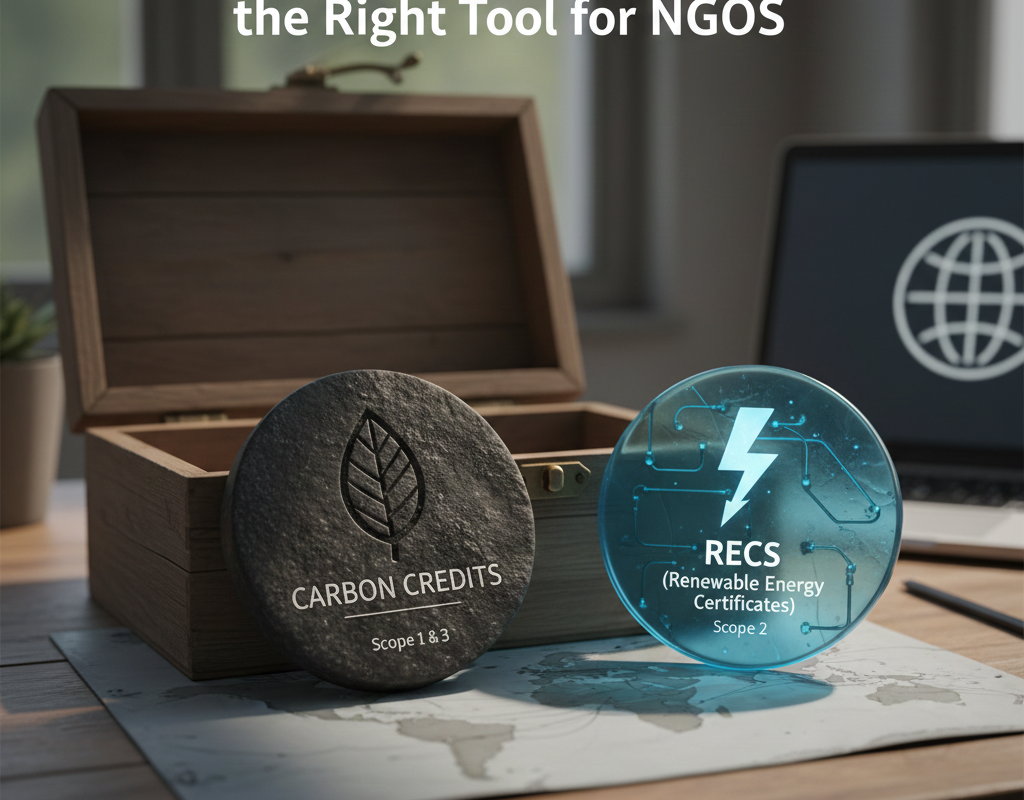
How NGOs Can Leverage Carbon Credits vs RECs?
How NGOs Can Leverage Carbon Credits vs RECs?
Non-governmental organizations (NGOs) are being asked to set an example as climate change picks up speed and sustainability emerges as a key component of global development. Nonprofit organizations are facing increasing pressure to quantify, cut, and offset their carbon footprints, from local environmental organizations to global humanitarian organizations. Carbon credits and renewable energy certificates (RECs) are two climate mechanisms that are frequently highlighted in this context.
Both techniques help achieve carbon reduction and climate action goals, but they work differently and have different strategic goals. Knowing the difference between carbon credits and RECs is crucial for NGOs looking to improve sustainability reporting, conform to ESG frameworks, and show donors and stakeholders that they are climate accountable.

Carbon Credits: What Are They?
One metric ton of carbon dioxide (CO₂) or its equivalent greenhouse gas can be reduced, eliminated, or avoided by using carbon credits, which are tradable certifications. Usually, validated climate projects like methane capture, renewable energy development, reforestation, or energy efficiency upgrades produce these credits.
Transparency and environmental integrity are ensured by validating and verifying projects using accepted standards like the Verra, Gold Standard, and Clean Development Mechanism.
An NGO is essentially making up for emissions it cannot instantly decrease when it buys carbon credits. Carbon offsetting is the term used to describe this practice.
Renewable Energy Certificates (RECs): What Are They?
One megawatt-hour (MWh) of power produced from a renewable energy source and delivered to the grid is attested by Renewable Energy Certificates, or RECs. Wind, solar, hydro, and biomass are examples of renewable sources.
Systems like Green-e are used to track RECs in markets like the US. Under the Renewable Purchase Obligation framework, the Central Electricity Regulatory Commission of India oversees renewable energy certificates.
An NGO asserts the environmental benefits of renewable electricity generation when it buys RECs. In particular, Scope 2 emissions—which come from the usage of purchased electricity—are addressed by RECs.
Why Carbon Credits and RECs Are Important for NGOs
Nonprofit organizations run offices, carry out fieldwork, organize events, go abroad, and oversee supply chains. Greenhouse gas emissions are produced by all of these activities.
Environmental transparency and ESG alignment are becoming more and more important to donors, institutional partners, and multilateral organizations. By including RECs and carbon credits into their climate plans, NGOs can:
- Take the lead on climate change.
- Reach carbon neutrality objectives
- Boost reporting on sustainability
- Boost your eligibility for financing
- Comply with international climate pledges
Donors who care about the climate increasingly give preference to companies that actively monitor and control their environmental impact.
NGOs’ Strategic Use of RECs
RECs are perfect for NGOs that have:
- Grid electricity use in office spaces
- IT infrastructure or data centers
- Urban activities that mainly depend on electricity
- Requirements for sustainability reporting
NGOs can claim renewable electricity use without physically installing solar panels by purchasing RECs equal to their annual electricity consumption.
RECs’ advantages for NGOs
- Claims for affordable renewable energy
- backs the country’s renewable energy goals
- Simple incorporation into yearly sustainability reports
- Makes managing Scope 2 emissions easier
- Enhances the green procurement approach
RECs can not, however, make up for emissions from supply chains, flights, or gasoline consumption.
NGOs’ Strategic Use of Carbon Credits
Carbon credits are more flexible and comprehensive. NGOs that carry out advocacy campaigns, emergency relief efforts, or overseas development activities frequently produce complicated emissions in a number of different categories.
NGOs can use carbon credits to offset:
- Emissions from staff and volunteer travel
- Using fuel in field operations
- Emissions from transportation and logistics
- Emissions associated with the event
- Carbon footprints in the supply chain
Carbon Credits’ Advantages for NGOs
- Greater coverage of emissions
- Backs international climate initiatives
- Improves impact communication and climate storytelling
- Permits certification of carbon neutrality
- Complies with global climate frameworks
Supporting verified carbon projects improves mission alignment for NGOs involved in environmental preservation or climate adaption.
RECs and Carbon Credits in Sustainability Reporting
These days, a lot of NGOs release sustainability or impact reports that follow guidelines like the ESG disclosure standards or the Global Reporting Initiative (GRI).
RECs and carbon credits help with:
- Open accounting for emissions
- Net-zero plans
- Reports on donor accountability
- Documentation of CSR compliance
- Strategies for mitigating climate danger
Credibility is increased by strategically using both tools.
Conclusion: How NGOs Can Leverage Carbon Credits vs RECs?
Although they are both effective instruments, carbon credits and renewable energy certificates have different purposes. Renewable energy claims are made possible by RECs, which also address power usage. Carbon credits help with global climate mitigation efforts and offer a wider range of emissions offset capabilities.
The choice for NGOs dedicated to climate leadership is not “carbon credits vs. RECs,” but rather how to successfully include both into an all-encompassing sustainability plan.
The next generation of sustainable development will be led by NGOs that embrace transparent carbon management strategies, as environmental accountability becomes a defining characteristic in funding, partnerships, and public confidence.
Carbon Credit Glossary for Carbon Markets | IndianCarbonCredit.com
Carbon Credit Glossary for Carbon Markets | IndianCarbonCredit.com