
 Aksh
Aksh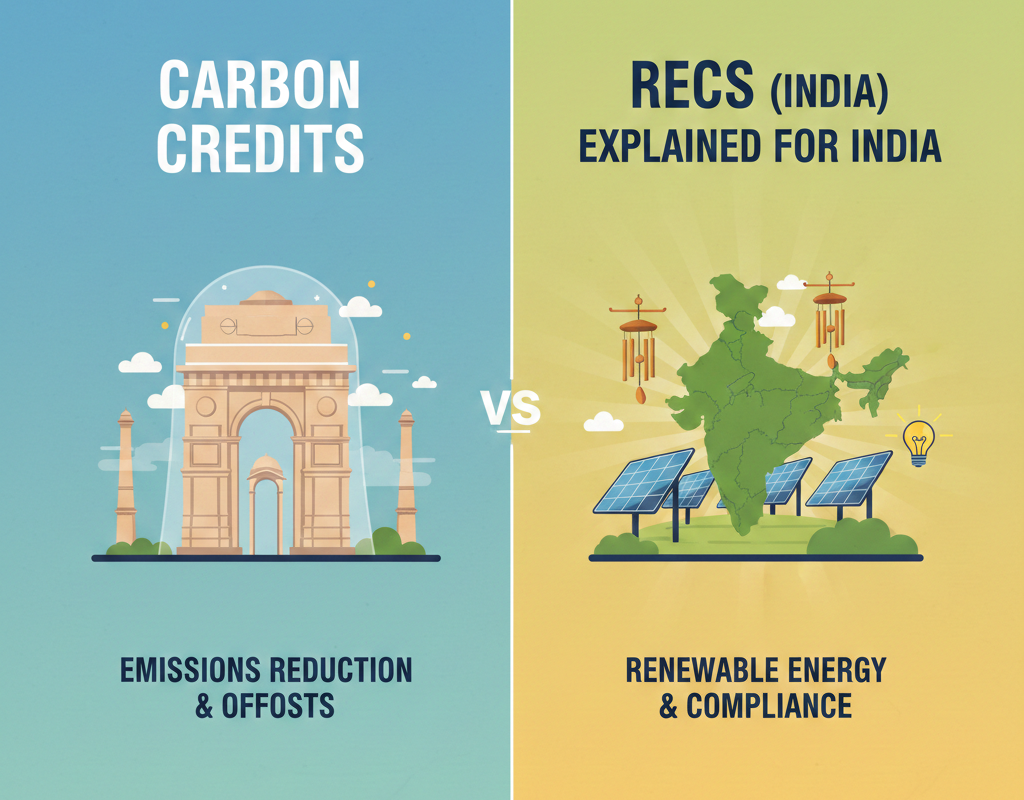
Navigating Carbon Credits and RECs in India
Navigating Carbon Credits and RECs in India
India is concentrating more on ways to lower greenhouse gas emissions and advance clean energy in the age of climate change and environmental responsibility. Carbon credits and renewable energy certificates (RECs) are two of these systems that have become important instruments for companies, sectors, and individuals trying to lower their carbon footprint. Although both are important for environmental sustainability, businesses and politicians navigating India’s expanding carbon market must be aware of their peculiarities.

Carbon Credits: What Are They?
One metric ton of carbon dioxide (CO₂) or its equivalent greenhouse gas (GHG) is removed from the atmosphere via carbon credits, which are tradable certifications. By enabling businesses to offset their emissions by funding initiatives that lower emissions elsewhere, they essentially offer a market-based strategy for reducing global warming.
Carbon credits can be produced in India through initiatives like:
- Reforestation and replanting
- Renewable energy initiatives (biomass, wind, and solar)
- Waste-to-energy projects
- Enhancements in industrial processes for energy efficiency
Through a number of frameworks, the Indian government funds these initiatives under international programs like voluntary carbon markets and the Clean Development Mechanism (CDM). After that, businesses can buy carbon credits to make up for their emissions and become carbon neutral.
Renewable Energy Certificates (RECs): What Are They?
Instruments known as Renewable Energy Certificates (RECs) attest to the production of power from renewable resources. In order to promote renewable energy and guarantee adherence to India’s Renewable Purchase Obligation (RPO), they offer a market mechanism.
RECs and carbon credits operate in distinct ways. They serve as evidence that electricity has come from renewable sources like solar, wind, biomass, or modest hydropower rather than directly offsetting emissions. A megawatt-hour (MWh) of renewable electricity is normally equivalent to one REC.
Important characteristics of RECs in India
- Encourages Renewable Energy: RECs provide financial incentives for the generation of clean electricity.
- Supports RPO Compliance: In order to fulfill RPO targets, obligated organizations, such as utilities and large corporations, must buy RECs.
- Tradable Certificate: In India, RECs are available for purchase and sale on accredited power exchanges.
- No Direct Carbon Offset: RECs are mostly tools for regulatory compliance, even though they indirectly lower carbon emissions.
Carbon Credits’ Function in India
India is the world’s third-largest CO2 emitter, and there is growing pressure on businesses to cut emissions. Carbon credits compensate for inevitable emissions and give companies a financial incentive to invest in sustainable initiatives. The following important industries profit from carbon credits:
- Production of power
- Producing
- Steel and cement industries
- Corporate and IT departments working toward ESG objectives
In addition to fostering innovation in green technologies, carbon credits assist India in fulfilling its obligations under international climate agreements like the Paris Agreement.
RECs’ Function in India
RECs are essential to the expansion of renewable energy in India because they
- Make it easier for utilities and other required organizations to comply with RPOs by making sure they buy a certain proportion of renewable energy.
- Give smaller producers of renewable energy the opportunity to sell electricity to the grid and profit from RECs.
- Encourage India to reach its 2030 target of 500 GW of renewable energy.
In contrast to carbon credits, RECs develop a market-driven strategy for boosting renewable energy generation rather than immediately offsetting emissions.
RECs and Carbon Credits in the Indian Market
The carbon and renewable energy markets in India are changing quickly:
- Voluntary Carbon Market: To reduce emissions and improve their environmental credentials, businesses willingly purchase carbon credits.
- Compliance Carbon Market: Structured carbon credit trading is made possible by regulatory frameworks established by international treaties.
- REC Market: RECs are exchanged on India’s two power exchanges, Power Exchange India Limited (PXIL) and Indian Energy Exchange (IEX).
India’s dedication to sustainability and its potential to develop as a global center for carbon trading are reflected in the expansion of these markets.
Obstacles and Things to Think About
Despite being effective instruments for sustainability, carbon credits and RECs have drawbacks.
- Verification and Quality: Strict verification and monitoring requirements are necessary to ensure the quality of carbon credits, as not all of them are created equal.
- Market Volatility: REC and carbon credit prices change, which has an impact on financial planning.
- Double Counting: Businesses need to make sure that carbon savings aren’t reported more than once.
- Awareness and Expertise: To successfully navigate these markets, Indian businesses require improved knowledge and consulting services.
Prospects for India’s Future
Through programs like these, the Indian government is aggressively advancing renewable energy and carbon neutrality.
- The Perform, Achieve, Trade (PAT) scheme promotes industrial energy efficiency.
- Energy efficiency and renewable energy initiatives are supported by the National Action Plan on Climate Change (NAPCC).
- Growth of Voluntary Carbon Markets: Promotes global trade and draws funding for environmentally friendly initiatives.
Both carbon credits and RECs will be essential in assisting India in meeting its sustainability and net-zero goals by 2070 as awareness of climate responsibility grows.
In conclusion: Navigating Carbon Credits and RECs in India
For Indian companies, legislators, and citizens looking to lessen their environmental effect, it is crucial to comprehend the difference between carbon credits and renewable energy certificates (RECs). RECs promote the use of renewable energy and adherence to RPO rules, whereas carbon credits concentrate on offsetting greenhouse gas emissions. When combined, these tools enable India to meet climate targets, advance sustainable energy, and persuade companies to make investments in a more environmentally friendly future.
Indian businesses can complete their regulatory requirements, become carbon neutral, and improve their ESG credentials by carefully leveraging both systems. This will ultimately help to create a low-carbon and sustainable economy.
Analyst’s Guide to Carbon Credits: Comprehensive Glossary & Market Terms
Analyst’s Guide to Carbon Credits: Comprehensive Glossary & Market Terms