
 Aksh
Aksh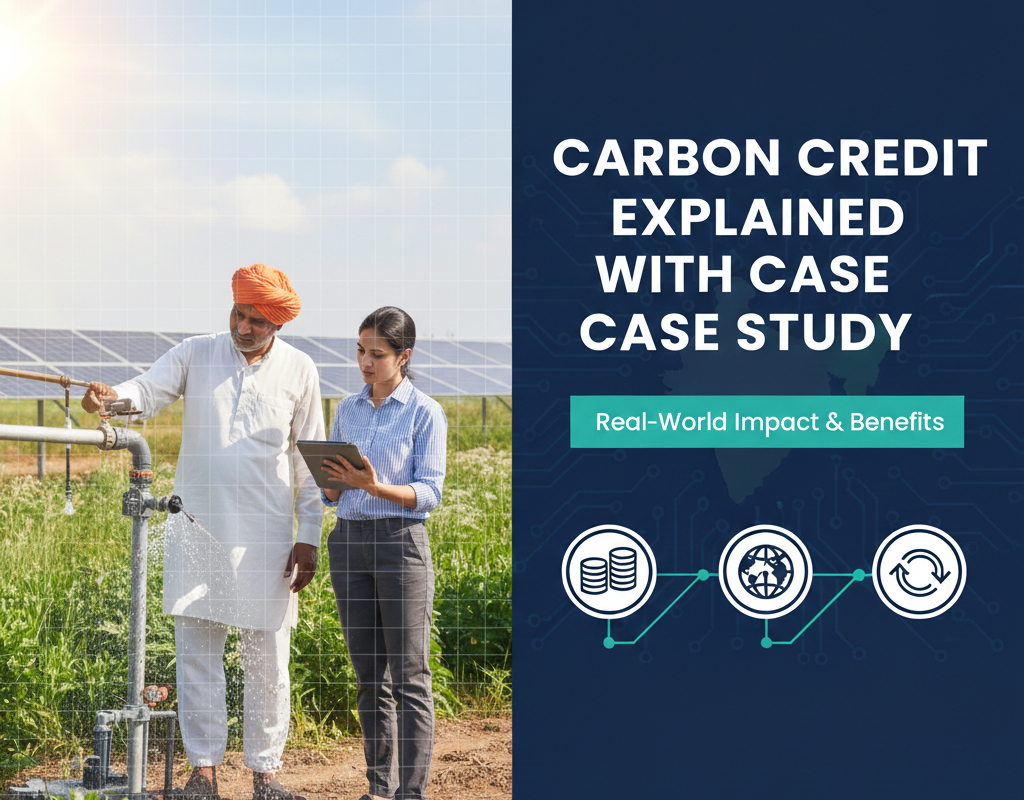
The Complete Guide to Carbon Credits
The Complete Guide to Carbon Credits
Countries, businesses, and communities are being pressured to take quantifiable steps to cut greenhouse gas emissions as climate change worsens and global temperatures increase. The idea of carbon credits is one of the most useful and extensively used instruments in this endeavor. Carbon credits are no longer just an environmental term used in policy circles; they have evolved into a powerful economic and climate-action mechanism shaping industries, investments, and sustainability strategies worldwide.
In India, carbon credits are gaining significant momentum as the country balances rapid economic growth with ambitious climate commitments. With expanding renewable energy projects, improved industrial efficiency, and emerging carbon markets, carbon credits are becoming a crucial part of India’s green transition.

Carbon Credits: What Are They?
One metric tonne of carbon dioxide (CO₂) or its equivalent greenhouse gas is reduced, avoided, or removed from the atmosphere in the form of a carbon credit. Verified efforts like clean cooking campaigns, waste management, afforestation, energy efficiency upgrades, and renewable energy installations are responsible for these reductions.
To put it simply:
One carbon credit is equivalent to one tonne of CO2 emissions that are eliminated or reduced.
Since carbon credits are tradable, they can be purchased and sold. In order to balance their overall carbon footprint, greenhouse gas emitting organizations might buy carbon credits to make up for emissions they are unable to immediately stop.
The Significance of Carbon Credits
Carbon credits are essential for combating climate change for several reasons:
- Mitigation of Climate Change
They offer a quantifiable and responsible means of lowering greenhouse gas emissions globally.
- Financial Rewards
By converting pollution reductions into monetary assets, carbon credits promote investment in sustainable behaviors and clean technologies.
- Assistance for Emerging Markets
Projects in underdeveloped nations gain from new sources of income, which lower emissions and support sustainable development.
- Accountability for the Corporate Climate
Carbon credits assist businesses in fulfilling their environmental, social, and governance obligations as well as climate targets and sustainability goals.
Carbon Credit Types
- Carbon Credits for Renewable Energy
Produced by renewable energy projects that use biomass, wind, sun, and hydropower in place of fossil fuels to generate electricity.
- Carbon Credits for Energy Efficiency
Produced by means of energy optimization, effective machinery, and industrial advancements.
- Credits for Forestry and Land Use
Produced by carbon dioxide-absorbing afforestation, reforestation, and avoided deforestation initiatives.
- Credits for Waste Management
Derived from waste-to-energy projects, methane avoidance, and landfill gas capture.
- Credits for Rural Development and Clean Cooking
Produced by spreading biogas systems or clean cookstoves, which take the place of conventional biomass consumption.
An explanation of carbon markets
There are two primary markets where carbon credits are traded:
- Market for Voluntary Carbon
Carbon credits are voluntarily purchased by businesses and people to offset emissions or achieve environmental objectives. Investor expectations, branding, and corporate responsibility are the main drivers of this sector.
- Market for Compliance Carbon
Regulated marketplaces where businesses are required to adhere to legally mandated emission standards. Government rules are met through the usage of carbon credits or allowances.
While actively taking part in voluntary carbon markets, India is presently creating its own framework for a structured carbon market.
India’s Prospects for Carbon Credits
India’s carbon credit market looks to have a bright future because
- Increasing business pledges to achieve net-zero
- Growth of green hydrogen and renewable energy
- Government programs that promote carbon markets
- Growing demand for high-integrity credits globally
India is anticipated to emerge as a significant global provider of reliable carbon credits as market mechanisms develop and regulatory clarity increases.
In conclusion: The Complete Guide to Carbon Credits
A workable, scalable, and financially feasible way to lower greenhouse gas emissions and promote sustainable development is through carbon credits. They present India with a special chance to draw in climate funding, advance clean technology, and accomplish long-term environmental objectives without sacrificing economic expansion.
India may establish itself as a global leader in climate action by comprehending the operation of carbon credits, taking part in reliable ventures, and fortifying market frameworks. This article’s case study demonstrates that carbon credits are practical tools that provide quantifiable social, economic, and climate advantages rather than merely being theoretical.
Carbon credits will remain crucial in constructing a resilient and low-carbon future for India and the rest of the globe as the urgency of the climate crisis increases.
What Are Carbon Credits in Simple Words? A Complete Guide for India and the World
What Are Carbon Credits in Simple Words? A Complete Guide for India and the World