
 Aksh
Aksh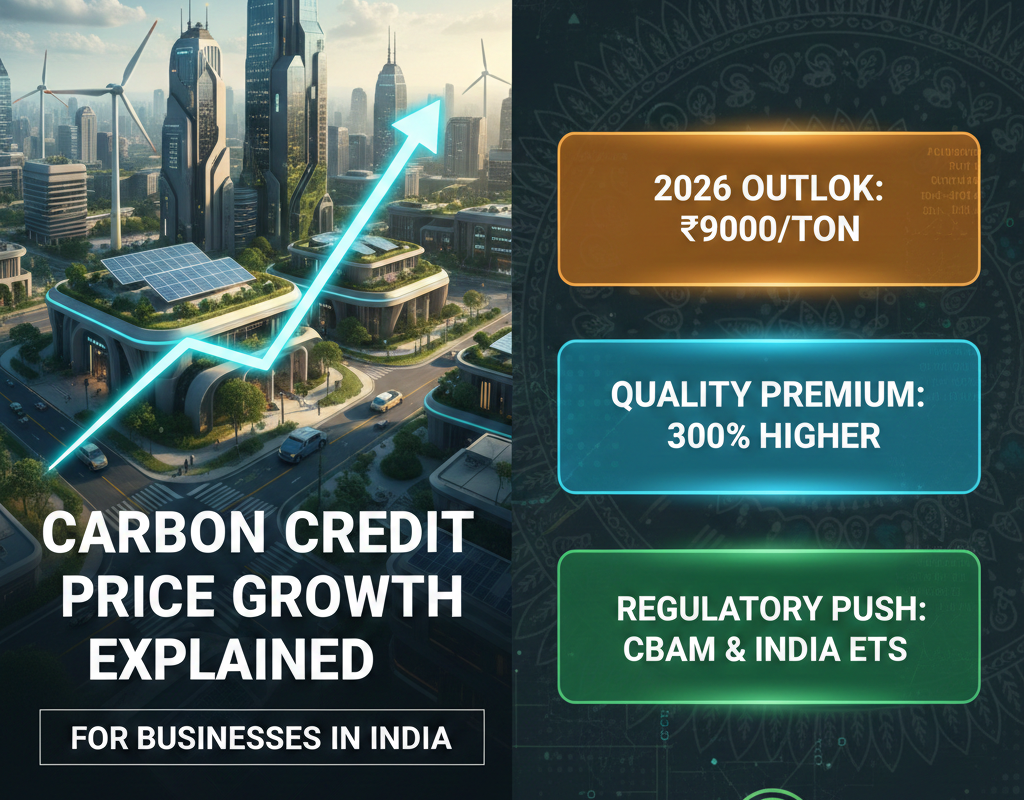
Carbon Credit Price Explained for Businesses in India
Carbon Credit Price Explained for Businesses in India
Businesses are becoming more concerned about lowering their carbon footprints and adhering to environmental, social, and governance (ESG) standards as India speeds up its transition to sustainable growth. Carbon credits, which enable businesses to offset their greenhouse gas (GHG) emissions, are one of the main tools in this endeavor. Businesses hoping to maintain their competitiveness while supporting global climate goals now need to understand the price of carbon credits in India.

Carbon Credits: What Are They?
One metric ton of carbon dioxide (CO₂) or an equivalent greenhouse gas that has been decreased, avoided, or eliminated from the atmosphere is represented by a tradable certificate known as a carbon credit. Based on the “cap-and-trade” model, the system enables businesses who surpass their carbon reduction goals to sell credits to those that are having difficulty meeting voluntary or statutory goals.
Projects involving waste management, energy efficiency, afforestation, renewable energy, and other sustainable activities may result in carbon credits in India. By funding these initiatives, businesses help achieve national and international climate action targets in addition to offsetting their emissions.
Carbon Credit Types Offered in India
Companies actively purchase Voluntary Carbon Credits (VCCs) to improve their ESG credentials; these are frequently utilized in corporate sustainability reporting.
- Certified Emission Reduction (CER): Indian projects produce CERs for confirmed emissions reductions under the Kyoto Protocol’s Clean Development Mechanism (CDM).
- Renewable Energy Certificates (RECs): These certificates enable companies to fulfill renewable purchasing obligations (RPOs) and promote the production of renewable energy.
Because prices differ based on certification, project type, and market demand, it is crucial to understand the type of carbon credit.
Factors Affecting India’s Carbon Credit Price
The following important factors affect the price of carbon credits in India:
- Dynamics of Supply and Demand
The equilibrium between supply and demand is the primary factor influencing carbon credit pricing. Prices typically increase when more businesses attempt to offset emissions as a result of voluntary ESG activities or regulatory pressure. On the other hand, an excess of credits from forestry or renewable projects can result in reduced costs.
- Project Type and Site
Credits from initiatives with significant social and environmental co-benefits, like innovative renewable energy sources or community-driven afforestation, can fetch higher prices. In a similar vein, the costs of certification and verification may make projects in areas with higher compliance standards more costly.
- Standards for Certification
A carbon credit’s certification establishes its legitimacy. In India, the Verified Carbon Standard (VCS), CDM, and Gold Standard are common standards. The cost of carbon credits can rise dramatically with higher-quality certificates that promise more environmental benefits or transparency.
- Rules and Regulations
The market is influenced by international agreements and governmental regulations. Guidelines for selling carbon credits are set by regulatory agencies and the Ministry of Environment, Forests, and Climate Change (MoEFCC) in India. Furthermore, pricing may be impacted by demand pressure brought on by alignment with international goals like the Paris Agreement.
Carbon Credits’ Significance for Indian Companies
- Reporting and Compliance with ESG
ESG reporting is now required for Indian companies, particularly those in industries like manufacturing, energy, and logistics. By allowing businesses to show their dedication to sustainability and conform to international ESG standards, carbon credits help them draw in partners and investors.
- Sustainability in Business
Businesses actively offset emissions that cannot be removed by operational efficiency alone by buying carbon credits. This helps achieve national climate goals in addition to enhancing brand reputation.
- Control of Risk
Companies who don’t control their carbon impact run the risk of fines, increased taxes, and harm to their brand as climate legislation change quickly. A versatile approach to reducing compliance risks and preparing for any future carbon pricing situations is provided by carbon credits.
How Indian Companies Can Acquire Carbon Credits
There are several ways for Indian companies to obtain carbon credits:
- Direct Purchase from initiatives: Businesses have the option to make direct investments in waste management, afforestation, or renewable energy initiatives. Higher-quality credits and extra community benefits are frequently offered by this approach.
- Carbon Exchanges: Websites such as the India Carbon Exchange make it simpler for companies to locate vetted suppliers by facilitating the transparent exchange of carbon credits.
- Brokers and aggregators are middlemen who assist companies in locating, confirming, and acquiring carbon credits in line with their ESG plans.
Businesses should confirm certification, additionality, and project credibility before purchasing credits to make sure the price of the carbon credit accurately reflects the project’s true environmental impact.
Methods for Increasing the Spending on Carbon Credits
Knowing how to maximize carbon credit purchases is just as crucial for Indian companies as keeping an eye on prices:
- Long-term Contracts: You can protect yourself from price fluctuation by securing long-term agreements with credit providers.
- Portfolio diversification spreads risk and optimizes environmental effect by investing in a variety of project types, such as energy efficiency, afforestation, and renewable energy.
- Integrating with Internal Reduction Measures: Cost-effectiveness and sustainable growth are guaranteed when operational emission reductions and carbon credit purchases are combined.
In conclusion: Carbon Credit Price Explained for Businesses
Knowing the price of carbon credits is essential for Indian companies’ compliance and long-term sustainability strategy. Businesses can make well-informed decisions that support ESG commitments, manage carbon obligations, and improve their competitive edge by closely examining market trends, certification requirements, project types, and governmental legislation.
Businesses that proactively incorporate carbon credits into their environmental strategy will be better positioned to prosper in a low-carbon economy as India’s carbon markets get stronger and international sustainability regulations tighten.
Carbon Credits Income Benefits: How Indian Businesses and Farmers Can Profit from Carbon Trading
Carbon Credits Income Benefits: How Indian Businesses and Farmers Can Profit from Carbon Trading
2 Comments