
 Aksh
Aksh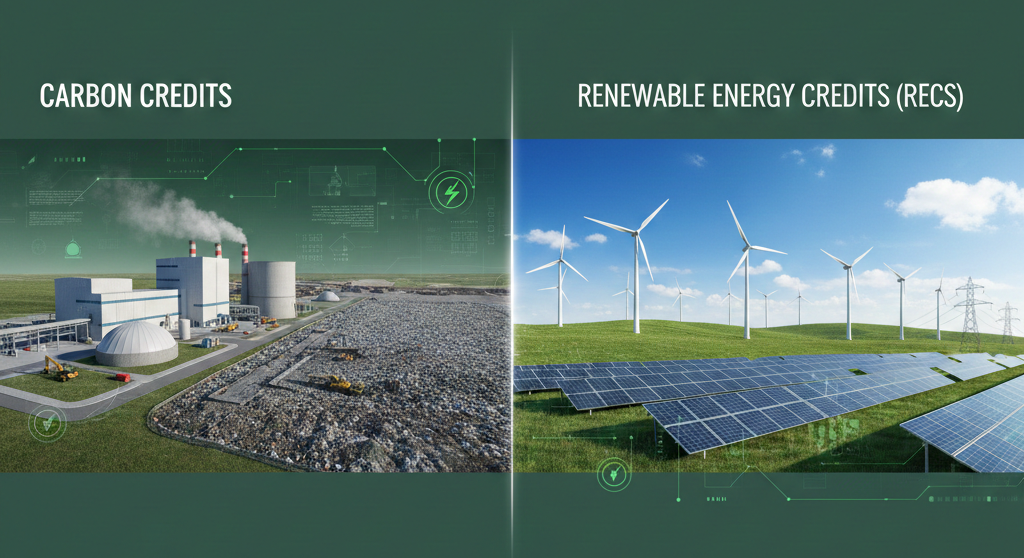
Waste Management Project Example
Waste Management Project Example
In its environmental history, India is at a turning point. Sustainable waste management is becoming a national issue due to the fast urbanization, increased industrialization, and rising garbage creation. The global climate economy is also changing quickly, providing financial tools like Renewable Energy Certificates (RECs) and carbon credits to encourage sustainable enterprises.
Project developers, local governments, investors, and sustainability experts must all be aware of the distinction between carbon credits and RECs. This article explains how carbon credits and RECs work, how they differ, and which model has more financial and environmental value while providing a thorough example of a waste management project.

India’s Climate Opportunity and Waste Challenge
Every year, millions of tons of municipal solid trash are produced in India. Methane, a greenhouse gas far more powerful than carbon dioxide, is produced when a considerable amount of this garbage ends up in landfills. Inappropriate disposal of trash leads to:
- Emissions of methane
- Pollution of the soil
- Pollution of groundwater
- Risks to public health
Nonetheless, this difficulty offers a significant chance for climate funding. Environmental credits can be used to fund waste management initiatives, particularly those involving landfill methane capture and waste-to-energy.
This market is dominated by two main instruments:
- Credits for Carbon
- Certificates of Renewable Energy (RECs)
Let’s look at a real-world waste management project example before comparing them.
Example of a Waste Management Project: Waste-to-Energy Facility and Landfill Methane Capture
Consider a mid-sized Indian city that produces 800 tons of solid waste every day. This trash is typically disposed of in an open landfill.
Design of the Project
The city has a cutting-edge waste management system in place that consists of:
- Source-based segregation
- Plant for anaerobic digestion
- Methane collection system for landfills
- Power generation device that converts waste into energy
Effects on the Environment
- Significantly lower methane emissions
- Biogas-powered electricity
- Decreased volume of landfills
- Reduced reliance on fossil fuels
There are now environmental credits available for this project. However, which mechanism—RECs or carbon credits—is applicable?
Why Carbon Credits Are Preferred in Waste Management Projects
Carbon credits are frequently preferred in waste-based projects because
- Methane’s warming effect is more than 28 times that of CO2.
- Volumes of emissions reduction are substantial.
- Methane avoidance schemes are preferred by foreign buyers.
- Measurable emission reduction is valued by ESG-focused companies.
Additionally, carbon credits are highly compatible with:
- Net-zero pledges
- Science-based goals
- Climate pledges made by corporations
When It Makes More Sense to REC
When are RECs beneficial?
- The production of energy is the main source of income.
- Power is already sold to the grid by the developer.
- Demand for Renewable Purchase Obligation is high.
- Buyers of compliance need assurance that it is renewable.
REC trading in structured markets is frequently advantageous for waste-to-energy facilities that are connected with state utilities.
India’s Regulatory Environment
India’s carbon market architecture is being strengthened at a rapid pace.
Important motivators include:
- Framework for national carbon trading
- Expanding market for voluntary carbon
- Standards for corporate sustainability disclosure
- Mandates for renewable energy are growing.
Waste management initiatives are in line with India’s international climate commitments.
In order to increase the value of emission reduction projects, the nation is also aiming to create a structured domestic carbon market.
A Strategic Suggestion for Developers of Waste Projects
For a project using municipal solid trash that is properly organized:
- Generation of carbon credits is the main objective.
- Renewable Energy Certificates are a secondary source of income.
This model of dual revenue:
- Increases the viability of the financial plan
- Boosts investor trust
- Supports the placement of ESG
- Raises the project’s internal rate of return
Compliance, certification, and the best possible monetization plan are guaranteed by a qualified carbon consultancy partner.
Prospects for the Future: India’s Carbon Economy
The sustainability industry in India is about to undergo a radical change.
Among the new trends are:
- Monitoring, Reporting, Verification (MRV) in digital form
- Blockchain-driven credit monitoring
- Demand for Corporate Scope 3 emissions
- Mandates for climate transparency
- Programs for modernizing urban trash
An important part of India’s climate finance ecosystem will be waste management initiatives.
It is anticipated that carbon credits in particular will play a significant role in financing municipal projects.
Conclusion: Waste Management Project Example
The example of the waste management project makes it abundantly evident that although both RECs and carbon credits have financial advantages, their environmental functions are distinct.
Carbon Credits:
- Reward lowering emissions, particularly avoiding methane.
- Provide a more comprehensive climatic impact.
- Draw in international ESG purchasers.
RECs:
- Encourage the production of electricity from renewable sources.
- Encourage the goals of renewable compliance.
- Ideal for revenue models that are centered on power.
Carbon credits frequently offer more long-term value for garbage initiatives in India that want to optimize their financial and environmental effect, particularly when appropriately paired with RECs.
Waste management has evolved beyond simple disposal as India moves closer to sustainable development. It has to do with environmental change, economic opportunity, and climate leadership.
Comprehensive Carbon Credit Terminology: Expert Insights into Offsets, Trading, and Verification
Comprehensive Carbon Credit Terminology: Expert Insights into Offsets, Trading, and Verification
2 Comments