
 Aksh
Aksh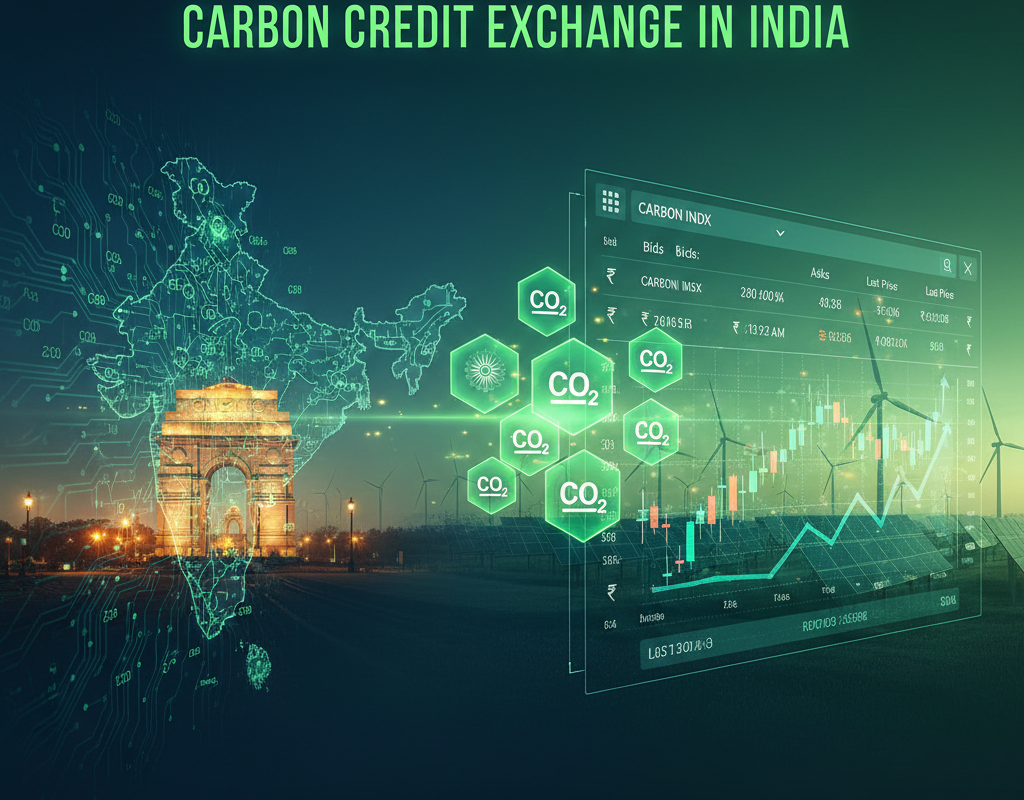
Carbon Credit Exchange in India
Carbon Credit Exchange in India
With the establishment of the Carbon Credit Exchange, India is going through a revolutionary period in its economic and environmental policy. Carbon markets are turning into crucial tools to meet carbon emission reduction goals, support climate action, and incentivize companies to implement eco-friendly practices as the world’s focus increasingly turns to sustainable development. A structured carbon trading market is more important than ever in light of India’s ambitious objective of reaching net zero by 2070.

A Carbon Credit Exchange: What Is It?
A carbon credit exchange is a regulated marketplace for the purchase, sale, and exchange of carbon credits. One ton of carbon dioxide (CO₂) or an equivalent greenhouse gas extracted from the atmosphere is represented as a carbon credit. Businesses and organizations that release greenhouse gases can buy carbon credits to make up for their emissions, and those that lower emissions by implementing energy efficiency, afforestation, or renewable energy projects can gain credits.
The carbon market in India is developing quickly and offers a controlled setting for companies to participate in carbon finance, support national and international climate pledges, and adhere to Environmental, Social, and Governance (ESG) objectives.
The Development of India’s Carbon Trade
India has made steady but slow progress toward a carbon credit exchange. In the beginning, carbon trading was a component of the Kyoto Protocol’s Clean Development Mechanism (CDM), which allowed Indian projects to receive Certified Emission Reduction (CER) credits for cutting emissions.
Nonetheless, the creation of domestic carbon exchanges in India is a big step in the right direction. As policies develop, these exchanges are intended to provide a clear, safe, and effective framework for the voluntary carbon market and, eventually, the compliance market. Carbon credits from biomass projects, wind power, solar energy, and forest conservation efforts are now being listed on major Indian exchanges.
Issues With India’s Carbon Credit Exchange
The Indian carbon market has a number of obstacles in spite of its bright future:
- Regulatory Uncertainty: Investors may become hesitant due to unclear policies that are constantly changing.
- Complexity of Verification: It can take a lot of resources to provide precise measurement and verification of emissions reductions.
- Market Liquidity: For effective trading, a strong, liquid market must be established.
- Awareness: A lot of companies are still not aware of the advantages of carbon credits or the best ways to become involved.
Technology’s Function in Carbon Trading
Modern technology is essential to the expansion of carbon exchanges in India. Blockchain-based systems are being developed to simplify transactions, guarantee transparency, and lower fraud. Accurate carbon credit monitoring, reporting, and verification are also being accomplished through the use of AI and big data analytics.
Digital platforms democratize access and accelerate market growth by enabling startups and smaller companies to engage in the carbon market.
Important Industries Taking Part in the Exchange of Carbon Credits
In India, a number of industries are actively involved in carbon trading:
- Energy Sector: A sizable portion of carbon credits are produced by solar, wind, and biomass energy installations.
- Forestry and Agriculture: Carbon sequestration is facilitated by reforestation, reforestation, and sustainable farming methods.
- Industrial Sector: Carbon credits are awarded to businesses who adopt cleaner production methods and energy efficiency measures.
- Transportation: Using electric cars and raising fuel efficiency standards lowers emissions and creates credits that may be traded.
Prospects for India’s Carbon Credit Exchange in the Future
India’s carbon trading industry appears to have a bright future. Carbon markets will be crucial in helping India achieve its goal of 500 GW of renewable energy by 2030. It is anticipated that the voluntary and compliance-based carbon markets would expand, providing chances for sustainable investments, carbon finance, and growth that is in line with ESG.
Given its significant capacity for renewable energy, strong government policies, and growing corporate interest in sustainability, experts expect that India might develop into a hub for the trade of carbon credits in Asia.
In conclusion: Carbon Credit Exchange in India
An important step toward economic growth, climate action, and sustainable development is India’s Carbon Credit Exchange. India can accomplish its net zero objectives, support renewable energy initiatives, and establish a more ecologically conscious business climate by enabling the sale of carbon credits.
In order to comply with international sustainability standards, lower carbon footprints, and promote green innovation, companies, governments, and investors must now engage in carbon trading in India. India is positioned to lead the world in carbon finance and serve as an example for sustainable growth as it fortifies its carbon market infrastructure.
Carbon Credits Explained: Benefits, Mechanisms, and Opportunities in India
Carbon Credits Explained: Benefits, Mechanisms, and Opportunities in India
2 Comments