
 Aksh
Aksh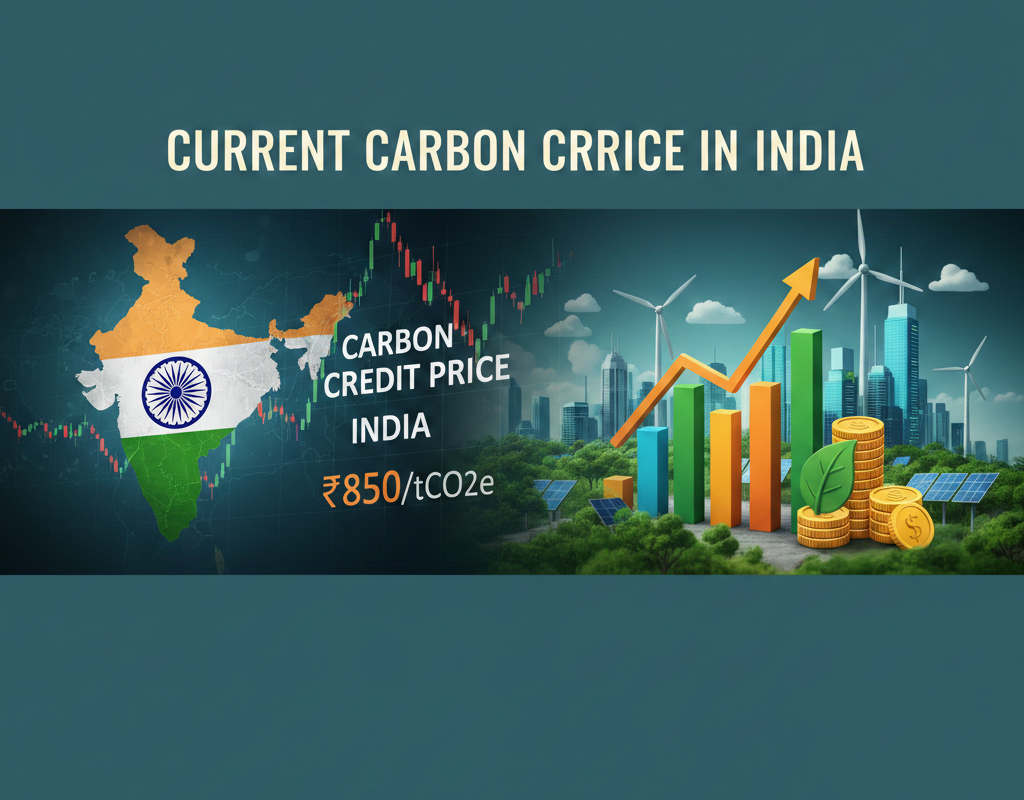
Current Carbon Credit Price in India 2026
Current Carbon Credit Price in India 2026
India’s carbon credit market is quickly becoming a vital tool for achieving climate goals, encouraging sustainable growth, and generating new income for companies, farmers, municipalities, and project developers. Investors, environmental strategists, policymakers, and market participants must comprehend the present carbon credit price in India in 2026 due to the introduction of the Indian Carbon Credit Trading Scheme (CCTS) and the increasing corporate pledges to net-zero targets.
The most recent price trends, including voluntary and expected compliance market rates, the pricing environment, value-driving factors, and projections for the Indian carbon market are all covered in this thorough analysis.

A Carbon Credit: What Is It?
It’s critical to clarify what a carbon credit is before discussing pricing. Through approved climate action projects, one metric tonne of carbon dioxide equivalent (CO₂e) has been prevented, decreased, or eliminated from the atmosphere. This is known as a carbon credit.
Projects including the deployment of renewable energy, forest conservation (REDD+), carbon capture in soil and agriculture, methane reduction, and energy efficiency programs are the sources of these credits. After that, they can be traded on voluntary or compliant marketplaces, with prices that vary according on demand, quality, and verification standards.
The Mechanism and Structure of the Indian Carbon Market
The environment surrounding carbon pricing in India is changing. In order to institutionalize carbon trading and techniques for reducing emissions intensity, the central government established the Carbon Credit Trading Scheme (CCTS) under changes to the Energy Conservation Act.
There are currently two main parts to the Indian carbon market:
- The voluntary creation and sale of carbon credits by project developers and other organizations is known as the Voluntary Carbon Market (VCM). Initiatives for agricultural carbon credits, clean energy projects, and community-based forestry are all part of this market.
- Compliance Market (Under CCTS): This framework, which is anticipated to debut in 2026, will allow emission-intensive businesses to exchange carbon credits in relation to performance-based goals, eventually evolving into a complete cap-and-trade system.
How Indian Carbon Credit Prices Are Set
In India, a mix of project characteristics, legal frameworks, and market dynamics affect the cost of carbon credits.
- Standards for Verification and Certification
Because consumers trust the environmental integrity of credits validated under strong international standards like Verra (VCS) or Gold Standard, they are usually more expensive than smaller or unverified schemes.
- Equilibrium between Supply and Demand
The demand for credits is expected to increase as India moves closer to becoming a market that complies with mandatory emission reduction targets for heavy sectors. This might put pressure on supply and raise costs. On the other hand, a large number of low-integrity credits may cause overall rates to decline.
- Objectives for Corporate Sustainability
Even before regulatory compliance becomes commonplace, demand for high-quality offsets is increased by multinational corporations and big Indian businesses purchasing credits in order to reach voluntary net-zero targets.
Trends in Carbon Prices: India and International Markets
Globally speaking, India’s present carbon credit costs are low:
- Prices in international voluntary markets typically fall between US $4 and $6 per tonne, with variations ranging from $0.25 to $27 per tonne depending on the project type and credit vintage.
- Due to stringent legislative restrictions and strong demand, compliance markets such as the EU Emissions Trading System (EU ETS) trade at much higher levels, frequently above €80 per ton.
- The lower prices in the Indian market are a result of both its early emphasis on voluntary market development and its infancy. However, it is anticipated that costs would progressively catch up with more general worldwide trends as compliance regulations take effect.
Opportunities and Difficulties to Come
Although the price movement for carbon credits is encouraging, the market still faces a number of obstacles:
- Maintaining Market Honesty
To maintain buyer confidence, strong verification and fraud prevention are crucial. Concerns over excessive issuance or low-impact credits have surfaced in international voluntary markets.
- Creating Clarity in Regulations
Prior to full trading, clear and transparent regulations for compliance market operations—including measuring, reporting, verification (MRV) procedures and penalty structures—are essential.
- Teaching Market Players
Many prospective project developers are unaware of the routes for monetizing carbon credits, particularly in small-scale or rural industries. Vast potential might be unlocked by increasing outreach and capacity building.
In conclusion: Carbon Credit Price Today in India 2026
The dynamic and often changing market environment is reflected in the current carbon credit pricing in India (2026). Projected compliance market pricing indicate increasing value and larger demand in the future, even though voluntary carbon credits trade at lower rates.
India’s carbon credit pricing is set to rise due to a variety of factors, including increased corporate ESG commitments, growing regulatory frameworks like the Carbon Credit Trading Scheme, and varied project pipelines. These factors will have an impact on the environment and create economic opportunities.
Investors, companies, legislators, and climate experts who want to successfully negotiate the Indian carbon credit market must comprehend these tendencies.