
 Aksh
Aksh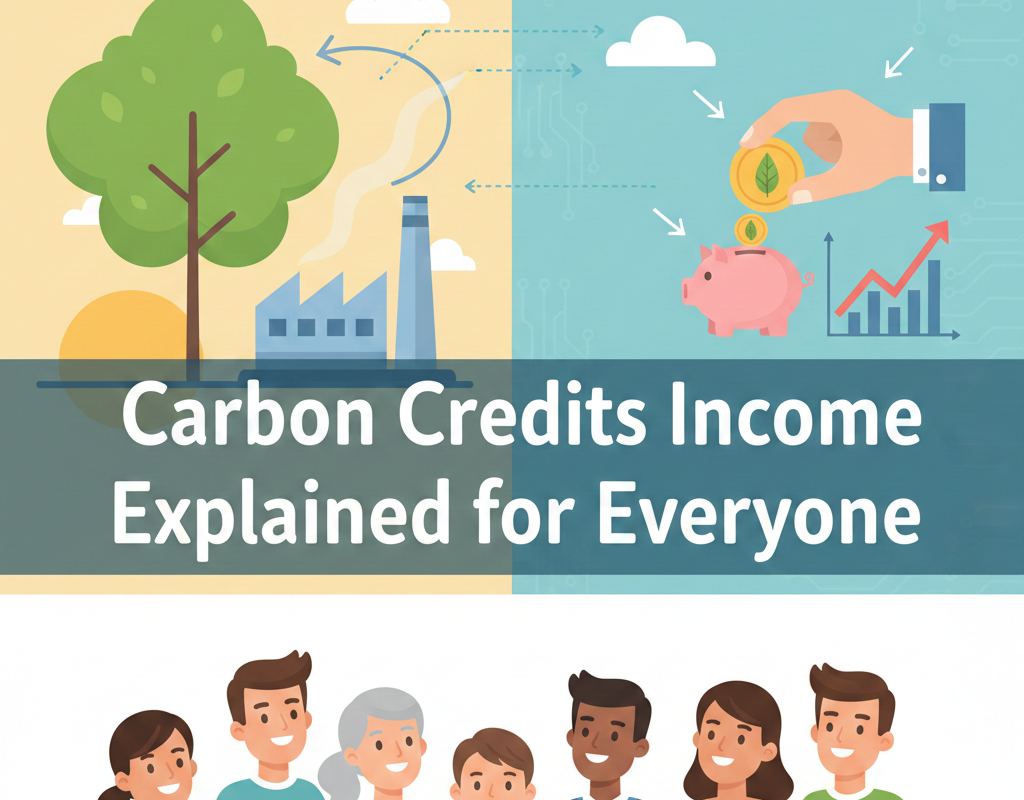
Carbon Credits Income Explained for Everyone
Carbon Credits Income Explained for Everyone
Carbon credits have become one of the most crucial financial instruments promoting sustainability as global efforts to tackle climate change increase. Carbon credits are no longer merely environmental tools in India and around the world; they are now assets that generate revenue for farmers, companies, industries, developers of renewable energy, and even private citizens.
It’s likely that carbon credits are involved if you’ve heard of people making money by upgrading farming methods, planting trees, or converting to solar energy. However, how does the revenue from carbon credits actually operate? Who foots the bill? What is your earning potential? And how can you get involved in the carbon credit market in India?

Carbon Credits: What Are They?
One metric ton of carbon dioxide (CO₂) or its equivalent greenhouse gas that has been decreased, eliminated, or avoided from the atmosphere is represented by a carbon credit.
Carbon dioxide and other greenhouse gases are released by businesses and industries during operations, transportation, and production. They can buy carbon credits from initiatives that lower or eliminate carbon emissions elsewhere in order to “offset” or balance these emissions.
Why Do Businesses Purchase Carbon Credits?
Companies purchase carbon credits for a number of reasons:
- Must comply with governmental requirements.
- To fulfill the objectives of carbon neutrality.
- To raise scores related to environmental, social, and governance (ESG).
- To improve the perception of the brand.
- Must adhere to global trade norms.
Major purchasers in the carbon market include manufacturing facilities, exporters, airlines, IT firms, large enterprises, and international brands.
Who Is Eligible to Receive Carbon Credit Income?
Large enterprises are not the only ones who may earn from carbon credits. India’s numerous sectors stand to gain:
- Projects involving tree planting and reforestation
Carbon dioxide is removed from the atmosphere through tree planting. Over time, carbon credits can be produced by private agroforestry enterprises, community forests, and large plantations.
- Developers of Renewable Energy
By substituting electricity derived from fossil fuels, solar, wind, and biomass facilities can produce carbon credits.
- Projects for Waste Management
Methane capture from biogas projects, composting facilities, and landfills lowers harmful emissions and is eligible for credits.
- Sectors
Credits can be produced by manufacturing facilities that use cleaner fuels, increase energy efficiency, or implement low-carbon technologies.
The cost of carbon credits in India
The cost of carbon credits in India is determined by whether the project sells domestically or abroad.
Important price determinants include:
- Global Climate Accords
- Demand for Corporate ESG
- Promises of carbon neutrality
- Governmental regulations
- Balance between supply and demand
High-end projects with significant social and environmental effects typically command greater prices.
India is becoming a significant source as the world’s need for carbon offsets rises because of its extensive agricultural base, growing renewable energy sector, and potential for afforestation.
The Registration Process for Carbon Credits
Projects must adhere to a set procedure in order to generate revenue in a legal and successful manner:
- Production of the Project Design Document (PDD).
- Computation of baseline emissions.
- Tracking the creation of the plan.
- Third-party verification.
- Enrollment in accordance with a recognized carbon standard.
- Continuous reporting and observation.
- Credit issuing and verification.
- Market sale.
To maximize carbon credit income, proper paperwork and expert guidance are essential.
Advantages of Earning Carbon Credits
Income from carbon credits has several advantages:
- An Extra Source of Income
Businesses and farmers make money from sources other than regular activities.
- Contribution to the Climate
Participants actively contribute to the fight against global warming.
- A rise in the value of assets
Carbon-projected land may increase in value over time.
- Brand Value and ESG
Businesses raise investor confidence and sustainability scores.
- Development in Rural Areas
Rural communities can benefit from carbon income.
India’s Prospects for Carbon Credit Revenue
India has enormous potential because
- A sizable amount of agricultural land
- Quick growth in renewable energy
- Government climate goals
- Corporate pledges to achieve net-zero
The nation wants to increase the capacity for non-fossil fuel energy and drastically lower the intensity of emissions.
Indian carbon credits may eventually increase in value due to growing pressure on global carbon prices.
Over the next ten years, it is anticipated that carbon farming, agroforestry, bioenergy, and carbon capture technologies will all expand quickly.
Concluding remarks: Carbon Credits Income Explained for Everyone
Carbon credit revenue is evolving into a structural element of the world economy, not merely a passing fad. India is leading this shift because of its agricultural terrain, policy impetus, and potential for renewable energy.
Whether you are an investor, farmer, business executive, or entrepreneur, carbon credits present a potent chance to combine financial gains with environmental responsibilities.
Your potential advantage in the developing low-carbon economy increases with your early understanding of and participation in the carbon credit ecosystem.
Carbon credits aim to protect the environment and generate revenue in addition to lowering emissions.
Carbon Credits Income for Startups: A Complete Guide to Monetizing Carbon Markets in India
Carbon Credits Income for Startups: A Complete Guide to Monetizing Carbon Markets in India