
 Aksh
Aksh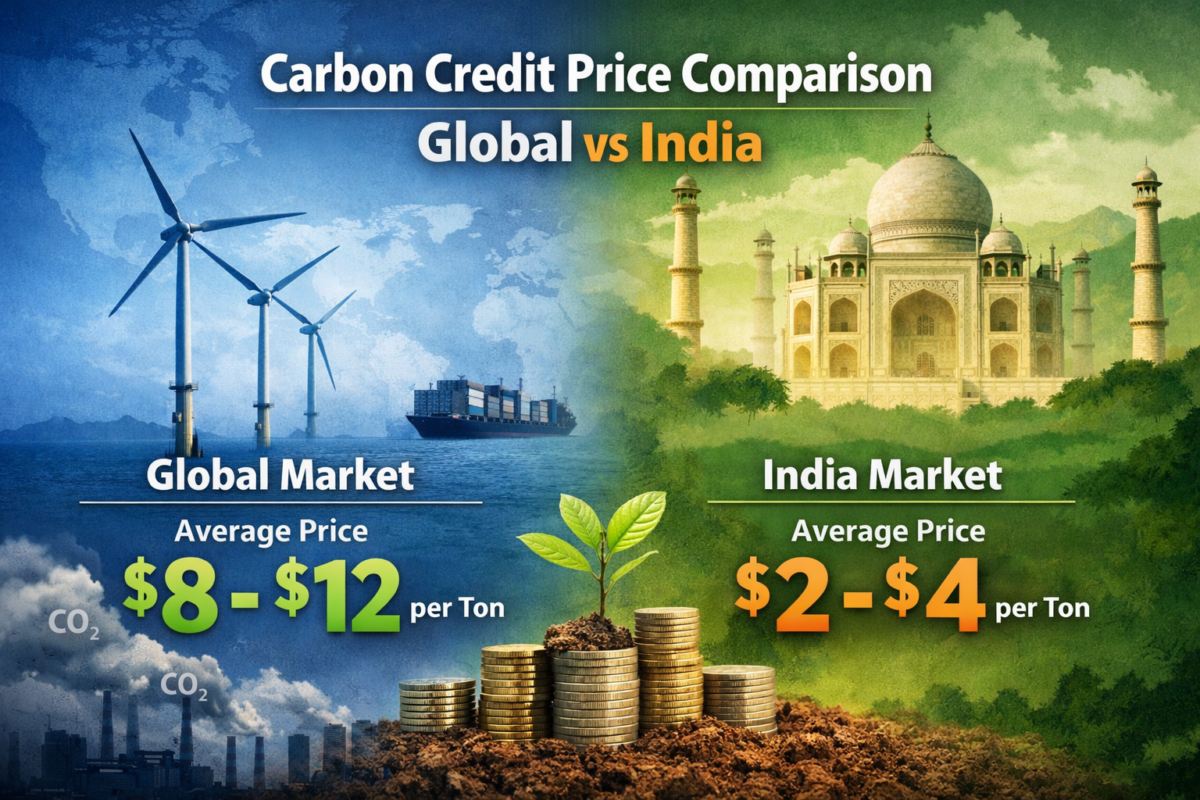
Carbon Credit Price Comparison Global vs India
Carbon Credit Price Comparison Global vs India
Over the past ten years, the global carbon market has changed quickly due to growing climate pledges, corporate sustainability objectives, and laws intended to lower greenhouse gas emissions. One of the most commonly asked questions as companies, governments, and investors get more involved in carbon trading is how the pricing of carbon credits in India and throughout the world compare.
Businesses preparing compliance plans, sustainability investments, or carbon offset purchases must comprehend the worldwide vs. Indian carbon credit pricing comparison. The price dynamics are becoming more organized and globally relevant as India expands voluntary participation and launches its own compliance carbon market.

Comprehending Carbon Credits: A Worldwide View
One metric tonne of carbon dioxide (CO₂) or an equivalent greenhouse gas that is avoided, decreased, or eliminated from the atmosphere is represented by a carbon credit. There are two main markets where these credits are traded:
- Markets for Compliance
- Markets for Voluntary Carbon (VCM)
Government-regulated systems with industry-imposed emissions caps oversee compliance markets. Businesses that exceed their emission limitations are required by law to buy carbon credits.
The European Union Emissions Trading System, or EU ETS, is the biggest compliance market in the world. The UK ETS, China’s national ETS, and California’s cap-and-trade scheme are additional noteworthy systems.
In contrast, voluntary markets enable businesses and people to offset emissions in excess of what is required by law. Corporate ESG obligations are what drive these marketplaces.
The composition and development of the carbon credit market in India
India has made significant contributions to international carbon markets for a long time, especially through the Clean Development Mechanism (CDM). Nonetheless, India has been creating a more organized domestic carbon trading system in recent years.
A compliant carbon market in India was made possible by the introduction of the Carbon Credit Trading Scheme (CCTS) by the Indian government as part of the Energy Conservation Act modification.
The carbon ecology of India consists of:
- Carbon projects with renewable energy
- Energy-saving initiatives
- Afforestation and forestry initiatives
- Waste-to-energy projects
- Initiatives to reduce industrial emissions
India has been a major player in voluntary markets, with Indian projects providing credit to buyers around the world.
Factors Affecting Global Carbon Credit Prices
Pricing is influenced by numerous macro and micro factors:
- Strictness of Regulation
In markets such as the EU ETS, stricter caps raise demand and drive up prices.
- Volatility of the Energy Market
Carbon pricing in compliance markets is directly impacted by changes in the price of fossil fuels.
- Commitments to Corporate Net-Zero
Premium project prices rise as a result of voluntary demand driven by large multinational firms.
- Verification and Quality
Strong reporting, monitoring, and verification skills help credits sell for more money.
- Stability in Politics
Price stability and investor trust are raised by stable policy frameworks.
Investment Viewpoint: India vs. Global
Markets for carbon credits offer both risk and opportunity for investors.
International Market Investing:
- Increased costs for compliance
- Robust regulatory support
- Mature markets have less volatility.
- High amount of capital needed
Investment in the Indian Market:
- Potential for early growth
- Reduced entrance fees
- Robust pipeline for renewable energy
- Possible price growth with the implementation of compliance
It might be advantageous for investors considering carbon credit investments in India to join during the initial stages of expansion.
India’s Regulatory Developments
The carbon trading scheme in India is anticipated to:
- Establish sectoral emission limits.
- Create a national registry.
- Make online trading platforms available
- Make verification procedures stronger
These steps will increase investor confidence and transparency, which could reduce the gap between the world and Indian carbon credit prices.
In conclusion: Carbon Credit Price Comparison Global vs India
The market for carbon credits is about to undergo a radical change. India’s developing carbon ecosystem has affordable options with significant growth potential, even though international compliance markets like the European Union Emissions Trading System maintain high and steady prices.
The prices of carbon credits around the world are still much higher than those of India’s voluntary and emerging compliance markets. However, price convergence can happen gradually if India complies with international norms and tightens regulatory enforcement.
India is seen by corporations, investors, and sustainability experts as a possible climate finance frontier. Global markets, meanwhile, offer regulatory predictability and stability.
Navigating the changing terrain of carbon credit pricing comparison between India and the rest of the world would require close attention to international integration, market supply-demand dynamics, and policy changes.
Carbon Credits Income for Startups: A Complete Guide to Monetizing Carbon Markets in India
Carbon Credits Income for Startups: A Complete Guide to Monetizing Carbon Markets in India