
 Aksh
Aksh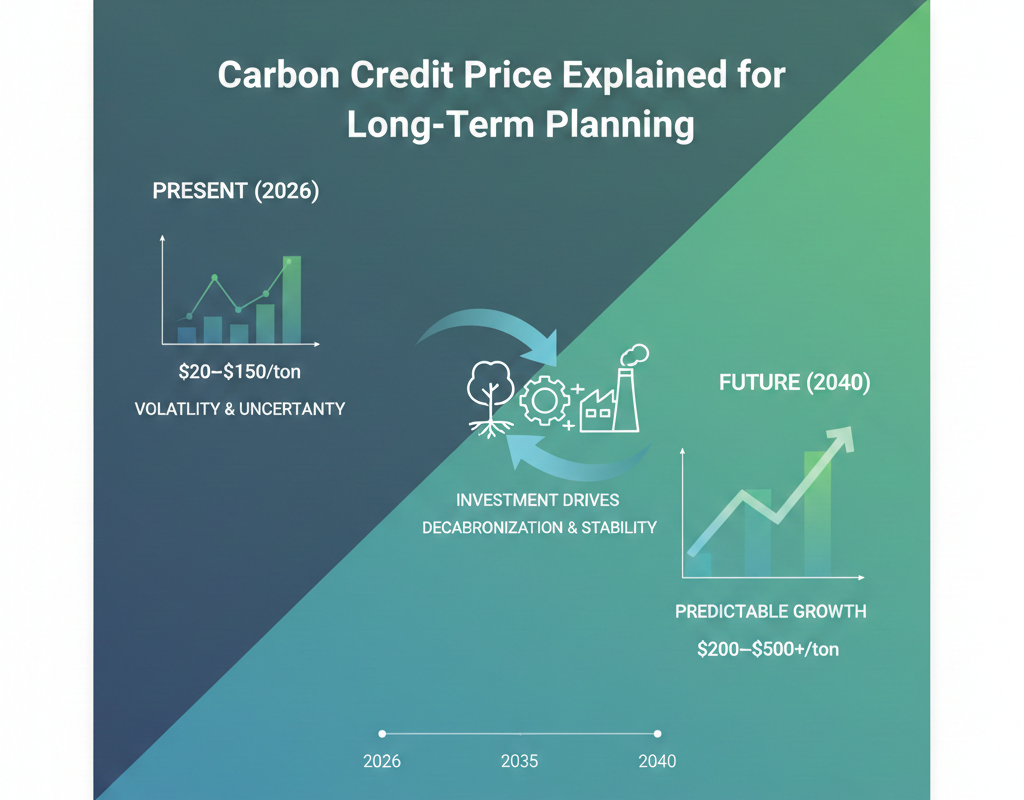
Carbon Credit Price Explained for Long-Term Planning
Carbon Credit Price Explained for Long-Term Planning
Carbon credits have transformed from a specialized environmental tool to a vital financial and strategic asset as global climate obligations increase. Understanding carbon credit pricing trends is now necessary for long-term planning for Indian businesses managing regulatory changes, ESG standards, and global supply chain requirements.
The cost of carbon credits affects risk management, business budgeting, environmental investments, and even global competitiveness. With global markets growing quickly and India moving toward structured carbon trading mechanisms, businesses need to know how carbon credit prices are set, why they change, and how to make long-term plans.

A Carbon Credit: What Is It?
One metric tonne of carbon dioxide (CO₂) or comparable greenhouse gasses that have been decreased or eliminated from the atmosphere is represented by a carbon credit. These credits are purchased by organizations to offset emissions that they are unable to immediately reduce.
There are two main market systems for trading carbon credits:
- Government regulations need compliance markets.
- Companies purchase voluntary markets in order to achieve sustainability objectives.
International frameworks governed by the United Nations Framework Convention on Climate Change and structured systems like the European Union Emissions Trading System govern compliance markets worldwide.
In order to connect its domestic sustainability initiatives with global climate commitments, India is creating its own compliance structure under the Carbon Credit Trading Scheme (CCTS).
Why the Price of Carbon Credits Is Important for Long-Term Planning
The cost of carbon credits has a direct impact on:
- Decisions around capital expenditures
- Strategies for ESG reporting
- Pathways for net-zero transitions
- Competitiveness in exporting
- Frameworks for risk management
- Confidence of investors
Carbon pricing, like energy or raw materials, becomes a predictable cost element for companies with a five to fifteen-year plan. Businesses frequently obtain a competitive edge when they proactively include carbon price into their strategic planning.
The Methods Used to Calculate Carbon Credit Prices
The cost of carbon credits varies greatly based on a number of environmental, governmental, and economic considerations.
- Type of Market: Voluntary vs. Compliance
Since compliance market credits are required by law, their prices are usually higher.
For instance, because of regulatory enforcement and restricted permits, prices under the EU compliance system have historically been significantly higher than those of the majority of voluntary carbon credits.
- Location
Credits from emerging markets, such as India, are frequently less expensive than those from industrialized ones. However, as verification and quality standards advance, this price difference is closing.
- Developments in Regulation
Government regulations have a big impact on prices. India may see a sharp rise in domestic credit demand and price increases if it implements tougher compliance regulations or a carbon tax.
Past Trends in the Price of Carbon Credits
Over the past ten years, there have been significant variations in the price of carbon credits.
In many markets, oversupply led to price crashes in the early 2010s.
- Mid-2010s: As regulatory reforms were implemented, there was a gradual stabilization.
- 2020–2023: Strong price recovery as a result of climate urgency and business net-zero commitments.
- From 2024 onward: Supply shortages and geopolitical changes may cause price volatility to increase.
Following regulatory tightening, prices in the EU compliance market increased significantly. Premium credits associated with nature-based solutions saw significant growth in voluntary marketplaces.
One important conclusion from these trends is that long-term planning needs to account for growing carbon pricing.
India’s Present Carbon Credit Price Situation
The Energy Conservation Act modifications are causing India’s carbon market to shift from project-based procedures to a structured trading system.
Important advancements consist of:
The Carbon Credit Trading Scheme (CCTS) was introduced.
- Extension of certificates for renewable energy
- Greater involvement of heavy industry sectors
- Conformity to international climate goals
Long-term projections indicate consistent growth as demand rises and domestic rules tighten, despite the fact that Indian carbon credit prices have typically been lower than those of European markets.
Price of Carbon Credits vs. Carbon Tax
Carbon taxes impose fixed costs per tonne of emissions, whereas carbon credits are market instruments that can be traded.
Although they are physically different, both strategies seek to internalize environmental costs.
Many nations employ hybrid methods that combine trading and carbon pricing. An greater incorporation of market-based mechanisms is suggested by India’s changing policy framework.
Comparison of International Markets
The largest compliant carbon market in the world and a standard for pricing trends is the European Union Emissions Trading System.
In the meantime, under Article 6 of the Paris Agreement, nations taking part in procedures governed by the United Nations Framework Convention on Climate Change are moving toward uniform carbon trading.
In conclusion: Carbon Credit Price Explained for Long-Term Planning
Pricing for carbon credits is now taking center stage in long-term corporate strategy. Understanding the fluctuations of carbon credit prices is crucial for Indian businesses managing changing rules, international climate commitments, and investor expectations.
Carbon credits will evolve from supplemental ESG tools to essential economic tools as voluntary markets grow and compliance mechanisms develop.
In addition to successfully managing risks, companies that proactively adjust to growing carbon costs will also be able to take advantage of long-term growth prospects in a low-carbon economy.
The price of carbon credits is becoming more than just an environmental indicator; it is a financial signal that will influence trade, investment, and industry in India and elsewhere.