
 Aksh
Aksh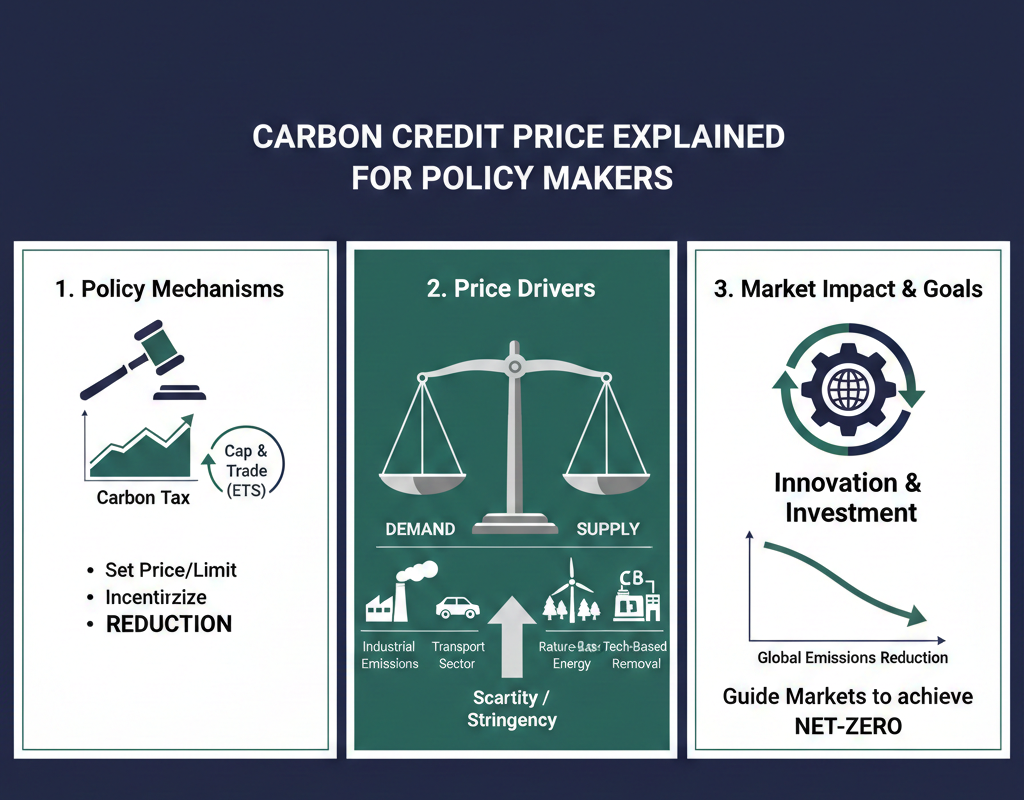
Carbon Credit Price Explained for Policy Makers
Carbon Credit Price Explained for Policy Makers
The price of carbon credits has quickly become one of the most important economic factors influencing global climate action. In order to create effective climate policies, promote sustainable economic growth, and align national pledges with international climate frameworks, policymakers must now comprehend the factors that influence, facilitate, and affect carbon credit pricing. Carbon markets are becoming essential instruments to achieve emissions reductions effectively and transparently as nations bolster their climate objectives under the Paris Agreement.
Carbon credit price has significant effects on industrial competitiveness, investment flows, and long-term decarbonization strategy in India, where economic growth and climate responsibility must coexist.

Comprehending the Economic Function of Carbon Credits
One metric tonne of carbon dioxide (CO2) or a comparable greenhouse gas that is avoided, decreased, or eliminated from the atmosphere is represented by a carbon credit. Projects include the use of renewable energy, energy efficiency upgrades, afforestation, methane capture, and cutting-edge carbon removal technologies are the sources of these credits.
Carbon markets, which function under two main systems—voluntary markets and compliance markets—are where carbon credits are exchanged. Governments establish and oversee compliance markets, which force some businesses to restrict emissions under legally enforceable limits. Companies and organizations can acquire credits through voluntary markets to offset emissions above and above legal limits, frequently in order to fulfill sustainability or net-zero goals.
What Affects the Cost of Carbon Credits?
The price of carbon credits is affected by several interrelated factors. It is essential to comprehend these factors in order to establish carbon markets that are reliable, significant, and stable.
- Dynamics of Supply and Demand
The price of carbon credits is mostly determined by supply and demand. In compliance markets, the government-imposed cap usually controls supply. Because there are fewer allowances available under a tougher cap, there is more scarcity, which could lead to price increases.
The emissions levels of regulated industry determine demand. Industries must buy more credits if their emissions exceed the allotted permits, which raises demand and prices. On the other hand, demand may drop and prices may fall if emissions drastically decline as a result of economic slowdowns or technical advancements.
- Policy Certainty and Regulatory Design
Clarity in regulations is crucial for carbon markets. Uncertainty in policy might deter investment and cause price volatility. Price expectations are stabilized when industries and investors have trust in well-defined long-term emission reduction paths.
Price behavior is directly influenced by design features like price floors, price ceilings, banking provisions, and allowance allocation techniques. A price floor, for instance, keeps carbon prices from dropping below a predetermined point, guaranteeing that the market will continue to encourage emissions reductions.
- International Mechanisms and Market Links
Domestic carbon credit prices may be impacted by international carbon trading systems, such as those outlined in Article 6 of the Paris Agreement. Cross-regional price convergence is possible when marketplaces are interconnected.
Global supply and demand trends may have an impact on domestic carbon credit pricing if India engages in international carbon trading. The balance between keeping domestic industry affordable and luring foreign investment must be evaluated by policymakers.
Trends in the Price of Carbon Credit Worldwide
Prices for carbon credits have varied significantly throughout marketplaces worldwide. Because of stricter regulations and tighter quotas, the European Union Emissions Trading System has seen significant price increases in recent years. On the other hand, the price of voluntary carbon markets has varied based on customer preferences, certification requirements, and project type.
Afforestation projects and other nature-based credits are frequently priced differently than technology-based removal credits like direct air capture. Because of the rising expenses and increasing demand for long-term carbon removal options, removal credits usually fetch higher prices.
Global price movements are useful benchmarks for Indian policymakers. They show how aggressive regulatory policies can raise costs, which encourage more substantial expenditures in decarbonization.
The Cost of Carbon Credit in India
Through institutional frameworks and policy actions targeted at creating a domestic carbon trading mechanism, India is now fortifying its carbon market architecture. Carbon pricing is a critical policy instrument because of the nation’s aim to reaching net zero by 2070 and drastically lowering emissions intensity by 2030.
India’s manufacturing, steel, cement, electricity, and chemical industries are major sources of emissions. These industries can be encouraged to invest in renewable energy, embrace energy-efficient technologies, and investigate green hydrogen pathways via a well-designed carbon market.
Pricing of Compliance vs. Voluntary Carbon Credits
Policymakers must be aware of the difference between voluntary and compl iant carbon credit prices.
Due to legally enforced demand, compliance markets typically exhibit higher and more stable prices. Emissions caps require businesses to adhere to them, guaranteeing steady demand.
Conversely, business commitments and reputational factors impact voluntary markets. The type of project, co-benefits, location, and certification requirements all have a significant impact on prices in voluntary markets.
Indian policymakers might take into account hybrid strategies, in which voluntary systems that encourage creativity and community-based initiatives coexist with internal compliance markets.
In conclusion: Carbon Credit Price Explained for Policy Makers
The price of carbon credits is a strategic tool influencing the shift to a low-carbon economy, not only a financial indicator. To create effective climate policy, policymakers must have a solid understanding of price mechanisms, market forces, regulatory architecture, and worldwide trends.
India’s climate path is at a turning point. Carbon pricing can encourage investment, boost industrial competitiveness, foster social development, and help the country achieve its long-term net-zero goals if it is implemented with the correct policy framework.
Policymakers can use carbon credit pricing as a potent accelerator for long-term economic reform by guaranteeing openness, honesty, and strategic vision in the creation of the carbon market.
Carbon Credit Price Market Trends 2026: Insights, Analysis, and Future Forecasts
Carbon Credit Price Market Trends 2026: Insights, Analysis, and Future Forecasts
2 Comments