
 Aksh
Aksh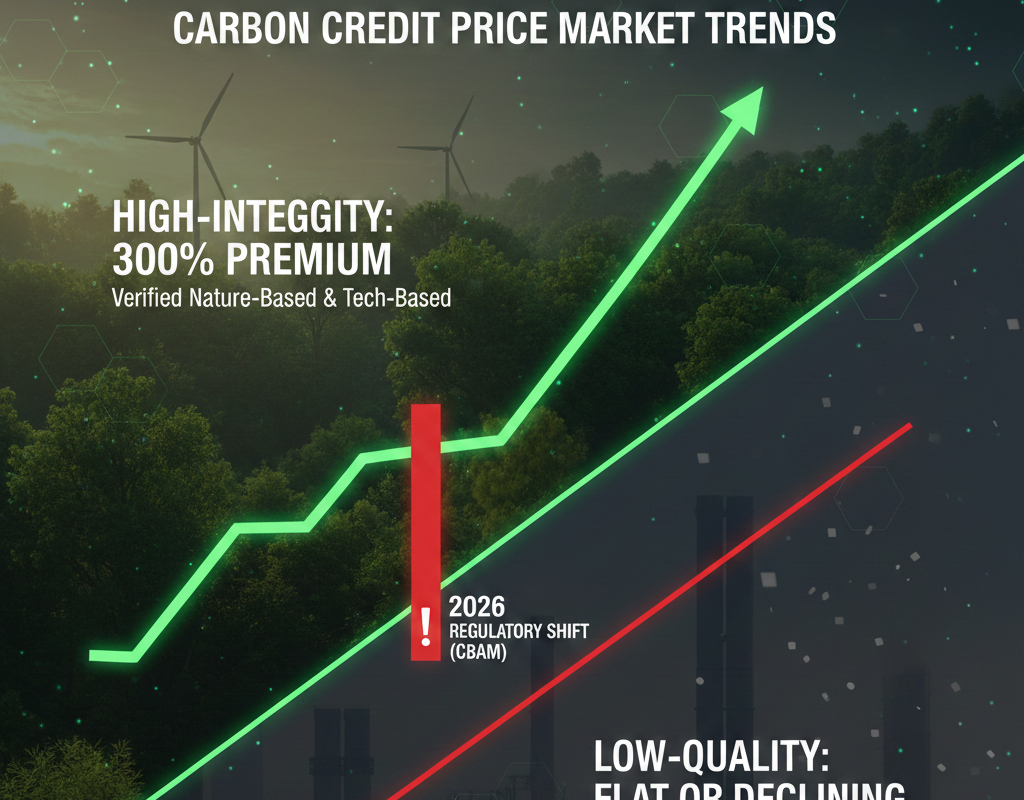
Carbon Credit Price Market Trends 2026
Carbon Credit Price Market Trends 2026
Over the past ten years, the global carbon credit market has seen substantial changes as a result of shifting governmental regulations, rising business pledges to net-zero aims, and increased awareness of climate change. In 2026, business investors, sustainability consultants, and environmental economists are all talking about carbon credit prices. For companies looking to offset their carbon emissions and for investors looking to take advantage of possibilities in the developing carbon trading market, it is essential to comprehend trends in carbon credit prices.

Comprehending the Cost of Carbon Credits
A permit that permits a business or individual to emit one metric ton of carbon dioxide or an equivalent quantity of greenhouse gasses is known as a carbon credit. The market for these credits is separated into voluntary carbon markets, where companies and people buy credits to satisfy sustainability targets above and beyond legal requirements, and compliance markets, which are governed by government regulations.
A number of variables, such as supply and demand dynamics, governmental policies, the use of renewable energy, and business net-zero pledges, affect the cost of carbon credits. Stricter emission standards and more corporate interest in sustainability projects have caused carbon credit prices, which were historically quite cheap, to rise significantly in recent years.
Overview of the Global Carbon Market
Carbon markets have grown into a multibillion-dollar industry on a global scale. Compliance carbon markets, like California Cap-and-Trade and the European Union Emissions Trading System (EU ETS), offer legal frameworks that generate steady demand for carbon credits. The voluntary carbon market (VCM), on the other hand, has expanded quickly due to consumer demand for ecologically friendly products and corporate efforts to reach net-zero emissions.
Trends in the worldwide carbon credit market for 2026 show that demand is still increasing. Increased use of renewable energy projects, carbon offset programs based on forestry, and advancements in carbon capture and storage (CCS) technology are some of the factors propelling this expansion. Prices for carbon credits are rising as a result of both voluntary market expansion and compliance.
India’s Trends in Carbon Credit Prices
India is becoming a major force in the world market for carbon. A growing quantity of carbon credits is being produced by the nation’s emphasis on sustainable industrial practices, forestry, and renewable energy. The government has implemented regulations to support carbon credit initiatives, especially in the clean technology, afforestation, and renewable energy sectors, and Indian businesses are becoming more involved in carbon trading.
India’s carbon credit pricing trends have been steadily rising, which is indicative of both rising domestic demand and worldwide market alignment. In order to fulfill their international sustainability commitments, multinational firms operating in India look for carbon credits, which are made available through projects under the Clean Development Mechanism (CDM) and new voluntary market initiatives.
Carbon Markets: Voluntary vs Compliant
Assessing price movements requires an understanding of the differences between voluntary and compliance carbon markets:
- Compliance Markets: Stable but less adaptable, these markets are regulated by regulatory frameworks. Government-imposed ceilings, sanctions for noncompliance, and industry-specific allocation guidelines are all reflected in prices in compliance markets.
- Voluntary Markets: These markets are more adaptable and are impacted by investor demand, consumer preferences, and business sustainability goals. Although prices can fluctuate more here, premium credits from forestry or renewable energy projects are frequently more expensive.
According to recent data, the price of voluntary carbon credits has been rising rapidly due to increased corporate ESG commitments, while the price of compliance carbon credits is still high because of tougher emission restrictions around the world.
Volatility of Prices and Market Hazards
Although there are many opportunities in the carbon credit market, price volatility is still a worry. Fluctuations may result from abrupt policy changes, overestimation of project carbon reduction, or delays in project verification. Temporary price increases may result, for instance, from false reporting of emissions reductions or from delays in the issuance of carbon credits.
Additionally, market players are subject to currency risk, especially in India, where local transactions take place in Indian rupees but carbon credits are valued in foreign dollars for export. To reduce such risks, forward contracts and hedging techniques are growing in popularity.
Prospects for Investing in Carbon Credits
Carbon credits are becoming more and more recognized as investment assets in addition to being instruments for sustainability compliance. The carbon market is accessible to investors via:
- Purchasing and selling certified carbon credits in the voluntary or compliance market is known as “direct carbon credit trading.”
- Investment funds that focus on purchasing and overseeing carbon offset projects are known as carbon credit funds.
- Finance initiatives that produce carbon credits, such as those involving carbon capture, afforestation, or renewable energy.
These investment opportunities provide both possible financial gains and environmental advantages. To guarantee the legitimacy and sustainability impact of the carbon credit-generating initiatives, however, thorough due diligence is necessary.
Influence of Government and Policy
Government regulations have a significant impact on how the carbon credit market develops. Through a number of incentive programs, the Indian government is aggressively supporting afforestation, energy efficiency, and renewable energy initiatives. Market stability is facilitated globally by carbon pricing mechanisms, carbon taxes, and cap-and-trade schemes.
Stronger regulatory support is anticipated in the near future, according to recent talks in the Indian Parliament on creating a solid framework for trading carbon credits. This might raise demand for and the cost of Indian carbon credits.
In conclusion: Carbon Credit Price Market Trends 2026
In 2026, the market for carbon credits will be a dynamic environment marked by rising corporate involvement, legislative backing, technical innovation, and demand. As the voluntary and compliance markets grow, carbon credit prices are expected to rise steadily, providing prospects for investors, companies, and project developers.
With forestry and renewable energy initiatives propelling market expansion, India is becoming a major supplier of carbon credits worldwide. Making educated judgments for firms and investors requires an awareness of price drivers, market trends, and verification standards.
The market for carbon credits, which provide both financial and environmental returns, will continue to develop as sustainability becomes a key component of environmental policy and corporate strategy. In 2026 and beyond, stakeholders will still need to keep an eye on government regulations, invest in high-quality carbon projects, and track changes in the price of carbon credits.
Carbon Credits Income for Urban Projects: Unlocking Sustainable Revenue for Cities
Carbon Credits Income for Urban Projects: Unlocking Sustainable Revenue for Cities
5 Comments