
 Aksh
Aksh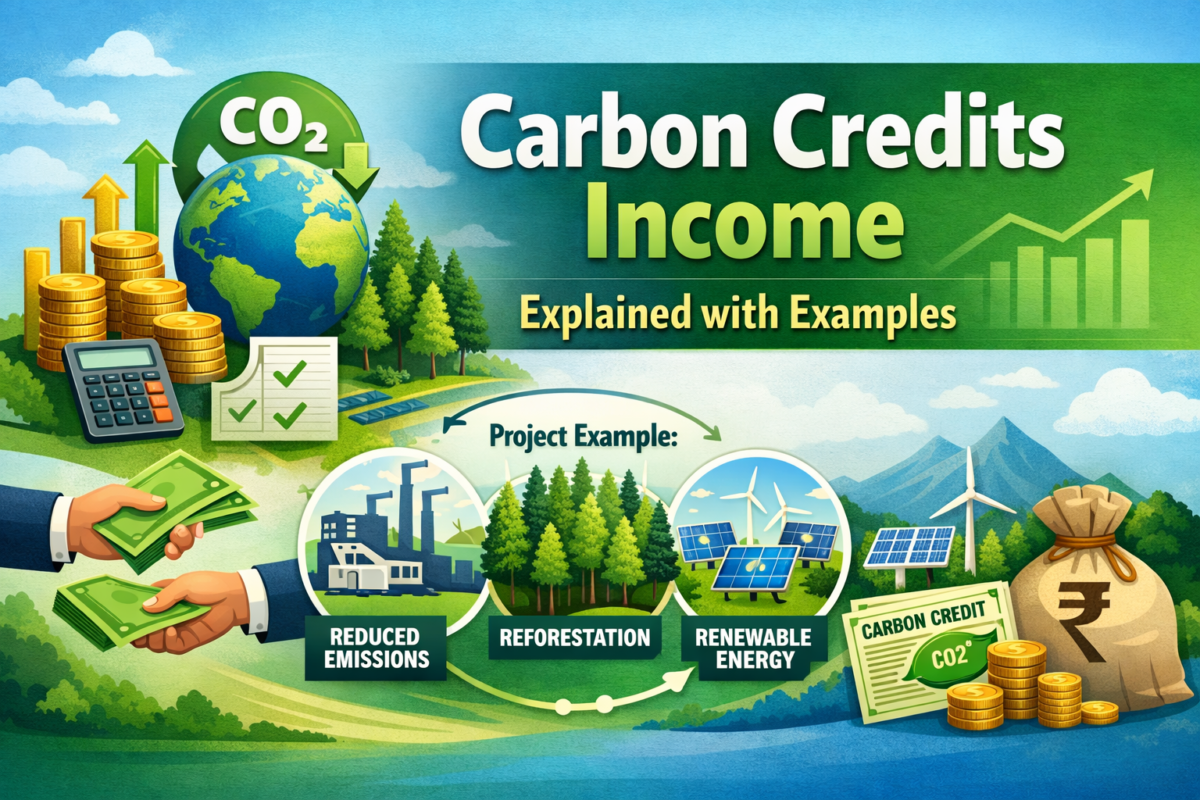
Carbon Credits Income Explained: How to Earn from Carbon Trading?
Carbon Credits Income Explained: How to Earn from Carbon Trading?
Environmental sustainability has developed into an economic opportunity in recent years, surpassing its status as only a moral obligation. Earning money from carbon credits is one such potential. Carbon trading has become a viable way for governments, corporations, and individuals to offset carbon footprints while making money as a result of increased awareness of climate change and worldwide emissions. The idea of carbon credits revenue is explained in this article along with its workings and practical applications, especially in the Indian context.

Carbon Credits: What Are They?
The authorization to emit one tonne of carbon dioxide or the equivalent quantity of another greenhouse gas (GHG) is known as a carbon credit. In the battle against climate change, carbon credits essentially serve as a unit of measurement. By placing a monetary value on each tonne of greenhouse gas that a company is able to offset, they encourage them to cut emissions.
The underlying idea is straightforward: a business can sell the excess capacity as carbon credits if its carbon emissions fall below the permitted limit. On the other hand, businesses that exceed their emission limits are required by law to purchase carbon credits. By doing this, a carbon trading market—also referred to as an emissions trading system (ETS)—is created.
How Carbon Credits Produce Revenue?
There are several ways to earn money from carbon credits:
- Selling Excess Credits: Companies can lower their emissions below legal limitations by investing in emission-reducing technologies, such as energy efficiency upgrades or renewable energy projects. Carbon credits that can be sold in carbon markets are produced from the excess reduction.
- Government Incentives: For projects that produce verified carbon credits, certain governments offer direct tax breaks or cash incentives. Afforestation, clean technology adoption, and renewable energy projects are a few examples of this.
- Corporate Partnerships: To reduce their carbon footprint, several multinational firms buy carbon credits. As a result, there is a consistent need for verified carbon credits from regional initiatives, which gives people or small companies using sustainable practices the chance to make money.
- Carbon Credit Investment Funds: Investing in carbon credit funds, which combine several projects and sell the resulting credits on domestic or foreign markets, is another way for investors to make money.
How to Generate Income from Carbon Credits in India?
In India, obtaining revenue from carbon credits requires a methodical procedure:
- Determine Which Projects Are Eligible: Projects must result in quantifiable decreases in emissions. Afforestation, waste management, energy efficiency, sustainable transportation, and renewable energy are examples of common sectors.
- Project Registration: Register the project with a recognized organization, such as Verra for voluntary credits or the United Nations Framework Convention on Climate Change (UNFCCC) for CERs.
- Verification and Monitoring: Qualified auditors must conduct thorough monitoring of the project. They guarantee standard compliance and quantify the carbon reductions attained.
- Certification: Carbon credits for the computed reductions are given after verification.
Advantages of Earning Carbon Credits
- Financial Incentives: Carbon credits give sustainable projects access to an extra source of funding.
- Environmental Impact: Supports climate goals by encouraging individuals and companies to cut emissions.
- Regulatory Compliance: Assists businesses in meeting government emission standards while making money off of decreases.
- Market Growth: Demand is driven by the growing emphasis on carbon neutrality worldwide, which could eventually raise the value of credit.
Obstacles and Things to Think About
Although the revenue from carbon credits is encouraging, there remain obstacles:
- Costs of Verification: Certification, especially for smaller projects, can be costly.
- Market Volatility: Variations in carbon credit prices impact the predictability of income.
- Complicated Regulations: Complying with the law requires an understanding of regulatory structures and standards.
- Project Sustainability: To guarantee continuous emissions reductions, long-term success necessitates continuous project management.
India’s Prospects for Carbon Credits
The carbon market in India is expected to expand. The market for carbon credits is predicted to increase as a result of worldwide corporations looking for offsets and the government’s aim for net-zero targets by 2070. Important trends consist of:
- Domestic carbon trading systems’ expansion.
- Corporate interest in voluntary carbon markets has grown.
- Technological advancements such as blockchain for trading and tracking carbon credits.
- Incorporating carbon credits into reporting systems for environmental, social, and governance (ESG) issues.
Advice for Increasing the Revenue from Carbon Credits
- Select High-Impact Projects: Give special attention to initiatives that result in notable decreases in emissions.
- Keep Up with Market Rates: Keep an eye on carbon credit rates on a regular basis to sell when they’re at their best.
- Diversify Your initiatives: To lower financial risk, work on a variety of initiatives, such as afforestation, biomass, and solar.
- Cooperate with Experts: For precise measurement and market access, cooperate with qualified auditors and carbon experts.
- Utilize Government Programs: Take advantage of subsidies or incentives to promote the use of clean technology and renewable energy.
Advice for Increasing the Revenue from Carbon Credits
- Select High-Impact Projects: Give special attention to initiatives that result in notable decreases in emissions.
- Keep Up with Market Rates: Keep an eye on carbon credit rates on a regular basis to sell when they’re at their best.
- Diversify Your initiatives: To lower financial risk, work on a variety of initiatives, such as afforestation, biomass, and solar.
- Cooperate with Experts: For precise measurement and market access, cooperate with qualified auditors and carbon experts.
- Utilize Government Programs: Take advantage of subsidies or incentives to promote the use of clean technology and renewable energy.
In conclusion: Carbon Credits Income Explained: How to Earn from Carbon Trading?
Income from carbon credits is a special combination of financial opportunity and environmental responsibility. In India, there are numerous opportunities to profit from carbon trading, ranging from afforestation and renewable energy to industrial efficiency programs. By comprehending the certification procedure, monitoring systems, and market conditions, companies and individuals may make sustainability a real source of income.
A growing source of revenue and investment, carbon credits are more than just a means of reducing emissions in light of the growing global attention being paid to climate change and India’s dedication to sustainable growth. Participating in carbon credit projects now can assure future financial and environmental benefits for local communities, corporations, and investors.
Carbon Credit Trading Best Practices: A Complete Guide to Maximizing Impact and Returns
Carbon Credit Trading Best Practices: A Complete Guide to Maximizing Impact and Returns