
 Aksh
Aksh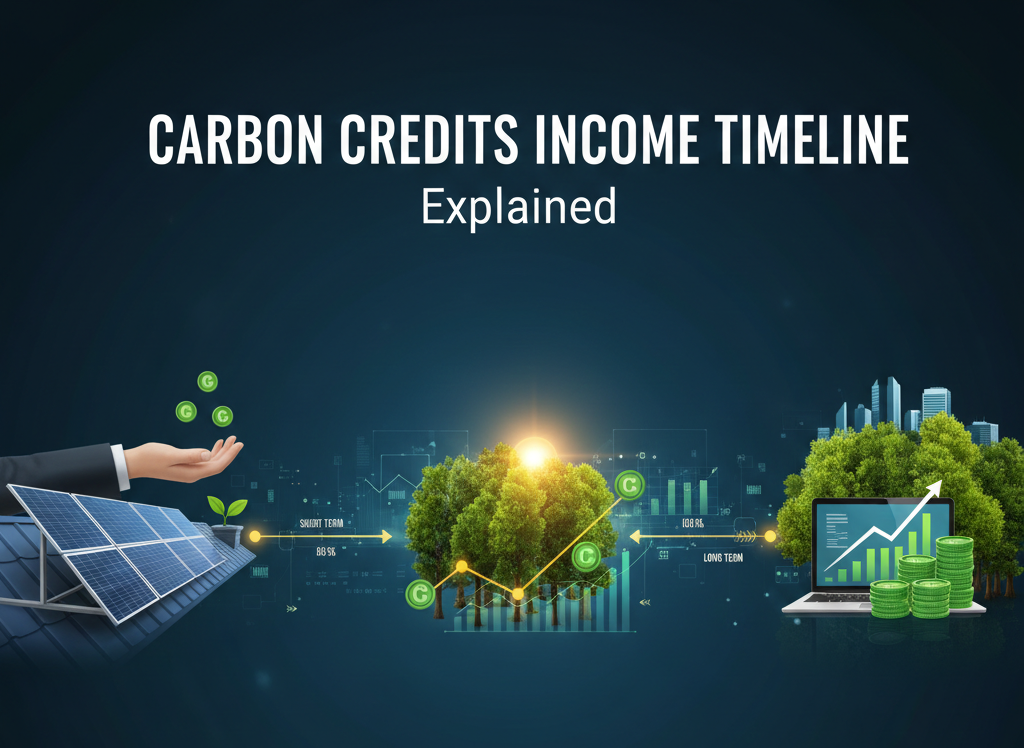
Carbon Credits Income Timeline Explained
Carbon Credits Income Timeline Explained
Global attention is shifting toward climate change mitigation and sustainable development. Carbon credits are one of the many green investment options that have become a practical and lucrative option for companies, farmers, and investors. However, one of the most frequently asked topics is: how and when do you get paid for your carbon credits? For investors hoping to make money while supporting environmental sustainability, it is essential to comprehend the carbon credit income timeline.
This essay, which is especially suited for the Indian market, explains the development of carbon credits from their inception to the generation of income. This article will explain the procedures and anticipated timelines for profiting from carbon credits, regardless of whether you are an individual investor or a business looking into carbon offset projects.

Carbon Credits: What Are They?
Understanding what carbon credits are is crucial before diving into the income timeline. One metric ton of carbon dioxide (CO2) or an equivalent greenhouse gas reduced in the atmosphere is represented as a carbon credit. Companies and organizations looking to offset their carbon emissions can purchase these tradable certificates in carbon markets.
Important Points:
- One carbon credit is equivalent to one ton of averted or decreased CO2.
- Issued by environmental projects that have been verified
- Carbon markets that are tradeable in voluntary or compliant
Carbon credit projects in India can include methane capture, energy efficiency programs, afforestation, and renewable energy installations. The timeframe for revenue generation is impacted by the unique validation and verification procedures for each project type.
Knowing the Income Timeline for Carbon Credits
The steps from project implementation to the point at which carbon credits are monetized are referred to as the carbon credits income timeline. Depending on the project’s size, type, and market conditions, this multi-step procedure can take years.
This is a thorough explanation of the timeline:
- Project Planning and Initiation (0–6 Months)
Finding a project that qualifies for carbon credits is the first step. This might be:
- Renewable energy initiatives (biomass, wind, and solar)
- Enhancements in energy efficiency (commercial, industrial)
- Projects involving reforestation and forestry
- Initiatives for waste management or methane capture
Project developers carry out cost analyses, feasibility assessments, and calculations of possible carbon reductions at this phase. Project design documents, or PDDs, are created and include information about:
- Initial emissions
- Estimated decreases in emissions
- Plans for reporting and monitoring
Because a well-documented strategy guarantees seamless validation and verification later in the process, this step is essential.
- Verification and Enrollment (6–12 Months)
Validation by an impartial, certified organization comes after project planning. Validation guarantees that the predicted emission reductions are credible and verifies that the project satisfies international criteria like the Verified Carbon Standard (VCS) or Gold Standard.
The project is registered with a carbon registry after validation. Prior to the issuance of carbon credits, this procedure is necessary. In India, registration compliance for particular project types is supervised by organizations such as the Ministry of Environment, Forests, and Climate Change (MoEFCC) or the Bureau of Energy Efficiency (BEE).
Implications for Income:
There is now no revenue. This is a crucial point in the carbon credits income timetable, though, because successful validation is a need for commercialization.
- Execution of the Project (1-3 Years)
The project enters the implementation phase after validation is finished. Depending on the kind of project:
- Renewable energy initiatives: setting up wind turbines, solar panels, or biomass facilities
- Projects involving reforestation: planting and caring for trees in certain regions
- Methane collection initiatives: Installing equipment in farms or landfills
The project begins producing quantifiable emission reductions during this time. Credibility must be maintained through consistent reporting and monitoring.
Income Implications:
Although direct carbon credit income has not yet been realized, there may be some early-stage funding or subsidies available. Depending on the intricacy of the project, this phase may take one to three years.
Factors Influencing the Timeline of Carbon Credit Income
Although the timeline above gives a broad picture, a number of variables might affect how soon income is realized:
- Project Type: Because renewable energy projects evaluate carbon reductions more quickly than forestry initiatives, they may produce credits more quickly.
- Verification Frequency: While some projects have multi-year cycles, others go through verification once a year.
- Market Demand: Credit sales and revenue realization can be accelerated by strong demand in voluntary carbon markets.
- Regulatory Compliance: MoEFCC or BEE regulations must be followed by Indian projects, which may have an impact on the timeframes for registration and issuance.
- Certification Standards: Although they may take longer to validate, premium certifications like Gold Standard might pay more.
Advantages of Knowing the Carbon Credits Income Schedule
Understanding the revenue timeline enables companies and investors to:
- Budget cash flow to prevent unforeseen expenses throughout the protracted period before income starts to arrive.
- Analyze ROI: Recognize possible long-term returns and when investments will begin to pay off.
- Reduce risks by identifying potential delay points, such as market volatility or verification.
- Optimize projects: If you need money more quickly, pick projects with shorter durations.
In conclusion: Carbon Credits Income Timeline Explained
The income schedule for carbon credits is a multi-step process that necessitates thorough preparation, verification, and market knowledge. Depending on the project type and certification requirements, Indian investors should anticipate a period of two to five years before they see a profit from the start of the project to the credit sale. Nevertheless, once set up, carbon credit initiatives offer steady sources of income while favorably influencing environmental preservation and the fight against climate change.
Investors can make well-informed decisions, optimize returns, and engage with confidence in India’s expanding carbon market by having a thorough understanding of each step of the timeline: planning, validation, implementation, monitoring, verification, issue, and sale.
Carbon credit initiatives can provide not just monetary benefits but also a significant contribution to a more sustainable and greener future by adhering to Indian rules and taking these actions.
Carbon Credit Trading Opportunities India 2026 | Growth, Market Trends & Investment Guide
Carbon Credit Trading Opportunities India 2026 | Growth, Market Trends & Investment Guide
2 Comments