
 Aksh
Aksh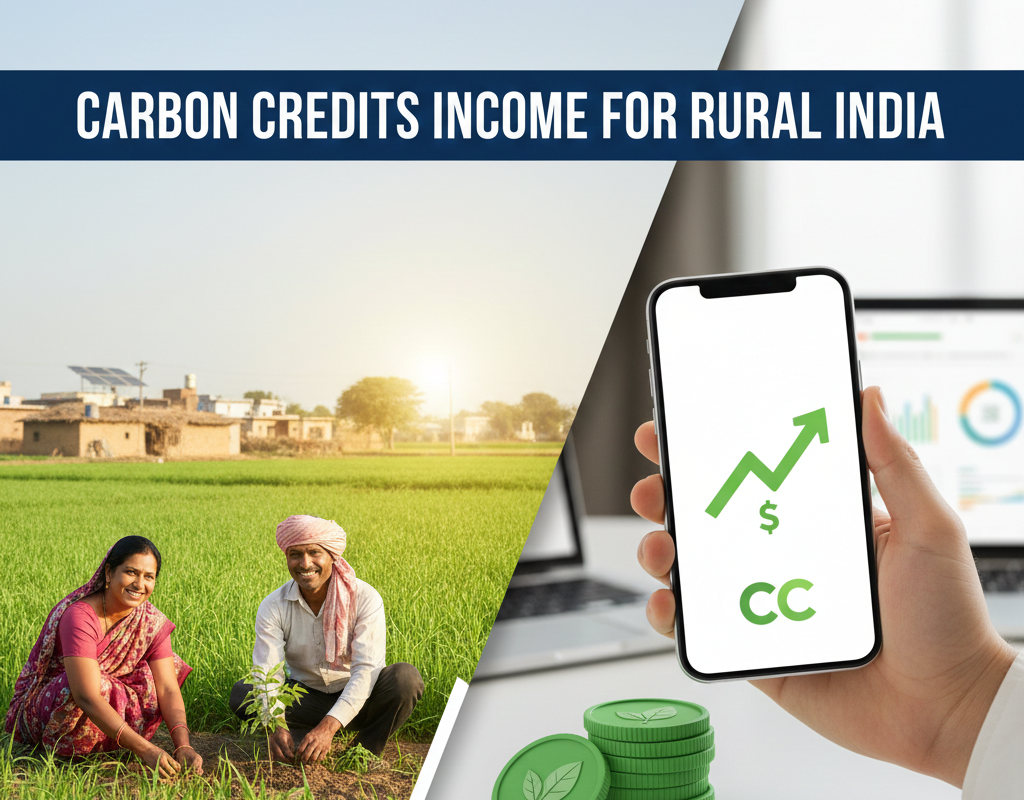
Carbon Credits Income in Rural India
Carbon Credits Income in Rural India
More than 65% of India’s population lives in rural areas, which have historically experienced economic hardships as a result of a lack of work options, reliance on agriculture, and environmental stresses. But the idea of carbon credit income is starting to show promise as a game-changer for villages, allowing for sustainable growth and offering a sizable revenue stream. By encouraging the use of renewable energy, afforestation, and sustainable farming methods, this new source of income is assisting rural people in actively mitigating the effects of climate change.

Comprehending Carbon Credits and Their Operation
One metric ton of carbon dioxide (CO2) or an equivalent greenhouse gas (GHG) removed from the atmosphere is represented as a carbon credit. Carbon credits are bought by governments, businesses, and organizations to offset their emissions and satisfy voluntary or legal sustainability requirements. Participating in carbon credit-generating activities, like planting trees, reclaiming damaged land, or switching to renewable energy, directly translates into financial incentives for rural communities in India.
India’s carbon credit market has grown quickly, particularly as a result of policies that support both the country’s national climate goals and the Paris Agreement. Rural households and community-based organizations can generate a consistent income from carbon credits to supplement traditional agricultural profits by monetizing their sustainable practices through participation in carbon credit schemes.
Important Industries Fueling Rural India’s Carbon Credit Revenue
In rural India, a number of industries are especially well-suited for producing carbon credits:
- Projects for Reforestation and Afforestation
In addition to increasing soil fertility and biodiversity, planting trees on damaged or underutilized farmland absorbs CO2 from the atmosphere. Through these programs, carbon sequestration is rewarded to rural farmers and villages. Nowadays, a significant portion of rural households’ income from carbon credits comes from community-led afforestation programs.
- Agriculture That Is Sustainable
Greenhouse gas emissions from agricultural operations can be decreased by implementing sustainable farming practices such crop rotation, zero-tillage, organic farming, and biofertilizers. Farmers that adopt these climate-friendly methods might receive carbon credits from programs that promote sustainable agriculture, giving rural India access to other sources of revenue.
- Projects Using Renewable Energy
The number of small-scale solar and biogas projects in rural India is increasing. These programs create carbon credits by substituting renewable energy for fossil fuels, which can then be sold to businesses or governmental organizations. In addition to encouraging renewable energy, this gives rural people steady income from carbon credits.
Carbon Credits’ Advantages for Rural India
Beyond just monetary benefits, carbon credit income has an influence on rural India.
- Economic Empowerment: By making eco-friendly activities profitable, rural households can diversify their sources of income and lessen their reliance on low-wage work or seasonal farming.
- Climate Resilience: By improving soil health, lowering erosion, and increasing water retention, reforestation and sustainable agriculture aid in communities’ adaptation to climate change.
- Employment Creation: Putting carbon credit initiatives into action leads to the creation of jobs in renewable energy installations, tree planting, maintenance, and monitoring.
- Community Development: Carbon credit revenue frequently supports local infrastructure, healthcare, and educational institutions, so promoting rural development as a whole.
- Benefits to the environment: Carbon credits support actions that lower greenhouse gas emissions, support biodiversity, and preserve ecological equilibrium.
Implementing Carbon Credit Projects Presents Difficulties
Notwithstanding the encouraging prospects, a number of obstacles prevent carbon credit schemes from being widely adopted in rural India:
- Knowledge and Awareness Gap: A large number of rural areas lack knowledge about carbon credits and the procedures needed to be a part of them.
- High Initial Investment: Low-income households may find it difficult to afford the initial costs associated with setting up biogas facilities, afforestation projects, or renewable energy projects.
- Complicated Certification Process: For rural people, obtaining carbon credits may be intimidating since it requires verification and registration with accepted carbon standards.
- Market Volatility: Demand, regulatory changes, and global carbon markets all affect the price of carbon credits, making it difficult to forecast income.
Government Programs and Assistance with Policies
The potential of carbon credits to meet climate targets and rural development objectives has been acknowledged by the Indian government. Important projects consist of:
- The National Action Plan on Climate Change (NAPCC) promotes energy efficiency, afforestation, and renewable energy initiatives.
- The Perform, Achieve, and Trade (PAT) scheme helps businesses cut emissions while generating chances for carbon offsets.
- State-Level Renewable Energy Incentives: Rural towns can take part in carbon credit markets because to the subsidies that many states provide for solar, wind, and biomass projects.
These initiatives give rural India a way to generate revenue from carbon credits while supporting national and international climate goals.
How to Begin Receiving Carbon Credits in Rural Areas?
There is a methodical strategy that rural communities interested in carbon credit income might take:
- Determine Viable Projects: Evaluate local resources such solar energy availability, animals for methane capture, and degraded land for afforestation.
- Interact with Certified Agencies: Work together with government organizations, private companies, or non-governmental organizations that are experts in the certification and tracking of carbon credits.
- Adopt Sustainable Practices: To cut carbon emissions, implement strategies like organic farming, the planting of trees, and the use of renewable energy.
- Monitor and Report: Keep tabs on developments and submit information to validate carbon credits in accordance with accepted guidelines.
- Sell Carbon Credits: After being validated, credits can be offered for sale on compliance or optional carbon markets, generating a consistent flow of income.
In conclusion: Carbon Credits Income in Rural India
A potent instrument for converting rural India into a center of sustainable development is carbon credits. Villages may fight climate change and make a significant income by tying financial incentives to environmental conservation. Rural communities can engage in the global carbon market through sustainable agriculture, waste management, renewable energy, and reforestation.
Government policies, NGO assistance, and private sector collaborations can work together to remove current obstacles and provide millions of rural households with the income from carbon credits. Carbon credit programs will help India’s rural economies thrive and pave the way for a more sustainable and greener future as the country continues its transition to climate-resilient growth.
Carbon Credit Trading Opportunities India 2026 | Growth, Market Trends & Investment Guide
Carbon Credit Trading Opportunities India 2026 | Growth, Market Trends & Investment Guide