
 Aksh
Aksh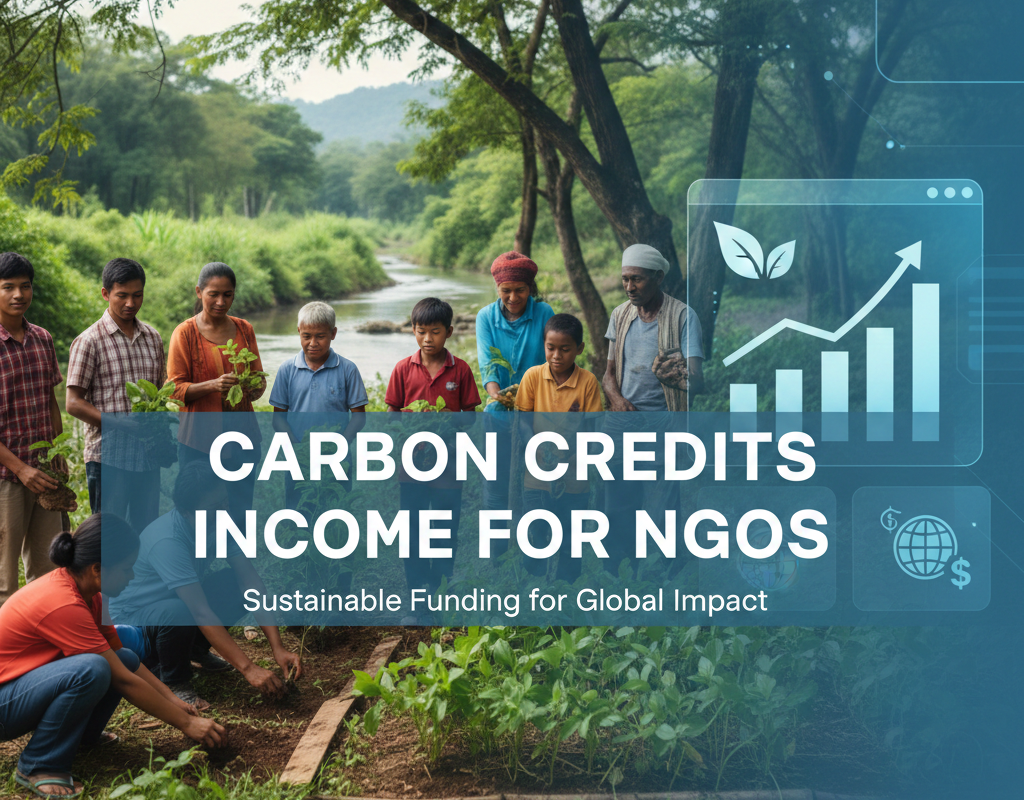
Carbon Credits Income for NGOs
Carbon Credits Income for NGOs
Carbon markets have become one of the most effective financial instruments for promoting environmental action as climate change continues to shift global priorities. Although businesses have long engaged in carbon trading, non-governmental organizations (NGOs) are becoming more and more aware of the enormous potential of carbon credit revenue as a long-term source of funding. Carbon credits present a revolutionary chance for NGOs engaged in waste management, forestry, rural development, renewable energy, and community empowerment to combine environmental benefit with long-term financial viability.
The compliance and voluntary carbon markets are expanding quickly in India, one of the fastest-growing economies in the world and a party to the Paris Agreement. This offers Indian NGOs a special chance to profit from climate-positive initiatives, build steady revenue streams, and support national

Comprehending Carbon Markets and Carbon Credits
One metric ton of carbon dioxide (CO2) or a comparable greenhouse gas (GHG) that has been cut, avoided, or eliminated from the atmosphere is represented as a carbon credit. These credits, which may be sold to companies looking to offset their emissions, are produced by verified climate mitigation projects.
The two main carbon markets are as follows:
- The Carbon Market for Compliance
Government rules oversee this market, and businesses are required to reach legally set emission reduction targets. Under the Carbon Credit Trading Scheme, which the Indian government launched, India is extending its compliance measures.
- Market for Voluntary Carbon
Businesses and people buy carbon credits in the voluntary market to fulfill carbon neutrality targets, ESG pledges, or corporate sustainability goals. This market is adaptable and available to community projects and NGOs.
The Reasons Carbon Credits Are Revolutionizing NGOs
Donations, grants, CSR contributions, and government support are all major components of traditional NGO funding schemes. These sources may be project-based and inconsistent. Revenue from carbon credits, however, provides:
- Consistent long-term revenue
- Funding dependent on performance
- Conformity to climate and environmental objectives
- Being financially independent
- Access to worldwide funding
Environmental impact is converted into a quantifiable financial asset through carbon credits. NGOs can create self-sustaining climate programs rather than relying just on funding.
The cost of carbon credits in India
Demand, international climate regulations, and company ESG pledges all affect the price of carbon credits. Depending on certification and quality, prices in the voluntary market can vary significantly.
Premium credits with significant biodiversity and community benefits are typically more expensive.
In the upcoming years, it is anticipated that India’s desire for structured carbon trading mechanisms will raise demand and transparency.
Important Advantages Over Income
Carbon credit initiatives offer several benefits:
- Development of the Community
Income can be used to fund infrastructure, healthcare, and education.
- Increased Trustworthiness
NGO credibility with partners and donors is enhanced by verified carbon programs.
- Business Collaborations
Verified carbon projects are preferred by businesses looking to align with ESG.
- Leadership in the Environment
NGOs play a significant role in sustainable development and climate action.
Obstacles NGOs Could Face
Notwithstanding the chance, NGOs should be ready for obstacles:
- Exorbitant upfront registration fees
- Intricate documentation
- lengthy certification periods
- Volatility of market prices
- Requirements for technical expertise
These risks can be reduced, though, by forming strategic alliances with carbon consultants and aggregators.
How NGOs Can Increase Their Revenue from Carbon Credits?
- Join Forces with Carbon Professionals
Better market access and seamless certification are guaranteed when working with seasoned carbon project developers.
- Prioritize High-Impact Initiatives
High-end purchasers are drawn to projects with significant social co-benefits.
- Assure Sturdy Monitoring Systems
The success of verification is enhanced by accurate data collecting.
- Use Corporate CSR Alignment to Your Advantage
Numerous Indian businesses look for carbon offset alliances that support their CSR objectives.
- Project Portfolio Diversification
Risk is decreased when waste management, renewable energy, and forestry projects are combined.
In conclusion: Carbon Credits Income for NGOs
Income from carbon credits for NGOs is now a viable, scalable, and significant funding source rather than just a theoretical prospect. NGOs are in a unique position to spearhead climate action while ensuring sustainable revenue as India fortifies its carbon market infrastructure and the demand for premium credits increases globally.
NGOs may increase their environmental and social impact, create recurring income, and form strategic business alliances by creating verified carbon initiatives in forestry, renewable energy, waste management, and community development.
Unprecedented opportunities are being created by the convergence of community development and climate finance. NGOs that take initiative, form solid alliances, and uphold strict transparency guidelines will become leaders in India’s carbon economy.