
 Aksh
Aksh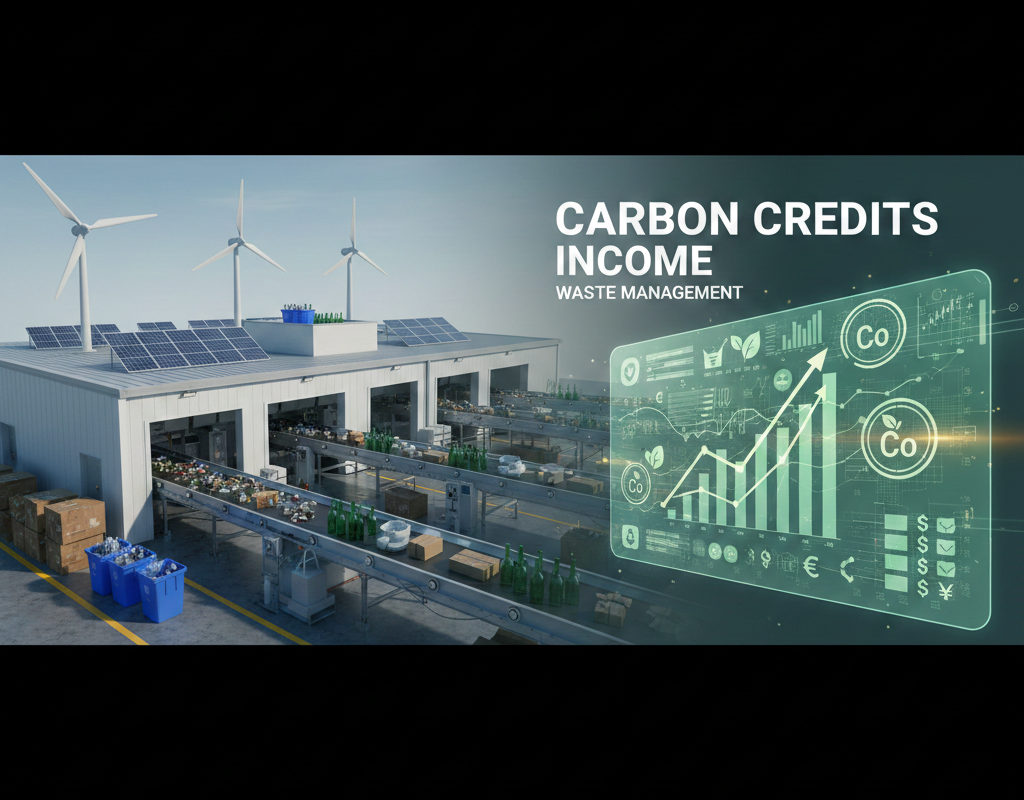
Carbon Credits Income from Waste Management
Carbon Credits Income from Waste Management
Over 160,000 tonnes of municipal solid garbage are produced daily in India, and as the country becomes increasingly urbanized and industrialized, this amount keeps growing. Waste is rapidly being seen as a significant economic opportunity, despite the fact that it has historically been seen as an environmental burden. In India’s developing climate economy, waste management is becoming a major source of revenue through structured carbon credit procedures.
Garbage management revenue from carbon credits is changing the way private garbage operators, governments, and companies with an emphasis on sustainability handle waste disposal. Organizations can produce quantifiable and tradeable carbon credits in addition to aiding in climate action by lowering methane emissions, capturing landfill gas, encouraging composting, and turning waste into energy.

Knowing About Carbon Credits in the Waste Industry
Verified decreases in greenhouse gas emissions are represented by carbon credits. One metric tonne of averted or decreased carbon dioxide equivalent (CO₂e) is equivalent to one carbon credit. Because landfills release methane, a greenhouse gas that is about 28 times more potent than carbon dioxide over a 100-year period, waste management operations are especially important in carbon markets.
Methane emissions can be measured and verified as carbon credits when waste management systems reduce methane emissions by energy conversion, capture, flaring, or composting. Following that, these credits may be offered for sale in carbon markets that are voluntary or compliant.
The Benefits of Waste Management for Carbon Credit Revenue
- High Potential for Methane Reduction
Methane is released during the anaerobic breakdown of organic waste in landfills. Significant emission reductions can be produced by projects that divert organic waste from landfills or trap methane before it escapes.
- High Voluntary Carbon Market Demand
Global firms are looking for community-driven, high-impact carbon credits more and more. India’s waste management initiatives provide:
- Explicit advantages for the environment
- Social impact (development of jobs, cleaner cities)
- Impact on the climate that can be measured
- Conformity to ESG reporting standards
- Adaptability in Both Urban and Rural Settings
Large cities are not the only places where waste-based carbon programs can be implemented. Participation is also possible for smaller towns, industrial parks, and agricultural processing facilities.
Verification and Certification’s Function
In order to make carbon credits profitable, waste initiatives need to be:
- Quantified using recognized techniques
- Regularly observed
- Confirmed by authorized third parties
- Listed in accordance with accepted carbon requirements
Credibility is guaranteed by verification, which also makes it possible to reach international buyers looking for premium credit.
With growing interest from ESG-driven investors and corporate sustainability leaders, the Indian carbon credit market is changing quickly.
Waste-Based Carbon Credits and Corporate ESG
There is increasing pressure on Indian and foreign companies doing business in India to fulfill their sustainability pledges. Carbon credits derived from waste offer:
- Support for Scope 3 emission reduction
- Improvements to ESG reporting
- Benefits of brand reputation
- Conformity to net-zero tactics
In India, sectors including manufacturing, IT services, hospitality, and fast-moving consumer goods are aggressively looking for trustworthy suppliers of carbon offsets.
Government Regulations Endorsing Waste-to-Carbon Projects
India’s legislative framework encourages waste management reforms by:
- Mission Swachh Bharat
- Rules for Solid Waste Management
- Mission of the National Bio-Energy
- EPR stands for Extended Producer Responsibility.
- Carbon-linked trash initiatives are made possible by these frameworks.
It is anticipated that waste-based emission reductions will become more formally integrated into compliance systems when structured carbon markets arise in India.
Problems with Waste Carbon Credit Initiatives
Despite the abundance of opportunities, developers must overcome certain obstacles:
- Gathering information and creating a baseline
- The initial outlay of funds
- Clarity of regulations
- Lengthy timelines for verification
- Volatility of market prices
However, these risks are greatly decreased by well-designed projects and organized advisory.
Municipalities’ Revenue from Carbon Credits
The following are advantages for municipal corporations:
- Lower expenses for landfill upkeep
- Sales proceeds from carbon credits
- Better public health
- Cleaner cities
More and more public-private partnerships are being set up to get money from composting and landfill methane.
In conclusion: Carbon Credits Income from Waste Management
Waste management revenue from carbon credits is becoming a rapidly growing financial reality rather than a theoretical sustainability concept. India can solve its waste problem and create sustainable income streams by converting waste-to-energy, composting, biomethanation, and methane reduction technologies into marketable climate assets.
Waste-based carbon initiatives provide a potent blend of economic opportunity and environmental responsibility for governments, commercial operators, investors, and ESG-focused businesses.
Waste management will be at the nexus of environmental preservation, public health, and carbon finance innovation as India fortifies its carbon market infrastructure and expedites its climate pledges.
Carbon credits, which turn trash into money, are not only an environmentally friendly option; they are also a calculated step toward climate leadership and sustainable growth.