
 Aksh
Aksh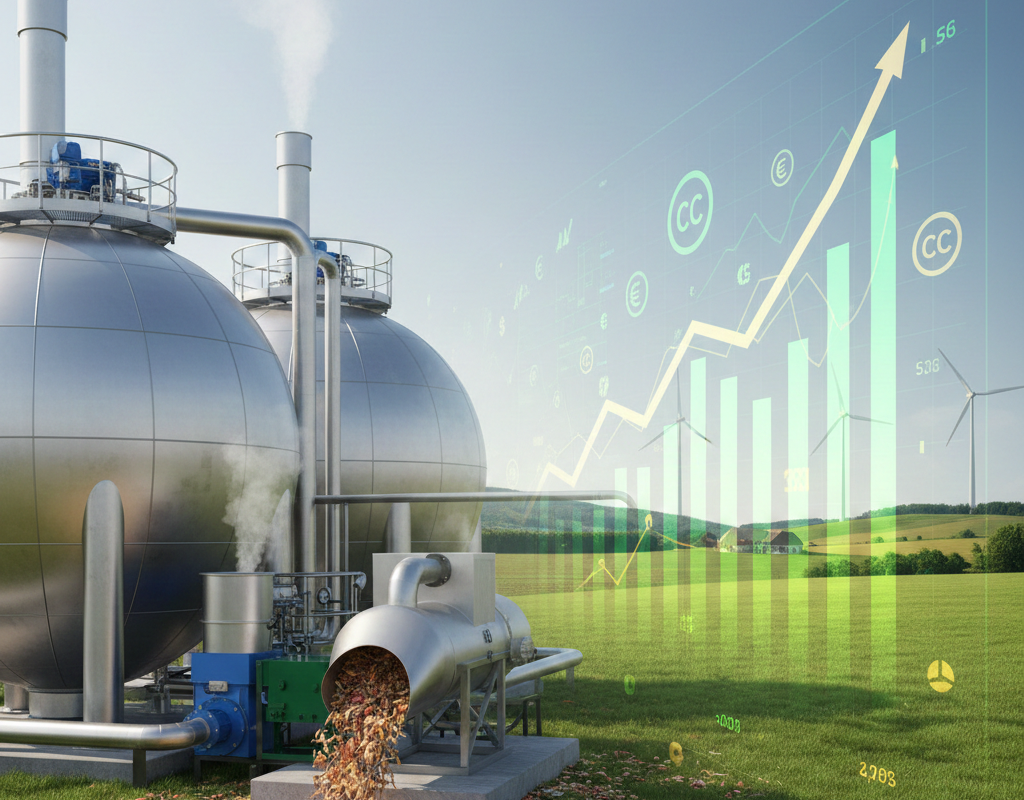
Carbon Credits Income from Biogas Plants
Carbon Credits Income from Biogas Plants
India’s shift to renewable energy is quickening as businesses, investors, and legislators prioritize decarbonization and sustainable development. Biogas plants are becoming one of the most potent renewable energy sources for mitigating climate change and providing a supplementary source of income in the form of carbon credits.
Project developers, farmers, industries, and investors can all benefit financially from the carbon credits generated by biogas plants. Biogas projects produce quantifiable greenhouse gas reductions that can be sold in both domestic and foreign carbon markets by capturing methane emissions and turning organic waste into clean energy.

The Benefits of Biogas Plants for Earning Carbon Credits
The following factors make biogas projects especially suitable for carbon credit income:
- High Potential for Methane Reduction
Due to methane’s enormous potential for global warming, methane collection produces significant amounts of carbon credits.
- Ongoing Reduction of Emissions
Year-round operation of biogas facilities results in steady and quantifiable carbon reduction outputs.
- Powerful MRV Ability
Biogas plants have well-established Monitoring, Reporting, and Verification (MRV) systems, which boost investor confidence.
- Assistance from the Government
Waste-to-energy and methane capture projects are encouraged by India’s renewable energy regulations and climate pledges.
India’s Potential Carbon Market
With prospects for both voluntary and compliance markets, India’s carbon market is developing quickly.
- Market for Voluntary Carbon (VCM)
Currently, the majority of biogas carbon credit projects take part in voluntary carbon markets, where businesses actively offset emissions in order to fulfill their ESG obligations.
Principal benefits:
- Adjustable prices
- International purchasers
- Registration is quicker than in compliant markets.
- Framework for the Indian Carbon Market
As part of its national climate plans, India is creating a structured carbon market mechanism. Biogas projects should benefit from more robust local trading platforms as regulations change.
The market for domestically produced carbon credits is rising in tandem with the expansion of sustainability pledges among Indian corporations.
Potential Revenue from Carbon Credits for Biogas
Biogas facilities’ revenue from carbon credits is dependent on several factors:
- Capacity of the Plant
Higher credits and more methane reductions are produced by larger facilities that process more organic waste.
- Feedstock Type
More credits are produced by feedstocks with a high methane production, such as food waste and animal dung.
- The cost of carbon credits
The following factors affect prices:
- Demand in the market
- Standard of certification
- Co-benefits like social effect
- Place of origin
Although voluntary market prices vary, they can generate a sizable amount of extra income outside of energy sales.
Obstacles in Biogas Plants’ Revenue from Carbon Credits
Although there are many opportunities, developers need to take into account:
- Volatility of Market Prices
The dynamics of global supply and demand determine changes in carbon prices.
- Initial Registration Fees
Investment is needed for documentation, validation, and verification.
- Modifications to Regulations
India’s carbon market policies are changing.
- Keeping an eye on complexity
Systems for precise measurement and reporting are essential.
Professional carbon experts, nevertheless, assist in reducing these dangers.
Combining Waste-to-Energy and Bio-CNG Programs
Programs supported by the government that encourage the production of compressed biogas improve the biogas plants’ economic feasibility.
Additional carbon reduction advantages may be computed when biogas is processed to Bio-CNG and substituted for diesel or LPG, hence enhancing the generation of credits.
The potential revenue from carbon credits is greatly increased by this integrated strategy.
Co-Benefits for the Environment and Society
Projects using biogas carbon offer several advantages for sustainability:
- Decreased open dumping
- Reduced pollution of groundwater
- Decrease of odor
- Increased fertility of the soil
- Lower levels of indoor air pollution
Projects with significant environmental and social co-benefits sometimes fetch higher carbon credit values.
Long-Term Prospects for India’s Biogas Carbon Income
The following factors make the future of carbon credit revenue from biogas plants seem bright:
- Growing carbon pricing worldwide
- Enhanced commitments to corporate sustainability
- Development of the national carbon market
- Growing interest in climate finance among investors
- Strong advocacy for the circular economy in policy
High-integrity carbon credits will become more in demand as climate accountability tightens.
Project developers should consider these strategic recommendations.
In order to optimize carbon credit revenue, developers ought to:
- Consult Carbon Experts Early
Accurate baseline assessment and seamless registration are ensured by professional assistance.
- Put in place reliable monitoring systems
Automated data logging increases the effectiveness of verification.
- Aim for High-End Purchasers
Projects with compelling sustainability narratives get higher prices.
- Combine Several Sources of Income
Combine the marketing of fertilizer and electricity with carbon credits.
- Remain Current with Indian Carbon Market Laws
Changes in policy could create new opportunities in the compliance sector.
In conclusion: Carbon Credits Income from Biogas Plants
The economics of renewable energy in India is being redefined by the revenue generated by carbon credits from biogas facilities. Methane reduction and the replacement of fossil fuels can be made profitable, giving biogas projects a significant boost in income.
Biogas carbon credits provide developers, farmers, investors, and businesses a strong opportunity due to growing voluntary carbon markets, changing domestic carbon trading systems, and growing corporate sustainability responsibilities.
Biogas facilities will be essential to waste management, the generation of renewable energy, rural development, and climate mitigation as India moves toward a low-carbon economy. Biogas plants can become long-term, sustainable sources of revenue with the right registration, verification, and carbon marketing.
2 Comments