
 Aksh
Aksh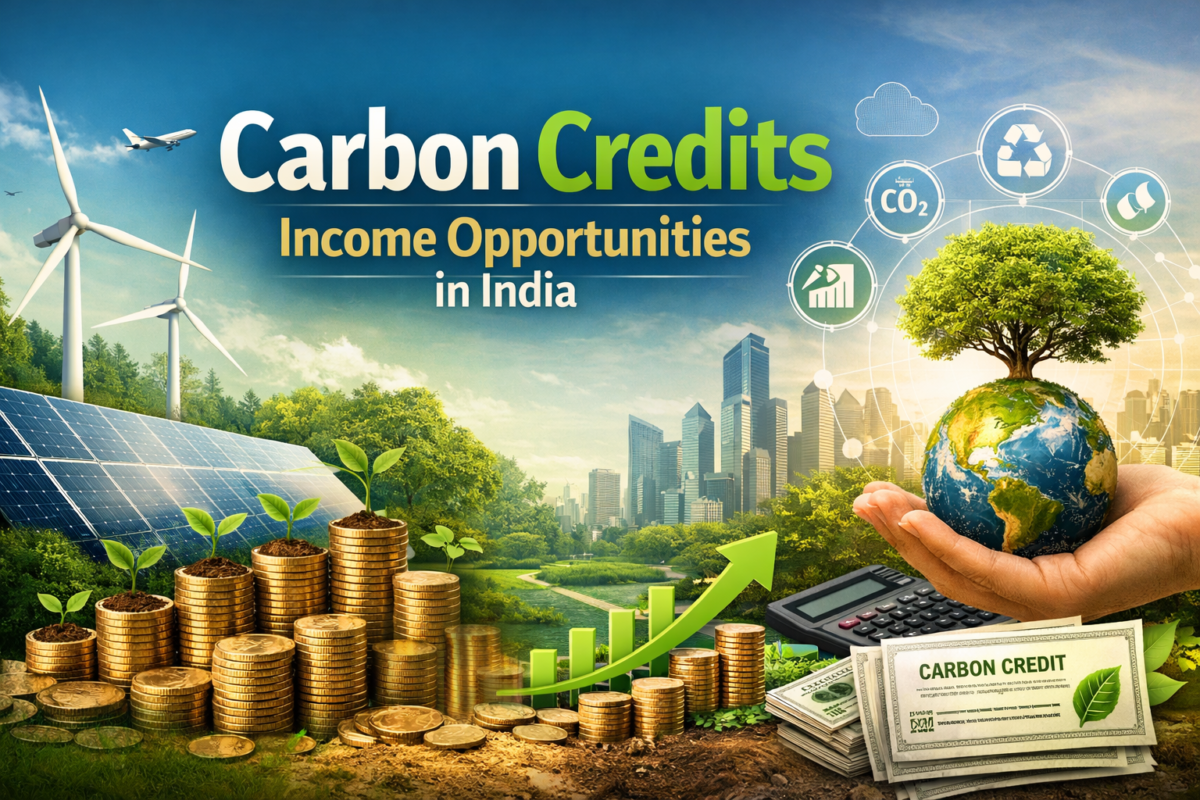
Carbon Credits Income Opportunities India
Carbon Credits Income Opportunities India
India is quickly becoming a major force in the global carbon credit market, providing a variety of revenue streams for big businesses, farmers, individuals, and entrepreneurs. Carbon credits have evolved from an environmental idea to a reliable source of revenue that promotes sustainable growth in all industries, thanks to India’s commitments under international climate frameworks and the fact that climate change is at the top of policy agendas around the world.
This in-depth study examines India’s carbon credit income prospects, going into detail on the system’s operation, the industries propelling expansion, the financial benefits for local communities, and doable tactics for generating income from carbon credits.

How Do Carbon Credits Generate Income and What Are They?
Measurable decreases in greenhouse gas emissions are represented by carbon credits. One metric ton of carbon dioxide equivalent is typically taken from the atmosphere or kept from being released with each credit. These credits can be sold directly to businesses looking to offset their emissions or traded on carbon markets.
Due to rising business demand for sustainability credentials and government support to reduce emissions while fostering economic development, carbon credit income prospects are growing in India.
Why the Carbon Market in India Is Expected to Expand?
Several important factors are driving the growth of the carbon market in India:
- National Climate Commitments:
India has made a significant policy push toward carbon reduction and renewable energy by pledging aggressive emission targets under international climate agreements. These goals encourage funding for initiatives that produce carbon credits, which turn into sources of income.
- Corporate Sustainability Objectives:
Indian and international businesses doing business in India are increasingly aiming for net-zero. In order to offset inevitable emissions, these companies seek carbon credits, which increases market demand and credit suppliers’ potential revenue.
- Government Programs and Incentives:
Government programs that promote energy efficiency, forest protection, carbon farming, and the growth of renewable energy sources offer incentives to support carbon reduction initiatives, which in turn produce carbon credits with a marketable value.
- Growing Global Demand:
Due to their affordability and co-benefits, which include community development, rural employment, and wildlife preservation, multinational corporations frequently go to emerging countries like India for high-quality carbon offsets.
How India Verifies and Accredits Carbon Credits?
It is necessary to be certified and verified by established carbon standards in order to generate revenue from carbon credits. These processes guarantee that carbon credits in India are authentic, quantifiable, and in line with global best practices.
Important Steps Involve:
- Establishing current emission levels prior to the start of a project is known as baseline assessment.
- Developing a carbon project design that details anticipated emissions reductions is known as project documentation.
- Continuous measurement of real emissions reductions is part of monitoring and reporting.
- Third-Party Verification: The authenticity and quantifiability of the emission reductions are confirmed by independent auditors.
Carbon credits can be exchanged in voluntary markets or within legal frameworks thanks to certification. Verified credits are typically more expensive and in greater demand.
India’s Government Assistance and Policy Structure for Carbon Credits
Although the market is still developing, the Indian government has implemented regulations and initiatives to encourage the creation of carbon credits and revenue prospects.
Important Government Assistance Could Include:
- Goals for increasing the capacity of renewable energy that obliquely assist carbon credit initiatives
- National energy efficiency programs, such as those that support LED lighting and industrial upgrades
- Programs for conservation and reforestation under rural development plans
- Policies for agriculture that support environmentally friendly farming methods
These initiatives support the expansion of projects that create carbon credits and bring in money for nearby communities.
Issues Facing the Indian Carbon Credit Industry
The Indian carbon credit ecosystem has a number of obstacles to overcome despite growing opportunities:
- Technical proficiency and awareness
Many small businesses and farmers are unaware of the prospects for carbon credits and how to apply for them. In certain industries, there is also a lack of technical capability to measure, track, and report emissions.
- Certification Cost
Particularly for smaller enterprises, certification and verification procedures can be expensive. The cost of certification per unit can be reduced by grouping projects or by hiring middlemen.
- The volatility of prices
Prices for carbon credits may alter in response to changes in regulations, market maturity, and worldwide demand. In order to control price risk, participants must use strategies.
How Companies and Individuals Can Begin Receiving Income from Carbon Credits?
There are several ways to start making money from carbon credits, regardless of your occupation: environmental professional, farmer, industrial business owner, or entrepreneur.
- Determine the Type of Project You Are Working on
Determine whether your assets, business operations, or land can produce carbon credits. Agriculture, waste management, forestry, energy efficiency, and renewable energy are typical categories.
- Collaborate With Carbon Professionals
Work together with certifiers and developers of carbon projects who are aware of market demands and international standards.
- Create a Plan for the Carbon Project
Make a thorough strategy that outlines the anticipated reductions in emissions as well as the monitoring and verification procedures.
In conclusion: Carbon Credits Income Opportunities India
For India’s economy, carbon credits offer a game-changing revenue prospect that promises monetary rewards for sustainable practices. The range of profits is wide and growing, ranging from investments in carbon farming and renewable energy to forestry programs and methane collection projects.
Individuals and companies can use carbon credits to make money and support global climate goals with the correct approach, certification procedures, and market participation.
In addition to offering financial opportunities, the Indian carbon credits income trade is a driving force behind social, economic, and environmental change.
Carbon Credit Platforms for Renewable Energy in India | Indian Carbon Credit
Carbon Credit Platforms for Renewable Energy in India | Indian Carbon Credit