
 Aksh
Aksh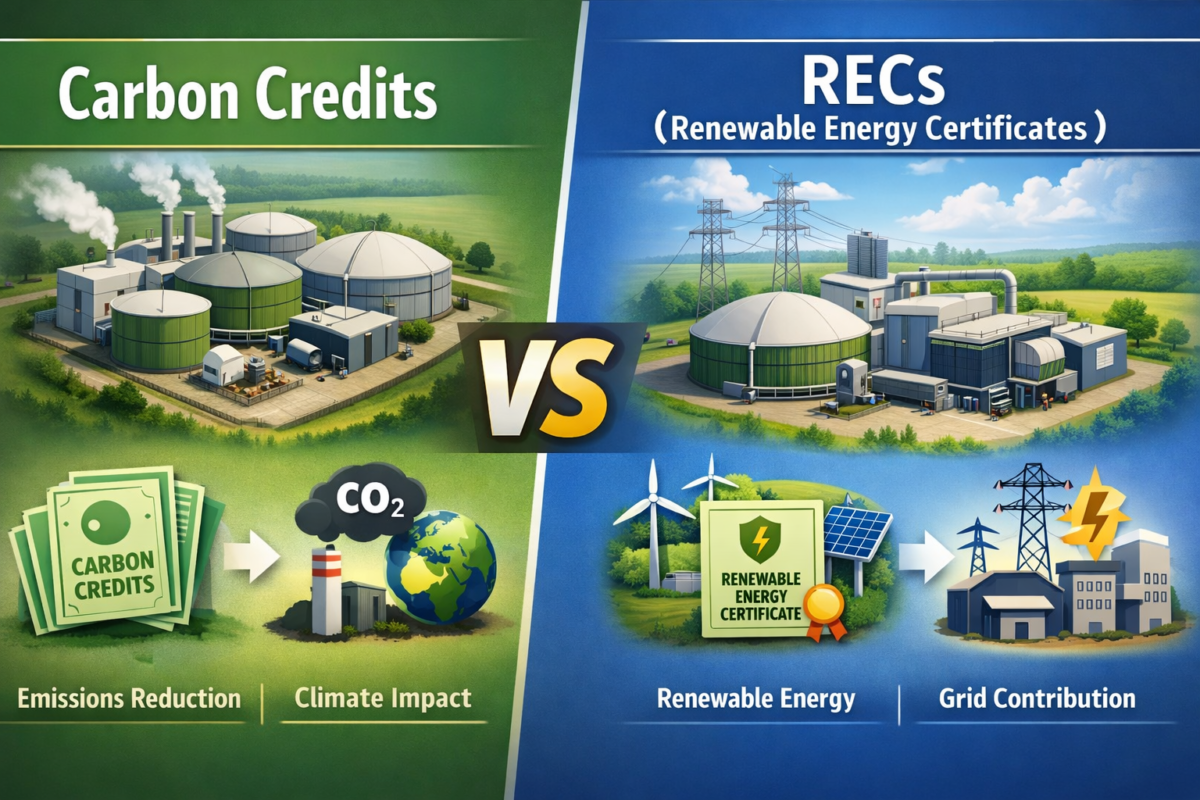
In-Depth Biogas Plant Case Study in India
In-Depth Biogas Plant Case Study in India
Overview
With the goal of lowering greenhouse gas emissions while satisfying the country’s expanding energy needs, India is gradually moving toward sustainable energy solutions. Biogas facilities, which turn organic waste into clean energy while offering financial and environmental advantages, have become one of the most promising renewable energy solutions.
Carbon credits and renewable energy certificates (RECs) have become increasingly important for biogas plants in recent years. Although they both encourage the production of clean energy, their functions and the regulatory environments in which they function are different. The practical installation of a biogas plant in India is examined in this case study, along with its advantages, difficulties, and how carbon credits and RECs contribute to project feasibility.

A biogas plant: what is it?
A biogas plant is a facility that produces biogas from organic waste materials, including municipal solid waste, animal dung, and agricultural wastes, through anaerobic digestion. Methane and carbon dioxide make up the majority of biogas, a sustainable fuel that can be utilized for transportation, heating, and electricity production.
There are multiple crucial steps in the process:
- Collecting organic waste from homes, businesses, and farms is known as feedstock collection.
- For the best digestion, pre-treatment involves reducing particle size and modifying moisture content.
- Anaerobic Digestion: In oxygen-free digesters, microorganisms decompose the organic matter.
- Biogas Capture: This process gathers methane-rich gas to produce energy.
- Digestate Management: Less chemical fertilizer is used because the residual material is used as organic fertilizer.
Advantages of Biogas Facilities
Biogas facilities provide several advantages in terms of the environment, society, and economy:
- Methane, a powerful greenhouse gas, is trapped and converted into electricity rather than being released into the atmosphere, reducing greenhouse gas emissions.
- Reducing reliance on fossil fuels, renewable energy generation offers a reliable supply of fuel or power.
- Production of Organic Fertilizer: The digestate generated increases soil fertility and lowers the need for chemical fertilizers.
- Waste Management Solution: Biogas plants effectively handle organic and agricultural waste.
- Economic Incentives: Financial viability is enhanced by energy sales revenue, carbon credits, and RECs.
These advantages not only promote environmental sustainability but also tie in with India’s national goals for climate change and renewable energy.
Case Study of a Biogas Plant: A Useful Illustration
- Overview of the Project
Imagine a 50 cubic meter per day biogas plant in a rural area of India that produces power by digesting agricultural waste and cow dung.
- Feedstock: 15 tons of crop leftovers and cow dung each day
- Production of Biogas: 300 cubic meters per day
- Production of Electricity: 120 kWh daily
- Digestate: 10 tons of organic fertilizer each day
- Potential for Carbon Credits
Methane emissions that would have resulted from improper handling of the organic waste are decreased by the initiative. Based on conventional computations:
- Avoided methane emissions: 40 tons of CO2e annually
- Displacement of fossil fuels: 80 tons CO2e annually
- 120 tons of CO2e annually in total carbon credits
At an average market price of INR 1,200 per ton, carbon credits might bring in INR 144,000 annually, bringing significant economic value.
- Potential for REC
The annual production of the plant is 43,800 kWh (120 kWh per day × 365 days). Every MWh is eligible for one REC. The total revenue would be INR 43,800 per year if the REC market price was INR 1,000 per certificate.
Implementing Biogas Plants Presents Difficulties
Biogas initiatives confront obstacles despite their obvious advantages:
- High Initial Investment: Small-scale farmers can find it difficult to pay for the building of biogas plants.
- Feedstock Supply: It is essential that organic waste be consistently available.
- Technical Expertise: Trained staff are necessary for proper plant functioning.
- Regulatory Obstacles: Documentation and verification processes are necessary for carbon credit registration and REC certification.
- Market Volatility: Variations in the price of carbon credits and RECs impact the predictability of revenue.
Public-private partnerships, capacity building initiatives, and government incentives are frequently used by successful projects to get beyond these obstacles.
Government Assistance and Incentives
Through programs like these, the Indian government promotes biogas plants:
- Capital subsidies for residential and community biogas systems are offered by the National Biogas and Manure Management Programme (NBMMP).
- Selling electricity to the grid and making extra money is made possible by Renewable Energy Certificates (RECs).
- Carbon Credit Incentives: Enabling market registration for voluntary and compliant emission reductions.
By taking these steps, biogas facilities can continue to be profitable while meeting national climate goals.
In conclusion: In-Depth Biogas Plant Case Study in India
The biogas plant case study demonstrates how RECs and carbon credits work in tandem to support sustainable energy. RECs assist biogas plants in fulfilling their renewable energy commitments and improving grid integration, while carbon credits offer observable climate benefits and increased financial rewards.
Combining these strategies to support biogas plants can be advantageous for investors, legislators, and rural communities. In addition to lowering greenhouse gas emissions, these projects promote India’s sustainable development objectives by generating organic fertilizer, renewable energy, and local jobs.
Biogas facilities are an important part of India’s renewable energy landscape because, when correctly managed and utilized through carbon credits and RECs, they show a win-win model for environmental sustainability and economic progress.