
 Aksh
Aksh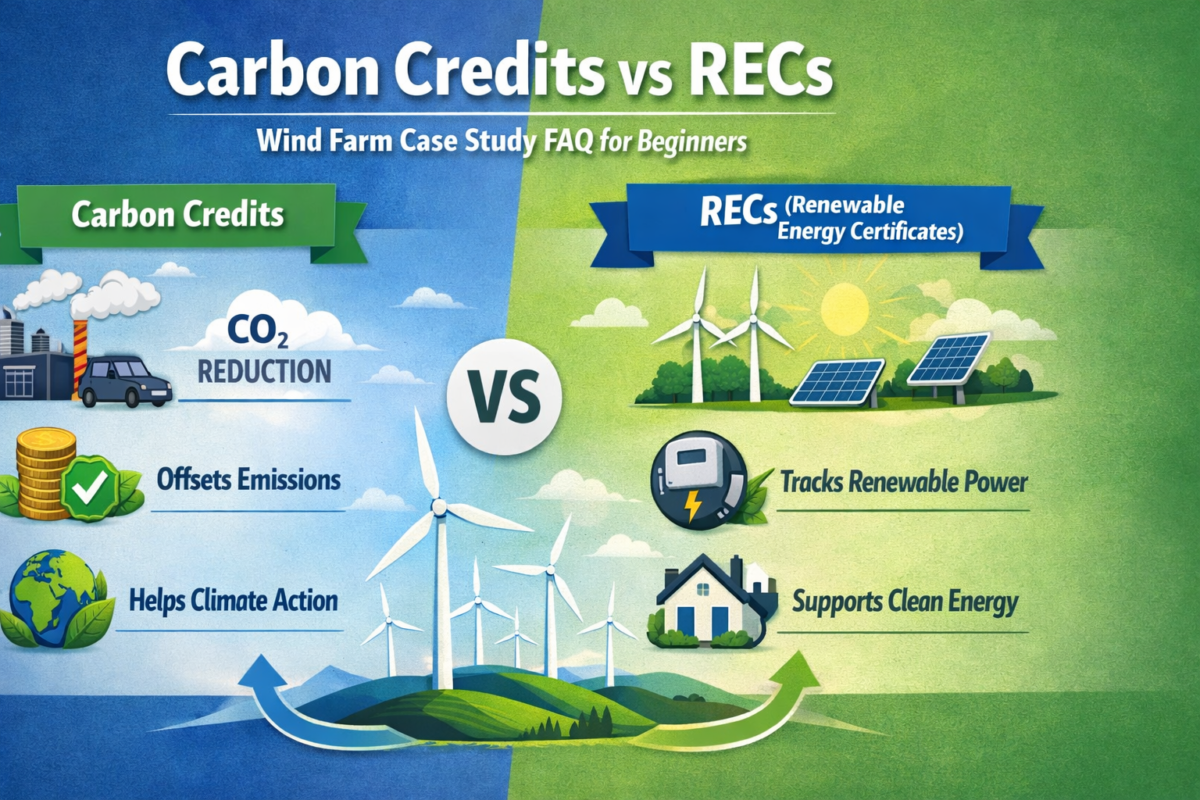
Carbon Credits vs RECs for Beginners: Step-by-Step FAQ
Carbon Credits vs RECs for Beginners: Step-by-Step FAQ
Environmental sustainability has emerged as a key component of global government policy and corporate strategy in recent years. Initiatives like Renewable Energy Certificates (RECs) and carbon credits are becoming more popular in India as means of lowering carbon footprints and encouraging the use of renewable energy. It can be difficult for novices to distinguish between carbon credits and RECs. In order to assist people, companies, and organizations in navigating the realm of carbon offsetting, this article attempts to offer a thorough FAQ guide.

Carbon Credits: What Are They?
The right to emit one metric ton of carbon dioxide (CO2) or an equivalent amount of another greenhouse gas (GHG) is represented by carbon credits, a sort of marketable certificate. Carbon credits are essentially a way to encourage businesses and individuals to cut their carbon emissions. One ton of CO2 is removed or avoided from the atmosphere for every credit.
- How Are Carbon Credits Operational?
Carbon trading markets are where carbon credits operate. Companies are subject to emission limits set by governments or international organizations. A business can sell the excess emissions as carbon credits if its emissions fall below the allotted limit. On the other hand, businesses that above their emissions limit are required to buy carbon credits to make up for their excess emissions.
- The advantages of carbon credits
- Promote sustainability in the environment.
- Offer monetary rewards for initiatives aimed at reducing emissions.
- Assist businesses in becoming carbon neutral.
- Encourage afforestation, energy efficiency, and renewable energy projects.
Certificates of Renewable Energy (RECs): What Are They?
Renewable Energy Certificates (RECs) are marketable documents attesting to the fact that one megawatt-hour (MWh) of electricity was produced using renewable energy sources like hydroelectric, wind, or solar power. RECs have a specific connection to the production of renewable energy, whereas carbon credits are related to the reduction of greenhouse gas emissions.
- How Are RECs Operational?
The idea behind RECs is to separate the “environmental attribute” of renewable energy from the actual electricity. The REC can be sold individually to businesses that wish to meet their renewable energy requirements, and the actual power produced by a renewable energy plant can be sold to the grid.
- RECs’ advantages
- Encourage adherence to RPOs, or Renewable Purchase Obligations.
- Encourage the construction of infrastructure for renewable energy.
- Allow businesses to make indirect claims for their use of renewable energy.
- Promote funding for renewable energy initiatives.
FAQ for Novices
- Are RECs and carbon credits interchangeable?
Indeed. Businesses frequently use both RECs and carbon credits to meet their overall sustainability objectives. While RECs show a commitment to using renewable energy, carbon credits offset emissions that cannot be decreased internally.
- Who is eligible to purchase RECs and carbon credits in India?
Carbon Credits: Businesses, sectors, non-governmental organizations, and individuals seeking to comply with emission standards or voluntarily offset emissions.
RECs: Businesses, utilities, RPO-obligated entities, and voluntary purchasers with an interest in using renewable energy.
- What is the price of carbon credits in India?
The project kind, certification standard, and market demand all affect the price. Voluntary carbon credits typically cost between INR 500 and INR 1500 per ton of CO2 equivalent.
- What is the price of RECs in India?
The supply and demand in the market determine how much REC costs. CERC sets the floor price and forbearance price in India. At the moment, each certificate of solar or non-solar REC costs between INR 2,000 and INR 3,500.
- Does India have legal recognition for carbon credits?
Indeed, India has both internal carbon markets and frameworks under the Clean Development Mechanism (CDM). India produces carbon credits that are accepted and exchangeable around the world.
- Does India have legal recognition for RECs?
Indeed, CERC oversees RECs in accordance with the REC Mechanism Regulations. They assist legally required organizations in fulfilling their Renewable Purchase Obligations (RPO).
- Are environmental effects guaranteed by carbon credits?
Certified carbon credits provide quantifiable and extra environmental benefits by ensuring that emission reduction programs are validated by criteria like the Verified Carbon Standard (VCS) or Gold Standard.
- Can RECs be used in place of carbon credits?
Not precisely. RECs stand for renewable energy production, however they cannot directly reduce emissions unless they are used in conjunction with initiatives to reduce energy use. Greenhouse gas emissions are immediately offset by carbon credits.
- How do businesses disclose RECs and carbon credits?
Carbon credits are typically included by businesses in their corporate social responsibility or sustainability reports. RPO compliance reporting is where RECs are documented. Credibility and acknowledgment of environmental initiatives are guaranteed by transparent tracking.
- What impact does buying RECs have on India’s renewable energy industry?
Businesses support renewable energy projects financially by acquiring RECs, which promotes additional investment in solar, wind, and small hydro projects. Indirectly, this aids India in meeting its goals for renewable energy.
- Are RECs available for purchase in India?
Indeed. Some platforms enable people to acquire RECs to assist the adoption of renewable energy, however they are primarily targeted at business and industrial groups.
In conclusion: Beginner’s Guide to Carbon Credits vs RECs in India
Anyone joining the sustainability space, whether as an individual, company, or organization, must comprehend the distinction between carbon credits and RECs. Although they both seek to alleviate environmental issues, their goals are distinct. While RECs attest to the production and use of renewable energy, carbon credits concentrate on mitigating greenhouse gas emissions.
Starting with verified carbon credits and RECs is a good approach for newcomers in India to support the growth of renewable energy, engage in sustainable behaviors, and contribute to national goals. Carbon credits and RECs can be effective instruments for a more environmentally friendly future if used properly and with knowledge.
2 Comments