
 Aksh
Aksh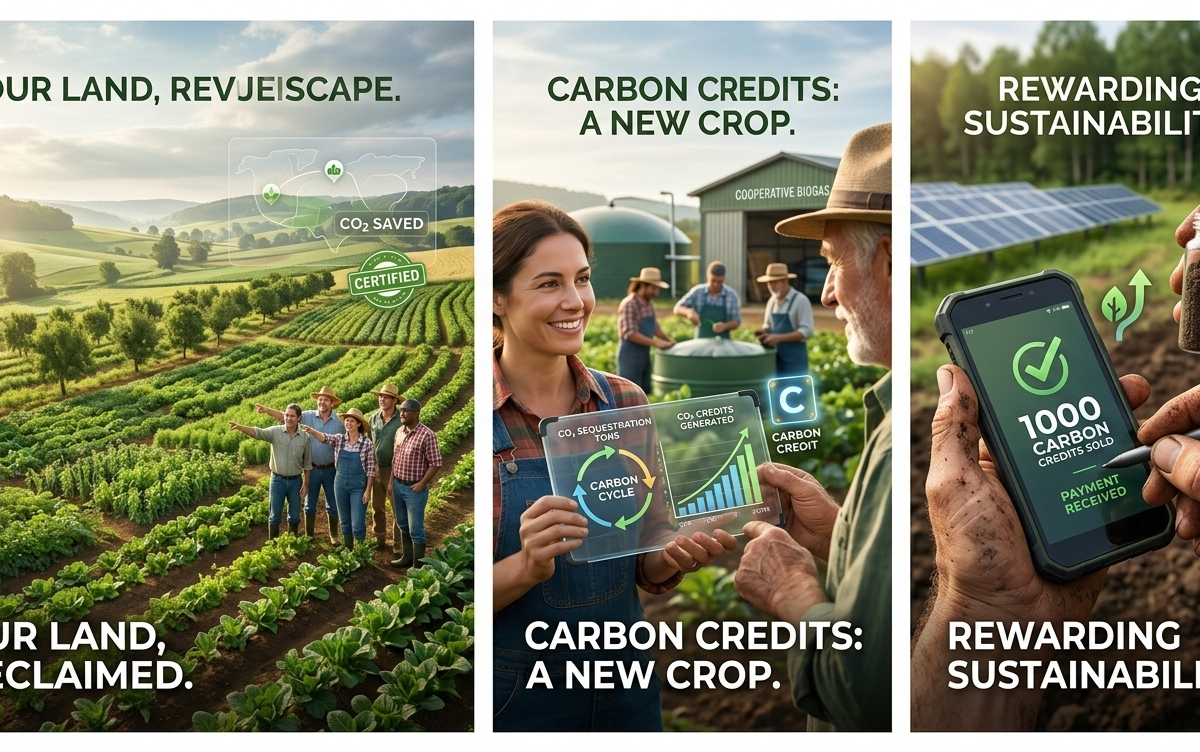
The Rise of Carbon Farming in India
The Rise of Carbon Farming in India
Climate change is changing the world more and more, thus creative solutions that improve communities and solve environmental problems are crucial. Among these, carbon credits in agriculture have become a potent tool for lowering greenhouse gas emissions while also providing farmers with a substantial revenue. This is the tale of an innovative farmer cooperative in India that changed rural lifestyles, embraced sustainable practices, and gained access to carbon markets.
This in-depth paper examines how a farmer cooperative successfully obtained carbon credits, the tactics they employed, the advantages they reaped, and the lessons that other agricultural communities and stakeholders might learn.

Introduction: The Rise of Carbon Farming in India
Historically, farming has been at risk from climate change. Every year, heat waves, droughts, floods, and unpredictable rains have an impact on harvests and livelihoods. But what if farming could not only be affected by climate change but also contribute to its solution?
Carbon sequestration, or the process of absorbing atmospheric carbon dioxide and storing it in the soil and plants, is the first step in this change. The net greenhouse gas footprint of farming is decreased when agricultural techniques enhance soil health and increase carbon storage. Carbon credits, which farmers can exchange or sell in voluntary and regulated carbon markets, can be created from these measurable environmental advantages.
The Collaborative Model: Unity in Strength
Smallholder farmers in rural India frequently lack the scale and technical expertise to take part in international carbon markets on their own. By pooling resources, territory, and collective negotiating power, a cooperative structure offers a solution.
Typically democratically run and owned by its members, a cooperative assists farmers in:
- To reach critical mass for the development of carbon projects, combine data and land.
- Gain access to knowledge on carbon accounting, climate measurement, and agricultural science.
- Discuss the advantages and disadvantages of continuing oversight, certification, and verification.
- Get a fair share of the money generated by carbon credits.
Farmers may increase their influence, lower personal risk, and strengthen community resilience by cooperating. The cooperative serves as a link between contemporary climate innovation and conventional farming.
Project Genesis: From Idea to Action
A group of forward-thinking farmers in a semi-arid area of India who saw climate change as both a threat and an opportunity are at the heart of this success story. They looked for unconventional solutions in response to dwindling soil fertility, exorbitant input costs, and unpredictable weather patterns.
To hold workshops on regenerative farming methods, the cooperative engaged climate consultants and agricultural specialists. They discovered how better soil management can boost yields, improve carbon sequestration, and produce measurable environmental benefits that qualify for carbon credits.
Inspired by this goal, the cooperative started a multi-phase initiative that focused on:
- Enhancement of soil health
- Decrease in the use of artificial nitrogen fertilizers
- Cropping system diversification
- Increased effectiveness of irrigation
- Adoption of methods for soil carbon sequestration
Putting Climate-Smart Practices into Practice
- Tillage for Conservation
The cooperative minimized soil disturbance by using conservation tillage in place of conventional plowing. This technique improves carbon storage by preserving soil structure, lowering erosion, and allowing organic matter to build up.
The farmers saw better moisture retention, lower fuel costs, and healthier microbial activity by keeping crop remains on the soil’s surface and avoiding frequent soil disturbance.
- The use of cover crops
Farmers planted cover crops like grasses and legumes in between planting seasons. These plants add biomass that increases the amount of organic carbon in the soil, fix nitrogen naturally, and prevent soil erosion.
The cooperative recorded consistent improvements in nutrient cycling and soil carbon over time, both of which are important factors in determining eligibility for carbon credits.
- Effective Management of Nutrients
Nitrous oxide is a powerful greenhouse gas that is produced when synthetic fertilizers are overapplied. The cooperative decreased fertilizer use without sacrificing yields by employing soil tests and precision application techniques.
A rare win-win in agriculture, this shift to optimal nutrient management benefited farmers’ bottom lines and the environment.
- Integration of Agroforestry
The natural carbon sink is a tree. By planting various tree species along field boundaries, the cooperative was able to capture carbon and generate a variety of revenue from feed, fruit, and timber.
Agroforestry further integrated environmental stewardship into routine farming by improving habitat connectivity, biodiversity, and shade.
Measurement and Verification of Carbon Accounting
Making the switch to climate-smart farming is one thing; measuring it for carbon markets is quite another. To record, quantify, and validate emissions reductions and sequestration gains, the cooperative collaborated with agricultural experts and certified carbon auditors.
This procedure comprised:
- Regular soil sampling
- Verifying changes in land use using satellite and remote sensing data
- Data validation by a third party and adherence to carbon market regulations
Accuracy and transparency were essential. The cooperative was only able to convert environmental advances into tradeable carbon credits by means of strict carbon accounting.
Getting into the Carbon Market
The cooperative created a portfolio of carbon credits that represented their climate impact when carbon sequestration data was confirmed. A carbon credit portfolio containing these credits was subsequently prepared for sale in voluntary carbon markets.
The cooperative was able to generate additional revenue by selling carbon credits. A creative departure from conventional agricultural economics, farmers now received income for storing carbon and helping to mitigate climate change rather than depending just on crop sales.
Crucially, the cooperative placed a high priority on equitable revenue sharing, guaranteeing that each farmer member received a fair share of carbon income according to their participation and efforts.
In conclusion: The Rise of Carbon Farming in India
Rural development and climate solutions can coexist, as demonstrated by this farmer cooperative’s transition from traditional agriculture to carbon credit achievement. Smallholder farmers can take an active role in carbon markets and benefit the environment and the economy by banding together, cooperating with scientists, and committing to sustainable practices.
Their tale serves as a beacon for rural communities around the world looking for a wealthy and sustainable future, not just in India.