
 Aksh
Aksh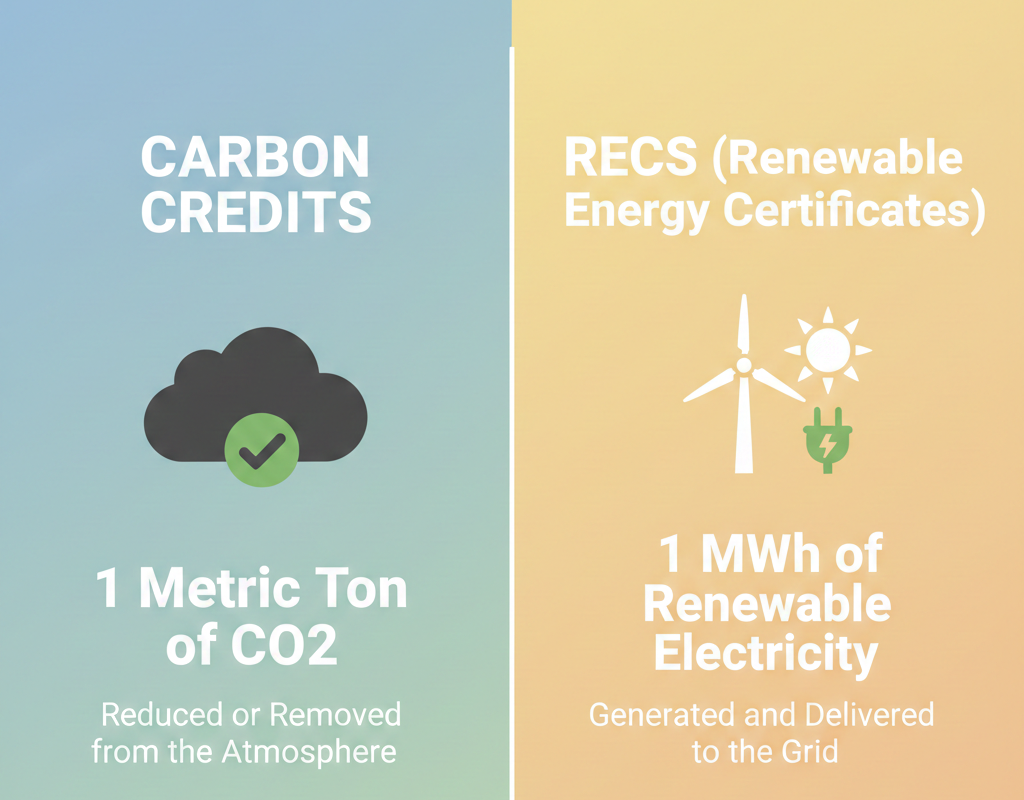
Understanding Carbon Credits and RECs Made Simple
Understanding Carbon Credits and RECs Made Simple
Businesses, governments, and individuals are looking for methods to lessen their environmental effect as climate change emerges as one of the most urgent global issues. Carbon credits and renewable energy certificates (RECs) are two frequently debated instruments in this shift toward sustainability. Despite their frequent interchangeability, these names refer to distinct mechanisms in environmental markets.
Knowing the difference between carbon credits and RECs is crucial in India, where industrial expansion and sustainability commitments are expanding quickly. This guide outlines both ideas in clear terms, examines how they vary, emphasizes their advantages, and talks about how they fit into India’s changing carbon market.

Carbon Credits: What Are They?
One metric ton of carbon dioxide (CO₂) or its equivalent is reduced or removed from the environment in the form of tradable certificates known as carbon credits.
To put it simply, a project receives one carbon credit for every ton of greenhouse gas emissions that are reduced. Companies or individuals wishing to offset their own emissions can then purchase these credits.
The Operation of Carbon Credits
Let’s dissect it:
- Projects that lower greenhouse gas emissions include wind farms, solar power plants, forest conservation programs, and methane collection facilities.
- An authorized authority verifies the emission decrease.
- For every ton of CO₂ that is eliminated or decreased, one carbon credit is given.
- These credits are bought by businesses who are unable to instantly cut their own emissions.
Renewable Energy Certificates (RECs): What Are They?
Market-based documents known as Renewable Energy Certificates (RECs) serve as evidence that one megawatt-hour (MWh) of electricity was produced using renewable energy sources and delivered to the grid.
RECs do not directly assess emission reductions, in contrast to carbon credits. Rather, they attest to the generation of electricity from renewable sources.
How RECs Operate?
Here’s a straightforward explanation:
- Electricity is produced by a renewable energy source, such as solar, wind, hydro, or biomass.
- One REC is awarded for each MWh of renewable electricity generated.
- The grid purchases the electricity.
- Companies that must fulfill sustainability objectives or renewable purchasing obligations (RPOs) can purchase the REC separately.
India’s REC Mechanism
In order to encourage the development of renewable energy, India has a well-organized REC process that is governed by national authorities. It assists responsible parties in fulfilling their Renewable Purchase Obligations (RPOs).
Power distribution firms and certain enterprises are required to buy a certain proportion of their electricity from renewable sources. They can buy RECs if they are unable to directly acquire renewable energy.
This system gives consumers flexibility while promoting the growth of sustainable energy.
The Main Distinctions Between RECs and Carbon Credits
RECs and carbon credits both promote sustainability, but their objectives, metrics, and market structures are very different.
- What They Stand for?
- Carbon Credits: One ton of CO2 is reduced or eliminated.
- RECs: Producing one megawatt-hour of renewable energy.
- Attention to the Environment
- Carbon Credits: Put an emphasis on cutting greenhouse gas emissions in a number of industries.
- RECs: Put a special emphasis on encouraging the generation of renewable energy.
- The Structure of the Market
- Carbon credits are offered in both voluntary and compliance markets.
- RECs: Mainly associated with energy markets and renewable purchasing commitments.
- Application
- Carbon Credits: Used to reach carbon neutrality by offsetting emissions.
- RECs: Used to reach goals for the use of renewable energy.
Why Carbon Credits Are Important to Companies?
For businesses aiming for net-zero goals, carbon credits offer flexibility. Some emissions are short-term inevitable, but operational effectiveness and the adoption of clean technologies continue to be priority.
Carbon credits enable companies to:
- Offset emissions that cannot be avoided
- Improve reporting on ESG issues
- Fulfill your commitments to sustainability
- Boost the reputation of your brand
- Draw in eco-aware investors
Carbon credits have evolved into a key element of corporate climate action in response to mounting international pressure for climate disclosure.
Why RECs Matter for Businesses?
Even if businesses are unable to install solar panels or wind turbines directly, they can still show their support for renewable energy by using RECs.
RECs have the following advantages:
- Observance of Renewable Purchase Requirements
- Displaying the use of renewable energy
- Encouraging the expansion of clean energy
- Enhancing reporting on sustainability
- Fulfilling the standards for green building certification
Large industrial users that operate in areas without direct access to renewable energy find RECs to be very beneficial.
Market Patterns and Prospects
- Increasing Interest in Voluntary Offsets
The market for premium carbon credits is rising as more Indian corporations commit to net-zero goals.
- Fortifying the Regulatory Structure
It is anticipated that India would establish structured compliance markets by formalizing its carbon trading system.
- A rise in corporate purchases of renewable energy
As industries switch to renewable energy, RECs will continue to be crucial.
- Emphasis on Superior Credits
Verified, open, and socially conscious enterprises are becoming more and more in demand from buyers.
Concluding remarks: Understanding Carbon Credits and RECs Made Simple
In the worldwide battle against climate change, carbon credits and Renewable Energy Certificates are effective instruments. Despite having different functions, they both help to lessen their negative effects on the environment and hasten the use of renewable energy.
Businesses, legislators, and investors must comprehend these tools in India, where sustainability is fast emerging as a key component of economic growth.
Across all industries, carbon credits aid in the reduction and offset of greenhouse gas emissions. RECs encourage the production and use of renewable energy. They serve as complementing pillars that support India’s changing climate strategy.
3 Comments