
 Aksh
Aksh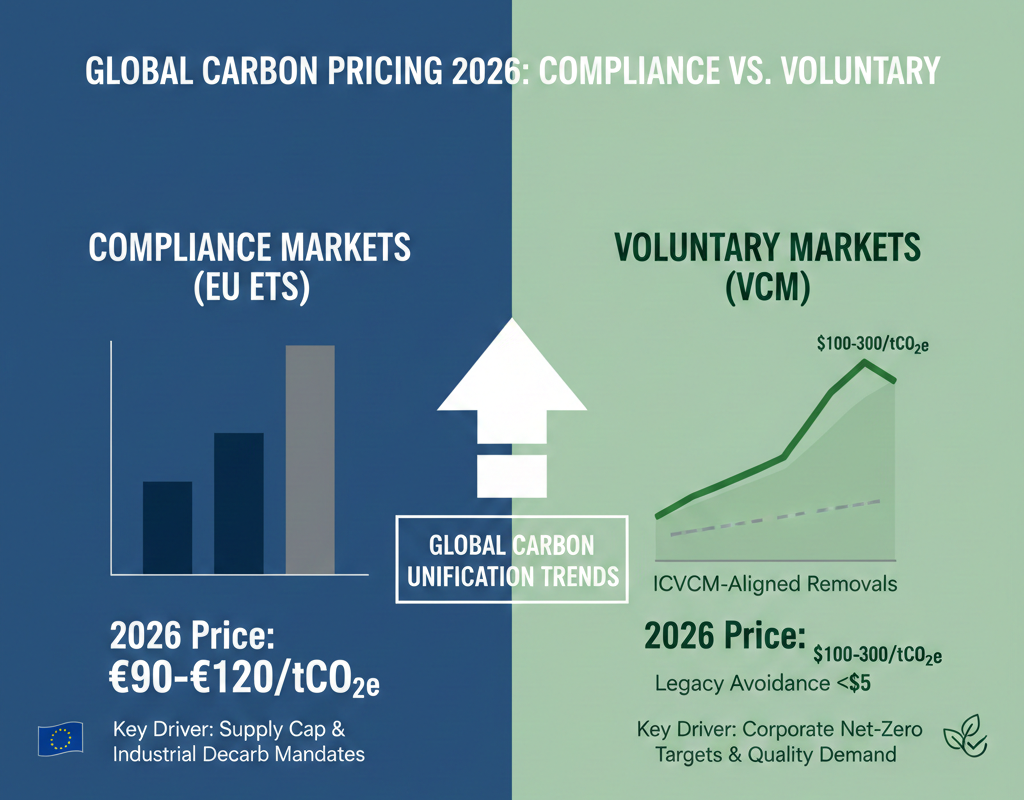
Carbon Credit Price Explained for Analysts
Carbon Credit Price Explained for Analysts
From specialized environmental processes, carbon markets have developed into multibillion-dollar financial ecosystems. It is now necessary for analysts to comprehend how carbon credit prices are formed in order to assess regulatory risk, business sustainability plans, ESG portfolios, and developing commodity markets. Carbon credit pricing is becoming a crucial part of financial and policy research as carbon markets across the world develop and India gets ready to expand its domestic carbon trading system.
For analysts looking for organized insights, this paper offers a thorough overview of the factors influencing carbon credit prices, valuation techniques, compliance versus voluntary markets, forecasting frameworks, international benchmarks, and India’s developing landscape.

Knowledge of Carbon Credits: The Basis for Pricing
One metric ton of carbon dioxide equivalent (tCO₂e) that is avoided, decreased, or eliminated is usually represented by a carbon credit. These credits are given out either through government-regulated compliance procedures or through voluntary programs that businesses employ to offset their emissions.
The pricing dynamics are shaped by two significant worldwide carbon market segments:
- Compliance Markets (systems for trading emissions mandated by the government)
- Voluntary Carbon Markets (VCM): purchases of offsets pushed by corporations
Every market type has unique risk factors, liquidity characteristics, and price drivers.
Pricing of the Compliance Carbon Market
Cap-and-trade systems govern compliance markets, with regulators establishing emissions limits and allocating allowances. Businesses that emit less than the allotted amount can sell extra credits, while those that exceed the limits have to purchase allowances.
The European Union Emissions Trading System, or EU ETS, is one of the most significant compliance benchmarks. Over the past 10 years, prices in this system have varied greatly, reflecting changes in economic cycles, policy tightening, and volatility in the energy market.
Important Factors Affecting Compliance Market Prices
Stricter regulations that limit emissions lower supply, which raises pricing.
- Conditions of the Energy Market
The cost of fossil fuels affects power generation decisions, which in turn affects allowance demand.
- Macroeconomic Operations
Demand for allowances and emissions levels are correlated with industrial output.
- Mechanisms of Market Stability
Reserve adjustments are one tool used to eliminate surplus allowances from circulation.
- Financial and Speculative Engagement
Carbon allowances are becoming more and more traded as financial assets by institutional investors.
Because of regulatory support and mandated demand, compliance carbon prices are often higher and more stable than voluntary credits.
Mechanisms of Carbon Credit Price Formation
Analysts need to be aware of how the price of carbon credits differs from that of conventional commodities.
- Pricing through Auction
Allowances are auctioned and clearance prices are decided by bidding; they are mostly used in compliance systems.
- Over-the-Counter (OTC) bilateral transactions
Prevalent in voluntary marketplaces when project developers and buyers engage in direct negotiations.
- Trading on Exchanges
Major commodity exchanges offer price discovery and liquidity through the trading of carbon allowance futures.
- Extended Offtake Contracts
Businesses affect forward curves by securing future credits at fixed pricing.
Predicting the Cost of Carbon Credits
Multi-variable modeling techniques are necessary for predicting the price of carbon credits.
- Forecasting Based on Policy
Examining government climate goals and emissions cap trends.
- Curves of Marginal Abatement Cost (MAC)
Calculating the price of small-scale emission reductions.
- Modeling of Energy Systems
Modeling changes in industrial decarbonization and power generation.
- Analysis of Financial Markets
Analyzing institutional positioning and futures curves.
In conclusion: Carbon Credit Price Explained for Analysts
Analysis of carbon credit prices necessitates a multidisciplinary approach that incorporates macroeconomic modeling, commodities market analysis, policy evaluation, and ESG metrics. Carbon markets will keep growing in size, sophistication, and financial significance as governments step up their efforts to combat climate change and businesses speed up their net-zero pledges.
Gaining an understanding of carbon credit price systems can help analysts navigate the worldwide shift to a low-carbon economy. Carbon pricing knowledge is now essential to forward-looking financial analysis, whether it is used to estimate India’s developing trading ecosystem, evaluate voluntary offset initiatives, or monitor compliance market allowances.
Analytical excellence in the age of the climate economy will be determined by an understanding of the pricing mechanisms of carbon credits, which are evolving from environmental instruments to essential financial assets.
Carbon Credit Price Market Trends 2026: Insights, Analysis, and Future Forecasts
Carbon Credit Price Market Trends 2026: Insights, Analysis, and Future Forecasts
2 Comments