
 Aksh
Aksh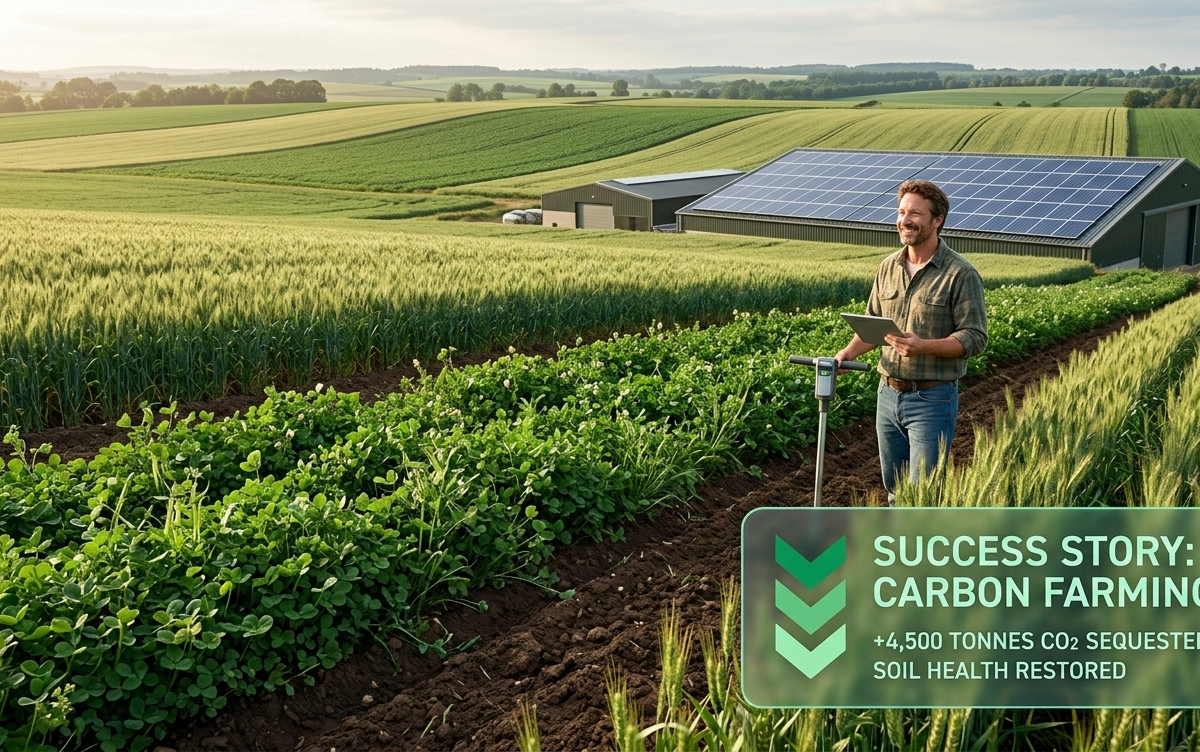
Carbon Farming Project Success Story
Carbon Farming Project Success Story
Initiatives for carbon farming projects all throughout India have become strong drivers of climate resilience, economic growth, and environmental restoration in recent years. These initiatives show how sustainable practices can not only improve soils and sequester carbon dioxide but also produce quantifiable carbon credit revenues for farmers and communities, which is a remarkable success story as climate change changes agricultural landscapes and threatens traditional farming systems.
Agriculture’s transition from traditional tillage and input-heavy farming to regenerative agriculture, climate-smart practices, and soil carbon augmentation is at the core of this movement. The outcome is an engaging story in which carbon farming serves as a link between rural wealth and ecological sustainability.

India’s Growing Carbon Farming Industry
When it comes to implementing climate-smart farming practices, India is leading the way. Since millions of smallholder farmers depend on the land for their livelihood and agriculture contributes significantly to national emissions, implementing carbon farming project strategies has emerged as a top priority for both environmental and economic resilience.
The term “carbon farming” describes a group of farming techniques that improve soil and biomass carbon sequestration. Farmers can produce carbon credits—verified units of greenhouse gas reduction that can be traded in carbon markets—by increasing soil organic matter and lowering emissions.
The following are some essential regenerative agricultural techniques:
- Minimal and nonexistent tillage
- Using cover crops
- Accurate control of nutrients
- Crop diversification and rotation
- Integration of agroforestry
- Amendments to soil that are organic
These methods boost soil health, water retention, and crop resilience in addition to trapping atmospheric carbon. Motivated by the possibility of earning carbon credit income and protecting their farms from climate-related hazards, Indian farmers are embracing these practices more and more.
How Agriculture Uses Carbon Credits?
Understanding the carbon credit mechanism in agricultural contexts is crucial to appreciating the significance of a carbon farming success story. One metric ton of carbon dioxide equivalent (CO₂e) that has been prevented, decreased, or stored away from the atmosphere is represented by a carbon credit. Buyers wishing to offset emissions can purchase these credits, which are validated through stringent measurement, reporting, and verification (MRV) procedures.
Carbon farming initiatives in India generally adhere to these rules:
- Determining the farm’s current greenhouse gas emissions level is known as the baseline assessment.
- Implementing Regenerative Practices: Introducing strategies to improve soil and reduce emissions.
- Monitoring and Verification: Reporting on carbon sequestration and emission reduction on a monthly or yearly basis.
- Certification & Issuance of Carbon Credits: Credits are granted following third-party verification.
The Success Story: A Central Indian Village
In a remote area in central India, one of the most encouraging carbon farming project success stories took place. This community was experiencing severe soil erosion, low yields, and decreased revenues due to its reliance on rain-fed agriculture. Local farmers were at risk due to the growing unpredictability of the environment.
A prototype carbon farming project was started in 2021 with the help of sustainability advocates and agricultural specialists. The objective was to improve environmental performance while using carbon credits to generate revenue.
- Education and Awareness
Community-wide awareness initiatives were the first part of the project. Farmers gained knowledge of:
- The study of sequestering carbon
- Regenerative agriculture’s advantages
- Mechanisms for generating carbon credits
- Potential revenue beyond crop yields
Soil scientists, agronomists, and experts in the carbon market held workshops, building a solid knowledge base and gaining support from the community.
- Measurement, Verification, and Monitoring (MRV)
Accurate MRV was required for carbon sequestration to convert into tradable carbon credits. The project taught young people in the area as MRV technicians and used digital instruments for measuring soil carbon. In addition to increasing accuracy, this created technical jobs in the neighborhood.
Periodic monitoring verified that soil carbon levels were continuously rising while emissions of nitrous oxide and methane were falling—unmistakable proof of the advantages of carbon farming.
- Carbon Credit Issuance
The project was eligible to receive verified carbon credits at the end of the second year. The emission reductions and soil carbon increases were verified by independent certifying authorities, making the participating farms eligible to receive carbon credits.
Obstacles Met and Knowledge Acquired
Notwithstanding its achievements, the carbon farming project also identified significant obstacles:
- The intricacy of carbon markets
Carbon market procedures are typically daunting to smallholder farmers. Effective aggregation methods, in which project developers served as middlemen for the issue and sale of loans, were crucial to addressing this.
- Data Gathering and Validation
High-quality MRV requires a lot of resources. Training local technicians was the project’s answer, which decreased costs and decentralized monitoring.
- First Investment Obstacles
Making the switch to regenerative techniques required an initial financial commitment. Community savings organizations, microfinance options, and subsidies were crucial in closing this disparity.
These experiences offer a road map for upcoming carbon farming initiatives, stressing the value of financial support systems, accessible technology, and community involvement.
The Bigger Story of Climate
Carbon farming programs are not stand-alone endeavors; rather, they are a component of the worldwide effort to achieve climate resiliency, sustainable development, and net-zero agriculture. India is integrating climate action into agriculture by allowing farmers to absorb carbon, lower greenhouse gas emissions, and receive carbon credits.
This success story highlights how carbon farming can be used to:
- Align agricultural output with environmental objectives
- Change rural livelihoods by using creative finance
- Encourage national pledges to reduce carbon emissions
It represents a broader change in the way society sees agriculture—not just as a system of production, but also as a source of climate solutions.
In conclusion: Carbon Farming Project Success Story
This success story of a carbon farming operation shows how local circumstances may inform climate action while still producing global advantages. This strategy has revolutionized sustainability in Indian agriculture by fusing regenerative agriculture, carbon credit systems, community engagement, and supportive regulatory frameworks.
The advantages go much beyond sequestering carbon:
- Improvement of the economy for farmers and rural areas
- Enhanced soil regeneration and ecological balance
- A framework for climate-resilient agriculture that is scalable
- A new frontier in sustainable finance and carbon markets
Carbon farming is now more than just an idea; it is a successful example of how environmental responsibility and financial sustainability can coexist.